 To enhance service speed and avoid tariff delays, we've opened a US warehouse. All US orders ship directly from our US facility.
| Cat. No. | Product Name | Field of Application | Chemical Structure |
|---|---|---|---|
| DC81020 | ME 3407 |
ME-3407 (EF-4040) is a H+-K+-ATPase redistribution disruptor and myosin light chain kinase (MLCK) and protein kinase A inhibitor. ME-3407 blocks gastric acid secretion and aminopyrine accumulation by inhibiting microsomal-to-apical membrane redistribution of H+-K+-ATPase and suppressing MLCK-mediated myosin light chain phosphorylation. ME-3407 is promising for research of peptic ulcer.
More description
|

|
| DC80896 | KCNQ2 modulator-1 |
KCNQ2 modulator-1 is a KCNQ2 modulator.
More description
|
|
| DC80892 | JRC-I-191 |
JRC-I-191 is an anti-HIV-1 agent. JRC-I-191 inhibits HIV-1 YU-2 entry into cells. JRC-I-191 does not inhibit infection of cells by amphotropic murine leukemia virus. JRC-I-191 can be used for the research of HIV-1 infection.
More description
|
|
| DC80841 | Ikarisoside B |
Ikarisoside B is a potent and selective Organic cation transporter 1 (OCT1) inhibitor with an IC50 of 11.18 μM. Ikarisoside B shows selectivity over OCT2 (IC50 = 56.54 μM). Ikarisoside B can be used for the research of metabolic disease.
More description
|
|
| DC80769 | HD202A |
HD202A is an orally active, selective dual inhibitor of MNK1/MNK2 (with IC50 values of 6.09 nM and 8.06 nM, and Kd values of 1.913 μM and 5.244 μM, respectively) that inhibits the MNK-eIF4E signaling pathway. By downregulating perilipin 2 and SCD1, while upregulating adipose triglyceride lipase and PPARγ coactivator 1α, HD202A enhances mitochondrial fatty acid oxidation and redox homeostasis. HD202A effectively suppresses body weight gain, hepatic lipid accumulation and elevation of serum lipids, significantly improves glucose tolerance and insulin sensitivity of the organism, and ameliorates inflammatory features. With these comprehensive pharmacological activities, HD202A exhibits great application potential in studies of metabolic dysfunction-associated steatotic liver disease.
More description
|
|
| DC80726 | GPR119 agonist 4 |
GPR119 agonist 4 is a GPR119 agonist and oral glucose-lowering agent with a human GPR119 EC50 of 42 nM.GPR119 agonist 4 activates GPR119.GPR119 agonist 4 reduces blood glucose area under the curve in an oral glucose tolerance test.GPR119 agonist 4 exhibits improved clearance in liver microsomes.GPR119 agonist 4 can be used for the research of type 2 diabetes mellitus.
More description
|
|
| DC80660 | FKA-9i |
FKA-9i is an orally active anticancer agent. FKA-9i directly binds to and promotes the degradation of oncoproteins LRPPRC (kd: 7.387 μM), YBX1 (kd: 16.52 μM) and RPN1 (kd: 26.82 μM). FKA-9i inhibits the MAPK signaling pathway and mitochondrial oxidative phosphorylation. FKA-9i also induces cancer cell cycle arrest, apoptosis, mitochondrial dysfunction and ROS accumulation. FKA-9i can be used in the research of tumors such as gastric cancer.
More description
|
|
| DC80654 | FGFR3-IN-12 |
FGFR3-IN-12 is a selective fibroblast growth factor receptor 3 (FGFR3) inhibitor with an IC50 of 6.8 nM. FGFR3-IN-12 shows an IC50 of 19.2 nM against FGFR3V555M and an IC50 of 16.9 nM against TNK1 (Thirty-eight Negative Kinase 1). FGFR3-IN-12 inhibits cancer cells proliferation and induces caspase-mediated apoptosis. FGFR3-IN-12 exhibits antitumor activity in bladder cancer xenografts mice models. FGFR3-IN-12 can be used for the research of cancer, such as bladder cancer.
More description
|
|
| DC80422 | Chaperone complex ligand 1 |
Chaperone complex ligand 1 is a chaperone ligand for HSP90. Chaperone complex ligand 1 can be connected to the MET ligand by a linker to synthesis of MET degrader OZD-MET 01.
More description
|
|
| DC80369 | Carba1 |
Carba1 is a bifunctional Carbazole derivative that activates nicotinamide phosphoribosyltransferase (NAMPT) and enhances NAD biosynthesis. Carba1 binds to colchicine site of tubulin, enhancing the anti-tumor effect of various chemotherapy drugs, such as Paclitaxel. Carba1 exerts neuroprotective effect and can regulate cell energy metabolism. Carba1 can be used for the researches of cancer and chemotherapy-induced peripheral neuropathy (CIPN).
More description
|
|
| DC80359 | C11-BODIPY 505/515 Ceramide-1-phosphate ammonium |
C11-BODIPY 505/515 Ceramide-1-phosphate ammonium is a C11-BODIPY 505/515-labeled ceramide-1-phosphate ammonium that can be used to prepare lipid nanoparticles for drug delivery (Ex/Em = 505/515 nm).
More description
|
|
| DC80358 | BYBC-1 |
BYBC‑1 is a selective G4‑RNA‑targeting ligand with high affinity forKRAS and NRAS G4‑RNAs (Kd = 0.05-0.28 μM). BYBC‑1 stabilizes G4‑RNA structures in KRAS and NRAS mRNA, blocks thePI3K/AKT and MAPK/ERK pathways, activates the DNA damage response (DDR), suppresses energy metabolism, and induces S‑phase arrest and apoptosis. BYBC‑1 exhibits high selectivity over non‑malignant fibroblasts and significantly inhibits the growth of HCT‑116 xenograft tumors in vivo. BYBC‑1 can be used for the study of colorectal cancer.
More description
|
|
| DC80319 | BLT1-IN-1 |
BLT1-IN-1 is an orally active and selective BLT1 inhibitor with an IC50 of 8.7 nM and a Kd of 121 nM. BLT1-IN-1 exerts protective effects against acute lung injury and sepsis in in vivo models. BLT1-IN-1 can be used in research related to acute lung injury and sepsis.
More description
|
|
| DC80302 | Bentioflumin |
Bentioflumin is a fluoroalkylthiobenzene acaricide with excellent leaf penetration, and its control validity period against mites exceeds 25 days. Bentioflumin can be used in studies related to mite infestation.
More description
|
|
| DC80196 | AMPK activator 18 |
AMPK activator 18 is a potent allosteric activator of AMPK complexes containing the β2 isoform. AMPK activator 18activates α2-containing AMPK α2β2γ1 and α2β2γ3 complexes, with EC50 values of 17.2 and 82.1 nM. AMPK activator 18 stimulates β2-AMPK in cells, and glucose uptake by isolated skeletal muscle. AMPK activator 18 induces acetyl-coenzyme A carboxylase (ACC) and AMPK α-T172 phosphorylation. AMPK activator 18 can be used for the research of type 2 diabetes.
More description
|
|
| DC80174 | AL-38022A |
AL-38022A is a potent and selective 5-HT2 receptor agonist (Ki ≤2.2 nM), but a significantly lower (>100-fold less) affinity for other 5-HT receptors. AL-38022A potently stimulates functional responses via 5-HT2 receptor subtypes including [Ca2+]i mobilization and tissue contractions with apparently similar potencies and intrinsic activities. AL-38022A fully generalizes to the (±)-1-(2,5-dimethoxy 4-methylphenyl)-2-aminopropane hydrochloride (DOM) stimulus in drug discrimination paradigms. AL-38022A can be used for the glaucoma research.
More description
|
|
| DC79946 | 1,2-Linolein-3-caprylin |
1,2-Linolein-3-caprylin is an acylglycerol.
More description
|
|
| DC77830 | PB94 |
PB94 is a potent and selective inhibitor of HDAC11 with an IC50 of 108 nM and exhibits >40-fold selectivity over other HDAC isoforms. It ameliorates neuropathic pain in mouse models and can be radiolabeled with carbon-11 as [¹¹C]this compound for PET imaging, demonstrating significant brain uptake and potential for in vivo imaging applications.
More description
|
|
| DC77829 | SKLB-11A |
SKLB-11A is a selective, first-in-class allosteric activator of SIRT3 that binds with a Kd of 4.7 μM and enhances its deacetylase activity with EC50 of 21.95 μM. It improves cardiac function and alleviates myocardial damage in vivo.
More description
|
|
| DC73354 | MDL-811 Featured |
MDL-811 (MDL811) is a potent, selective and allosteric SIRT6 activator with EC50 of 5.7 uM (activated SIRT6 deacetylation), two-fold greater activity than MDL-800 (EC50=12.3 uM, Cat# 35760).
More description
|

|
| DC5147 | Molibresib(I-BET-762) Featured |
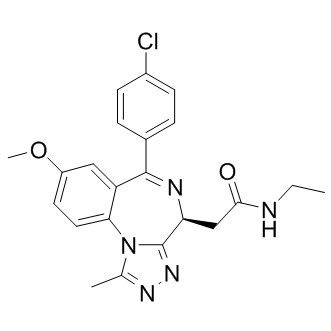
GSK 525762A is a potent small molecule inhibitors that disrupt the function of the BET family of bromodomains (Brd2, Brd3, and Brd4).
More description
|
|
| DC70537 | KDOBA67 Featured |
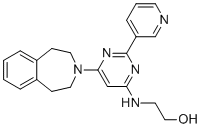
KDOBA67 is a novel cell-permeable inhibitor of H3K27 lysine demethylase KDM6A/B, inhibits TBXT expression chordoma cell lines.KDOBA67 displayed in vitro inhibitory activity in the low micromolar range with IC50 values of 2 to 5 uM in various chordoma cell lines, leading to induction of apoptosis.H3K27 demethylase inhibition via KDOBA67 alters chromatin state at TBXT and inhibits its expression.TBXT was a KDM6A/B target gene, and chromatin changes at TBXT following KDOBA67 treatment were associated with a reduction in TBXT protein levels.KDOBA67 treatment downregulated expression of a network of transcription factors critical for chordoma survival and upregulated pathways dominated by ATF4-driven stress and proapoptotic responses.
More description
|
|
| DC11041 | QCA276 Featured |
QCA276 is a novel potent BET proteins inhibitor with IC50/Ki of 10/.3 nM, QCA276 is the BET ligand for PROTAC QCA570.
More description
|

|
| DC8293 | UNC0224 Featured |
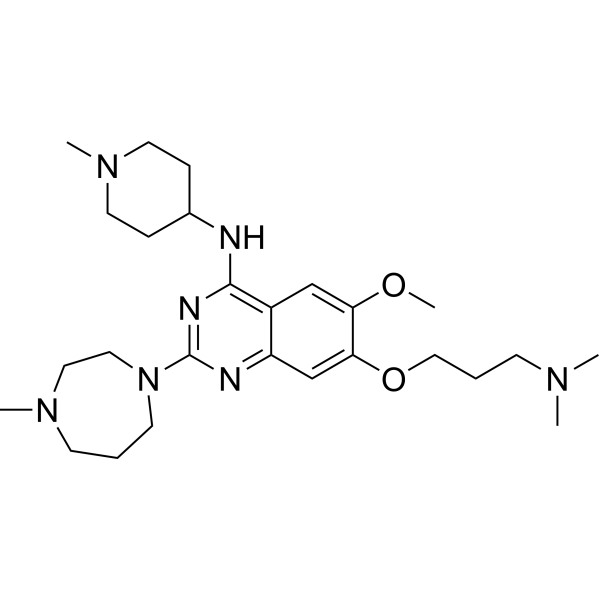
UNC-0224 is a potent inhibitor of G9a histone lysine methyltransferase (IC50 = 15 nM).
More description
|
|
| DC7658 | C646 Featured |
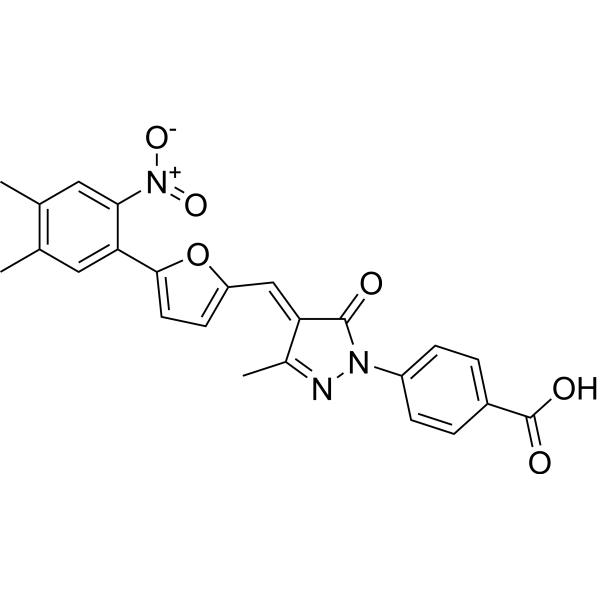
C646 is an inhibitor for histone acetyltransferase, and inhibits p300 with a Ki of 400 nM. Preferentially selective for p300 versus other acetyltransferases.
More description
|
|
| DC10656 | (+)-JQ1 carboxylic acid Featured |
(+)-JQ1 carboxylic acid is the carboxylic acid form of (+)-JQ1 for derivative synthesis.
More description
|

|
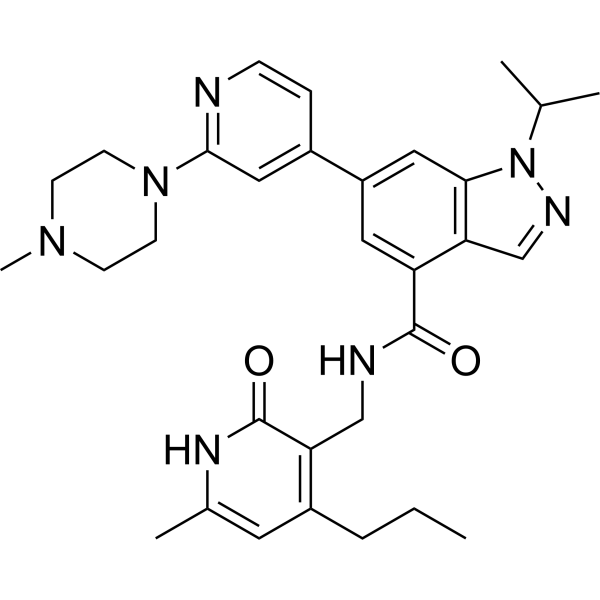
| DC7143 | GSK-343 Featured |
GSK343 is a potent and selective EZH2 inhibitor with IC50 of 4 nM, showing 60 fold selectivity against EZH1, and >1000 fold selectivity against other histone methyltransferases.
More description
|
|
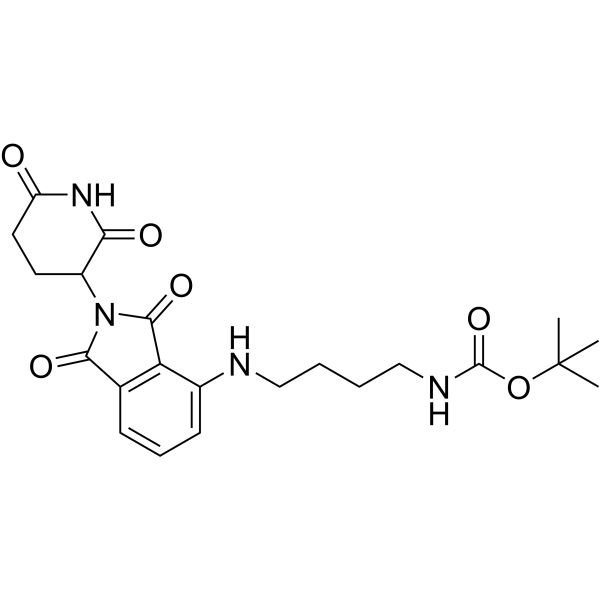
| DC71504 | Thalidomide-NH-C4-NH-Boc Featured |
Thalidomide-NH-C4-NH-Boc is a novel, potent, and selective class of Bromodomain-containing protein 4 (BRD4) and Bromodomain-containing protein 2 (BRD2) degrader for the development of therapeutics to treat cancers.
More description
|
|
| DC8261 | (-)-JQ-1 Featured |
The (-)-JQ1 stereoisomer has no appreciable affinity to BET bromodomains,it is the negative control of +JQ-1.
More description
|

|
| DC5019 | (+)-JQ1 Featured |
(+)-JQ1 is a BET bromodomain inhibitor, binding to all bromodomains of the BET family, but not to bromodomains outside the BET family.
More description
|
-JQ-1.gif)
|
