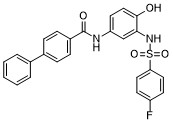
| Cas No.: | 2249435-90-1 |
| Purity: | >98% |
| Sotrage: | 2 years -20°C Powder, 2 weeks 4°C in DMSO, 6 months -80°C in DMSO |
| Cat. No. | Product name | Field of application |
| DC60034 | STING inhibitor-1 | STING inhbiitor, which inhibited the activation of the STING signal pathway and to prevent or treat a STING-mediated disease. |
| DC60033 | SN-011 | STING inhbiitor, which inhibited the activation of the STING signal pathway and to prevent or treat a STING-mediated disease. |
| DC39220 | STING agonist compound 17 | STING agonist compound 17 is a selective stimulator of interferon genes (STING) receptor agonist. |
| DC39210 | MSA-2 analogue | MSA-2 analogue is an orally available human STING agonist. |
| DC39031 | MSA-2 | MSA-2 is an orally available human STING agonist.MSA-2 is bound to STING as a noncovalent dimer. Extensive experimental analysis indicates that MSA-2 predimerization is required for binding. Acidic tumor microenvironments favor permeable, uncharged MSA-2. |
| DC39030 | SR-717 (lithium salt) | SR-717 is a non-nucleotide STING agonist with EC50s of 2.1 μM and 2.2 μM in ISG-THP1 (WT) and ISG-THP1 cGAS KO (cGAS KO) cell lines, respectively. SR-717 is a stable cyclic guanosine monophosphate-adenosine monophosphate (cGAMP) mimetic. |
| DC76699 | ZSA-51 | ZSA-51 is a potent and orally active STING agonist. ZSA-51 shows anticancer activity. ZSA-51 remodeles immune microenvironment both in tumor and lymph node. |
| DC73554 | HB3089 | HB3089 (HB-3089) is a novel potent, highly specific STING agonist, dose-dependently activates interferon-stimulated gene (ISG) signaling in THP1-Dual reporter cells with EC50 of 1-10 uM. |
| DC72041 | BSP16 | BSP16 is a potent, orally active stimulator of interferon genes (STING) agonist. BSP16 can selectively stimulate the STING pathway. BSP16 can be used for the research of cancer. |
| DC50039 | 3'3'-cGAMP (sodium salt) | 3’3’-cGAMP Fluorinated (c-[2'FdGMP]-[2'FdAMP]) is a synthetic analog of cyclic guanosine monophosphate- adenosine monophosphate (cyclic GMP-AMP, cGAMP) with a fluorine atom at 2’ position of the nucleosides. 3’3’-cGAMP is a cyclic di-nucleotide produced by bacteria. It is also referred to as "canonical" cGAMP due the presence of the classical 3’-5’ phosphodiester linkages between the guanosine and the adenosine. It has been reported that cGAMP binds STING (stimulator of IFN genes) and subsequently induces TBK1-IRF3-dependent production of IFN-β [1]. The incorporation of fluorine into biologically active molecules is commonly used in medicinal chemistry to improve their metabolic stability or to modulate physicochemical properties such as lipophilicity [2, 3]. Moreover, the introduction of a fluorine atom can change the biological activities of a molecule. Interestingly, when used at low concentrations in various cellular assays, 3’3’-cGAMP Fluorinated induces higher levels of type I IFNs than does cGAMP. STING ligands such as cGAMP induce type I IFNs and activate interferon stimulated genes (ISG) through IRFs. To facilitate their study, InvivoGen has developed stable reporter cells in two well established immune cell models: THP-1 human monocytes and RAW 264.7 murine macrophages. These cells express a reporter gene (SEAP or Lucia luciferase), under control of an IRF-inducible promoter. |

To enhance service speed and avoid tariff delays, we've opened a US warehouse. All US orders ship directly from our US facility.