
Alternate TextTo enhance service speed and avoid tariff delays, we've opened a US warehouse. All US orders ship directly from our US facility.
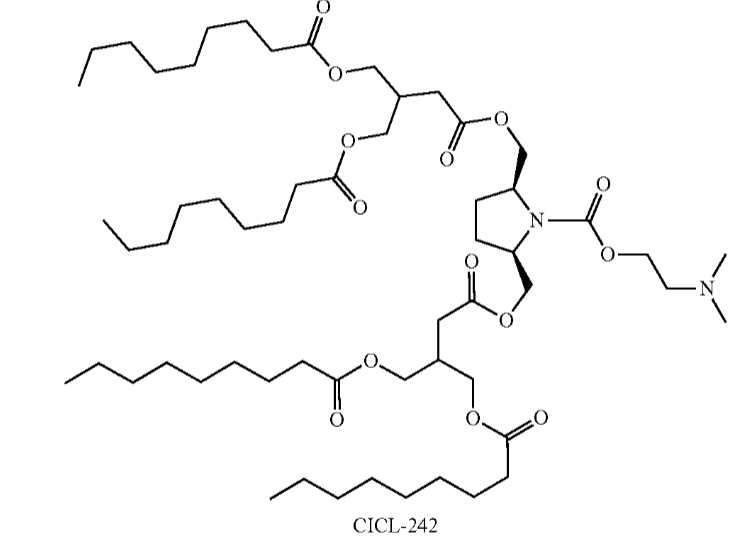

CICL-242

  Cat. No.:  DC67652  
Chemical Structure
For research use only. We do not sell to patients.
We match the best price and quality on market.
Email:order@dcchemicals.com  sales@dcchemicals.com
Tel:+86 21 58447131
We are official vendor of:
  • 20
  • 19
  • 18
  • 17
  • 16
  • 15
  • 14
  • 12
  • 11
  • 10
  • 9
  • 8
  • 13
  • 6
  • 5
  • 4
  • 3
  • 2
  • 1
More than 5000 active chemicals with high quality for research!
Field of application
CICL-242​ is a constrained ionizable cationic lipid highlighted in patent US 20250127728A1 as a promising candidate for advanced therapeutic delivery, particularly in stem cell and gene editing applications. Its structure features a rigid amine headgroup similar to CICL-207, which likely facilitates efficient endosomal escape and reduces non-specific uptake, enhancing targeted nucleic acid delivery. Although detailed performance data is not fully disclosed in the patent, CICL-242 is explicitly synthesized and included in gene editing experimental systems (e.g., CRISPR-Cas9 workflows), suggesting its potential for high-efficiency transfection in hard-to-transfect cells​ like hematopoietic stem cells (CD34⁺). This makes it a strong candidate for ex vivo cell engineering and regenerative medicine, where precision and low off-target effects are critical. While further validation is needed to quantify its efficacy and safety profile, CICL-242 represents a strategic innovation in the lipid library for next-generation genetic therapies.
Cas No.:
Chemical Name: CICL-242
Synonyms: CICL 242,CICL242
Purity: >98%
Sotrage: 2 years -20°C Powder, 2 weeks 4°C in DMSO, 6 months -80°C in DMSO
Cat. No. Product name Field of application
DC59010 C14-4 C14-4 (C14-494,Lipid B-4,Lipid B4) is a novel ionizable lipid with the highest T-cell transfection efficiency and low cytotoxicity.The C14-4 ionizable lipid has been explored for CAR-T therapy.To screen the excellent formulations for mRNA delivery, a lipid library of 24 ionizable lipids was constructed to make iLNPs, which were used to deliver luciferase mRNA into Jurkat cells.[115] The optimal iLNPs formulation was C14-4 iLNPs (C14-4 ionizable lipid, DOPE, chol, and PEG at a molar ratio of 35%, 16%, 46.5%, and 2.5%) (Figure 6c). The optimal dose of luciferase mRNA for C14-4 iLNPs was 30 ng. Compared with electroporated CAR T cells, the CAR T cells engineered via C14-4 iLNPs showed potent cancer-killing activity when they were cocultured with Nalm-6 acute lymphoblastic leukemia cells. To obtain a safer and more effective CAR mRNA delivery vehicle, the orthogonal design provided 256 potential formulations, and 16 representative iLNPs formulations were evaluated.Through evaluating the safety, delivery efficiency, and transfection efficiency of 16 iLNPs, the formulation B10 (C14-4 ionizable lipid, DOPE, chol, PEG at a molar ratio of 40%, 30%, 25%, and 2.5%) was screened out as the optimal performing formulation. The luciferase expression based on B10 formulation was increased threefold than the initial formulation. Reducing the accumulation and clearance of iLNPs in the liver can increase the expression of CAR mRNA in T cells, further improving the therapeutic effect of CAR-T. Studies have shown that cholesterol analogs can alter the mechanisms of intracellular circulation and enhance the delivery of mRNA, which may be related to the reduced recognition of iLNPs by the Niemann Pick C1 (NPC1) enzyme.The addition of a hydroxyl group to various locations in the cholesterol molecule can alter the binding kinetics between the modified cholesterol and NPC1, and reduced NPC1 recognition of cholesterol. The results showed that replacement of 25% and 50% 7 α-hydroxycholesterol for cholesterol in iLNPs improved mRNA delivery to primary human T cells in vitro by 1.8-fold and twofold, respectively.C14-4 is one of the ionizable lipids to efficiently deliver mRNA to Jurkat cells or primary human T cells. It will effectively promote the development of mRNA delivery by iLNPs for CAR-T therapy.
DC67812 CL15F 6-4 CL15F 6-4 is a short-tail ionizable lipid from the piperidine-based CL15F series, characterized by its symmetric branched structure with a 6-carbon main chain and 4-carbon side chain. This specific tail length critically determines the lipid nanoparticle's (LNP) properties, resulting in larger particles with a high surface density of the phospholipid DSPC. This elevated DSPC density reduces interactions with serum proteins like ApoE, minimizing rapid liver clearance and shifting mRNA delivery preference towards the spleen. Consequently, CL15F 6-4 LNPs achieve efficient, endogenous spleen-targeted delivery, making them a highly promising candidate for enhancing vaccine efficacy by preferentially transfecting antigen-presenting cells without complex functionalization.
DC60910 CL15F 7-5 CL15F 7-5 is a piperidine-based ionizable lipid from the CL15F library, characterized by a symmetrically branched tail structure with a 7-carbon main chain and a 5-carbon side chain. This moderate tail length positions it between short-tail (e.g., CL15F 6-4) and long-tail (e.g., CL15F 14-12) variants, granting it a unique balance in mRNA delivery properties. Its LNPs exhibit optimized organ selectivity, enabling significant mRNA expression in both the spleen and muscle, as demonstrated by in vivo luciferase assays following intravenous and intramuscular administration. This lipid structure facilitates a favorable DSPC surface density on LNPs, which moderates interactions with serum proteins like ApoE, thereby reducing rapid hepatic clearance and promoting extrahepatic delivery. In vaccine applications, CL15F 7-5 LNPs encapsulating SARS-CoV-2 RBD mRNA elicited robust anti-RBD IgG titers and neutralizing antibodies in mice, outperforming the clinically benchmarked SM-102 lipid. The piperidine headgroup further contributes to storage stability by minimizing the generation of aldehyde impurities that can form mRNA-lipid adducts. Consequently, CL15F 7-5 represents a versatile lipid for developing stable, spleen-targeted mRNA vaccines and therapeutics, leveraging tail-length engineering for enhanced efficacy without complex formulation changes.
DC67652 CICL-242 CICL-242​ is a constrained ionizable cationic lipid highlighted in patent US 20250127728A1 as a promising candidate for advanced therapeutic delivery, particularly in stem cell and gene editing applications. Its structure features a rigid amine headgroup similar to CICL-207, which likely facilitates efficient endosomal escape and reduces non-specific uptake, enhancing targeted nucleic acid delivery. Although detailed performance data is not fully disclosed in the patent, CICL-242 is explicitly synthesized and included in gene editing experimental systems (e.g., CRISPR-Cas9 workflows), suggesting its potential for high-efficiency transfection in hard-to-transfect cells​ like hematopoietic stem cells (CD34⁺). This makes it a strong candidate for ex vivo cell engineering and regenerative medicine, where precision and low off-target effects are critical. While further validation is needed to quantify its efficacy and safety profile, CICL-242 represents a strategic innovation in the lipid library for next-generation genetic therapies.
DC67651 CICL-238 Based on the data from patent US 20250127728A1, CICL-238​ emerges as a highly promising ionizable lipid candidate, demonstrating notable advantages for targeted delivery applications. It achieves exceptional transfection efficiency—reaching approximately 90% of CICL-207's performance in splenic T-cells even at a reduced lipid ratio of 50% in LNP formulations. Additionally, CICL-238 exhibits minimal off-target expression​ in hepatocytes (<8%, comparable to CICL-207), underscoring its enhanced specificity for immune cells over liver tissues. Its optimized structure likely contributes to efficient endosomal escape and reduced Kupffer cell uptake, making it ideal for liver-related therapies​ (e.g., siRNA silencing for metabolic diseases) and potentially broadening applications to genetic medicine where precision and safety are paramount. Further validation in disease models could solidify its role as a versatile, low-toxicity alternative to benchmark lipids.
DC60880 2Ac3-C18 2Ac3-C18 is a unique ionizable lipid with a distinct degradable core structure:featuring 2 acrylate units and 3 amine groups—linked to a C18 alkyl chain. Its LNPs (formulated with DOPE/cholesterol/DMG-PEG2000) exhibit spleen-specific mRNA delivery in vivo.
DC60879 Lipid te AA3-Dlin Lipid te AA3-Dlin is a novel ionizable lipid developed for mRNA-LNP vaccines.When formulated into LNPs, te AA3-Dlin demonstrates excellent stability in serum and protects encapsulated mRNA from degradation. A key feature is its unique protein corona profile, with high ApoE abundance, which is crucial for efficient in vivo targeting, particularly to the spleen. This enables potent dendritic cell transfection, leading to enhanced antigen presentation and robust cytotoxic T-cell responses for superior antitumor immunity.
DC60878 Lipid A-12 Lipid A-12 is an ionizable cationic lipid from Capstan Therapeutics and a close analog of CICL-1 (L829). The key structural distinction is in the headgroup spacer length, where the value of 'n' is 1 in A-12, compared to 0 in CICL-1 (L829).
DC67633 Lipid KEL12 (4S)-KEL12​​ is a novel, biodegradable ionizable lipid developed for advanced mRNA vaccine delivery. It was rationally designed by incorporating both a ketal group in the linker and ester segments in the hydrophobic tails, a dual-degradable strategy aimed at enhancing its safety profile. Through iterative optimization, (4S)-KEL12 was identified as a lead candidate with an optimal pKa value of approximately 6.78, which is crucial for efficient mRNA encapsulation and endosomal release.
DC67632 Lipid GL5 GL5 is an ionizable guanidine-based lipid nanoparticle (G-LNP) designed for superior mRNA delivery. Its guanidinocarbonyl-pyrrole (GCP) headgroup enables pH-responsive behavior and strong mRNA binding via bidentate hydrogen bonds. The cholesterol-free GL5-3 formulation forms compact, stable nanoparticles (~90-120 nm) that exhibit excellent spleen-targeting capability after intravenous injection.GL5-LNPs efficiently deliver mRNA to antigen-presenting cells (APCs), enhancing antigen presentation and T cell activation. In cancer immunotherapy models, GL5-based mRNA vaccines provided complete tumor protection and induced durable immune memory. The platform also enables mRNA delivery to other organs like the pancreas via different administration routes, demonstrating remarkable versatility and therapeutic potential.
X