| DC68213 |
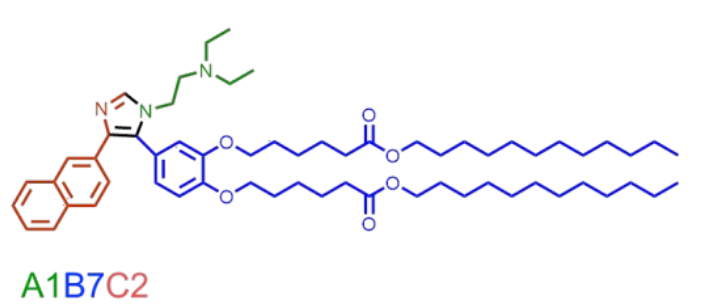
Lipid A1B7C2
|
A1B7C2 is an imidazole‑based ionizable lipid from the IMIL library. It features dimethylamino‑propyl imidazole head group, paired with B7 hydrophobic tails and C2 degradable ester linkers. LNPs assembled from A1B7C2 can effectively accumulate within the spleen after systemic administration. It mediates mRNA expression in splenic tissue, and is applied as a key control compound to investigate structure‑activity relationships for spleen‑targeted nucleic acid delivery. |
| DC68212 |
Lipid A3B7C2
|
A3B7C2 is an imidazole‑based ionizable lipid, featuring dimethylamino‑imidazole head group connected via ester‑type degradable C2‑linker to two C14 unsaturated aliphatic tails. It forms LNPs achieving 98 % splenic transfection proportion, potent for splenic dendritic cell‑targeted mRNA delivery, superior to MC3, SM102. |
| DC68208 |
Sail lipid 7669
|
Lipid 7669 is a premium, spleen-tropic ionizable lipid highly validated in US2025/0049948A1 for targeted mRNA delivery. Engineered for extrahepatic targeting, it achieves exceptional splenic protein expression while minimizing hepatic accumulation, significantly outperforming conventional liver-targeting lipids like MC3 and C12-200. In vivo bioluminescence data confirms its superior whole-body transfection efficiency and highly selective spleen tropism. This high-performance lipid is ideal for pioneering research in mRNA vaccines, splenic immune editing, and autoimmune disease therapies requiring precise extrahepatic delivery. Lipid 7669 is for research purpose. |
| DC68179 |
A5-CE-C7-6
|
A5-CE-C7-6 is an ionizable lipid engineered for spleen-targeted mRNA delivery, integrating a hydroxylated dual-amine core (A5) for enhanced mRNA binding and endosomal escape, a biodegradable carbonate ester linker (CE) enabling rapid hydrolysis (61% degradation in 24 h), and branched heptyl hydrophobic tails (C7-6) that optimize nanoparticle stability and spleen tropism. When formulated into cholesterol-free lipid nanoparticles (B-8 formulation), its unique architecture—combining hydroxyl groups for cellular uptake, carbonate-mediated biodegradability, and branched-chain fluidity—achieves unprecedented efficiency: low pKa (~6.0) minimizes liver accumulation while enabling 21% transfection of splenic NK cells, outperforming benchmark systems like MC3 SORT LNPs by >10-fold in spleen-specific delivery and establishing a new standard for in vivo immune cell engineering. |
| DC60942 |
113-AA-C8C14
|
113-AA-C8C14 is a spleen-tropic ionizable lipid with inherent splenic organ selectivity. Its formulated LNPs drastically reduce off-target liver uptake and drive 57-fold higher mRNA expression in spleen versus benchmark LNPs. It preferentially delivers nucleic acids to splenic immune cells like macrophages and T lymphocytes, supporting in vivo CAR-T engineering and mRNA vaccine research with minimal accumulation in other visceral organs. |
| DC68141 |
AMG514
|
AMG514 is a novel ionizable lipid designed for formulating spleen-targeting lipid nanoparticles (LNPs) to deliver immune‑remodeling mRNAs (IR‑mRNAs). Its key advantage lies in the formation of a unique “protein corona” enriched with vitronectin, coagulation factors, and specific apolipoproteins (e.g., ApoA‑IV), together with its relatively high apparent pKa (~7.5), which actively redirects LNPs to the spleen instead of the liver. This precise spleen‑targeting property enables efficient transfection of splenic antigen‑presenting cells (APCs). As a vaccine adjuvant, AMG514‑LNPs therefore elicit a more robust activation of adaptive immunity compared to conventional LNPs (e.g., cKK‑E12), generating significantly enhanced antigen‑specific CD8⁺ T‑cell and antibody responses, and inducing durable anti‑tumor immune memory in preclinical models. |
| DC60879 |
Lipid te AA3-Dlin
|
TE AA3-Dlin is an optimized lipid nanoparticle (LNP) carrier designed for mRNA-based cancer immunotherapy, enabling precise in vivo dendritic cell (DC) reprogramming to enhance antitumor immunity. TE AA3-Dlin LNP exhibits superior serum stability, maintaining consistent particle size and low turbidity under physiological conditions, while protecting mRNA from degradation, which is crucial for effective delivery. Functionally, TE AA3-Dlin preferentially targets splenic DCs by leveraging ApoE-enriched protein coronas, facilitating efficient cellular uptake and mRNA expression, as demonstrated by enhanced EGFP signals in DCs.This targeting promotes DC maturation, antigen presentation, and membrane-bound IL-15 expression, activating cytotoxic T lymphocytes (CTLs) for tumor rejection. In models like melanoma and colon carcinoma, it synergizes with checkpoint inhibitors, showing minimal toxicity and robust immunological memory. |
| DC67566 |
CureVac Lipid C24(CVL1,VitE-C4DE-Pip- S)
|
CVL1 (C24), also known as VitE-C4DE-Pip-S, is a vitamin E-derived ionizable lipid developed for lipid nanoparticle-mediated delivery of mRNA and other nucleic acids developed by CureVac. It features two hydrophobic α-tocopherol moieties connected to a bis-piperidine ionizable core through biodegradable succinate ester linkages, while a central thioether-containing spacer provides additional structural flexibility. CVL1 can be incorporated into LNP formulations to support nucleic acid encapsulation, cellular uptake, and intracellular delivery. CureVac has investigated CVL1-containing LNPs for mRNA expression in immune-related tissues and cells, including the spleen, lymph nodes, and antigen-presenting cells, making it a valuable research lipid for mRNA vaccines, cancer immunotherapy, and other nucleic acid delivery applications. |
| DC60839 |
A2T2C9 (CP-LC-1465)
|
A2T2C9 (CP-LC-1465) is an imidazole-based ionizable lipid with branched hydrophobic chains and β-propionate linkers, formulated in four-component LNPs for spleen-targeted mRNA delivery. It achieves >80% spleen selectivity with protein expression exceeding 1×10⁷ p/s in mice, driven by its negative zeta potential (-9.7 to -19 mV). Structural features including imidazole polar head and branched acrylate (C9) enhance splenic tropism, potentially through distinct protein corona interactions. Demonstrated low cytotoxicity (>75% viability in splenic cells) and biodegradability via pH-sensitive linkers enable efficient mRNA delivery without permanent charged additives, outperforming conventional anionic SORT systems in selectivity and therapeutic potential. |
| DC60828 |
YK-TLR-001
|
YK-TLR-001 is a cyclic acetal-based ionizable lipid for mRNA delivery. YK-TLR-001 LNPs are demonstrated to enhance mRNA expression in the spleens and to induce exceptional maturation of antigen-presenting cells (APCs) and to promote antigen presentation. |

 To enhance service speed and avoid tariff delays, we've opened a US warehouse. All US orders ship directly from our US facility.