
 To enhance service speed and avoid tariff delays, we've opened a US warehouse. All US orders ship directly from our US facility.
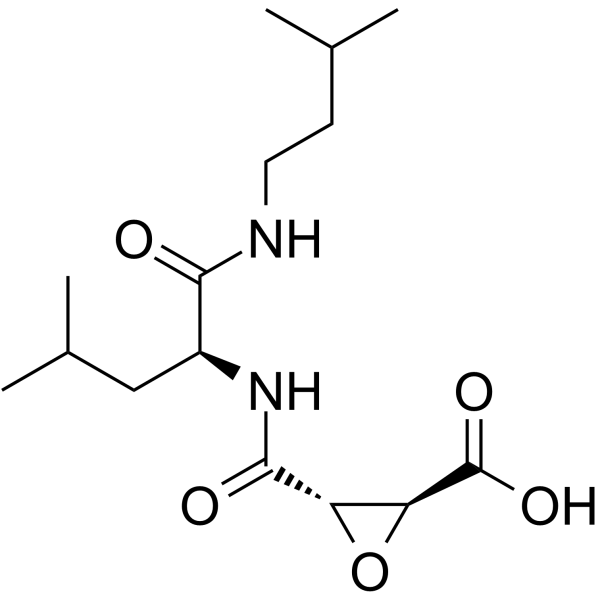



| Cas No.: | 76684-89-4 |
| Chemical Name: | 2-Oxiranecarboxylicacid,3-[[[(1S)-3-methyl-1-[[(3-methylbutyl)amino]carbonyl]butyl]amino]carbonyl]-,(2S,3S)- |
| Synonyms: | 2-Oxiranecarboxylicacid,3-[[[(1S)-3-methyl-1-[[(3-methylbutyl)amino]carbonyl]butyl]amino]carbonyl]-,(2S,3S)-;E-64c;2-Oxiranecarboxylicacid,3-[[[(1S)-3-methyl-1-[[(3-methylbutyl)amino]carbonyl]butyl]amino]carbo...;E-64-c;E-64c (EP 475,NSC 694279);L-trans-Epoxysuccinyl-Leu-3-methylbutylamide;E-64-c Loxistatin acid NSC 694279;anecarboxylicacid;E-64c,EP 475;Inhibitorforthiolprotease;Loxistatin acid;(2S,3S)-trans-Epoxysuccinyl-L-leucylamido-3-methylbutane |
| SMILES: | O=C([C@H]1O[C@@H]1C(N[C@H](C(NCCC(C)C)=O)CC(C)C)=O)O |
| Formula: | C15H26N2O5 |
| M.Wt: | 314.37734 |
| Purity: | >98% |
| Sotrage: | 2 years -20°C Powder, 2 weeks 4°C in DMSO, 6 months -80°C in DMSO |
| Description: | E 64c is a derivative of naturally occurring epoxide inhibitor of cysteine proteases, a Calcium-activated neutral protease (CANP) inhibitor and a very weak irreversible cathepsin C inhibitor. |
| In Vivo: | The t-1/2 of plasma E-64c is 0.48 hours. The hemodynamic effects of E-64c are absent at this dose. Using two way analysis of variance, the effects of reperfusion (p=0.0016) or E-64c (p=0.0226) per se on infarct size are significant. In comparing Group A with Group B and Group C with Group D, the depletion of CPK in the E-64c treated groups (Groups A and C) is slightly less than in the vehicle-injected groups (Groups B and D). The insufficient effect of E-64c alone may be explained by the early administration and relatively short t-1/2. Since the effectiveness of NCO-700 has been established,6),7) our findings might indicate a small but beneficial effect of E-64c on infarct size and CPK content[2]. |
| In Vitro: | E-64c, a derivative of naturally occurring epoxide inhibitor of cysteine proteases, with papain; especially with regard to the hydrogen bonding and hydrophobic interactions of the ligands with conserved residues in the catalytic binding site[1]. E 64c (k2/Ki=140±5M-1s-1) is demonstrated to be a lead structure for the development of irreversible cathepsin C inhibitors[3]. |
| Animal Administration: | Dogs[2] Studies are carried out in 83 mongrel dogs with a mean weight of 11.2kg. They are anesthetized with intravenous sodium thiamylal (7mg/kg). An intravenous bolus of E-64c (100mg/kg), dissolved in saturated sodium bicarbonate, is administered immediately before the occlusion and after reperfusion in Group A (n=17), whereas Group B (n=17) receive only the vehicle solution at these times. In the remaining 49 dogs (Groups C and D), the LAD is permanently ligated at the same level and an intravenous bolus of either Loxistatin acid (100mg/kg) (Group C; n=24) or vehicle only (Group D; n=25) is given immediately before and 1 hour after the ligation. The dose of E-64c is designed for its possible use in clinical practice and the estimated intramyocardial Loxistatin acid molecular concentration is 1,000 times that of total mCANP[2]. |
| References: | [1]. Khan MS, et al. Design, synthesis, evaluation and thermodynamics of 1-substituted pyridylimidazo[1,5-a]pyridine derivatives as cysteine protease inhibitors. PLoS One. 2013 Aug 5;8(8):e69982. [2]. Toda G, et al. Calcium-activated neutral protease inhibitor (E-64c) and reperfusion for experimental myocardial infarction. Jpn Heart J. 1989 May;30(3):375-86. [3]. Radzey H, et al. E-64c-hydrazide: a lead structure for the development of irreversible cathepsin C inhibitors. ChemMedChem. 2013 Aug;8(8):1314-21. |