
 To enhance service speed and avoid tariff delays, we've opened a US warehouse. All US orders ship directly from our US facility.
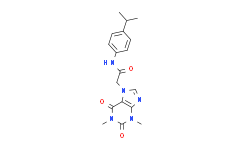



| Cas No.: | 349085-38-7 |
| Chemical Name: | 2-(1,3-Dimethyl-2,6-dioxo-1,2,3,6-tetrahydro-7H-purin-7-yl)-N-(4-isopropylphenyl)acetamide |
| Synonyms: | 2-(1,3-DIMETHYL-2,6-DIOXO-1,2,3,6-TETRAHYDRO-7H-PURIN-7-YL)-N-(4-ISOPROPYLPHENYL)ACETAMIDE;HC-030031;2-(1,3-dimethyl-2,6-dioxopurin-7-yl)-N-(4-propan-2-ylphenyl)acetamide;HC 030031;AC1LM9D6;Oprea1_280240;Oprea1_427263;SureCN1064155;1,2,3,6-Tetrahydro-1,3-dimethyl-N-[4-(1-methylethyl)phenyl]-2,6-dioxo-7H-purine-7-acetamide;HC030031;HEQDZPHDVAOBLN-UHFFFAOYSA-N;2-(1,3-dimethyl-2,6-dioxo-2,3-dihydro-1H-purin-7(6H)-yl)-N-(4-isopropylphenyl)acetamide;2-(1,3-dimethyl-2,6-dioxo-1,2,3,6-tetrahydropurin-7-yl)-N-(4-isopropylphenyl)acetamide;2-(1,3-dimethyl-2,6-dioxo-2,3,6,7-tetrahydro-1H-purin-7-yl)-N-[4-(propan-2-yl)phe |
| SMILES: | O=C1C2=C(N=C([H])N2C([H])([H])C(N([H])C2C([H])=C([H])C(=C([H])C=2[H])C([H])(C([H])([H])[H])C([H])([H])[H])=O)N(C([H])([H])[H])C(N1C([H])([H])[H])=O |
| Formula: | C18H21N5O3 |
| M.Wt: | 355.391 |
| Sotrage: | 2 years -20°C powder, 2 weeks 4°C in DMSO, 6 months -80°C in DMSO |
| Description: | HC-030031 is a potent and selective TRPA1 inhibitor, which antagonizes AITC- and formalin-evoked calcium influx with IC50s of 6.2±0.2 and 5.3±0.2 μM, respectively. |
| In Vivo: | After injection of AITC (50 μL of 10%) into the rat hind paw, HC-030031 (300 mg/kg) significantly reduces flinching during the first 5 min. Over the remainder of the hour, HC-030031 decreases flinch frequency, a result that mirrors the effects observed on formalin-induced flinching[1]. In the rat, oral administration of HC-030031 reduces AITC-induced nocifensive behaviors at a dose of 100 mg/kg. Moreover, oral HC-030031 (100 mg/kg) significantly reverses mechanical hypersensitivity in the more chronic models of Complete Freunds Adjuvant (CFA)-induced inflammatory pain and the spinal nerve ligation model of neuropathic pain. One hour post-oral administration, HC-030031 significantly reduces the lifting duration following 1% AITC injection (p<0.001)[2]. HC-030031 completely reverses the enhanced mechanical firing in inflamed mice (p<0.001)[3]. |
| In Vitro: | HC-030031 reversibly blocks TRPA1 currents with a similar potency, regardless of the agonist used; this includes blockade of currents elicited by reversible agonists, such as AITC, or irreversible agonists, such as N-methyl maleimide. HC-030031 blocks activation of TRPA1 by N-methyl maleimide, which opens the channel irreversibly through cysteine modification. HC-030031 does not block currents mediated by TRPV1, TRPV3, TRPV4, hERG, or NaV1.2 channels[1]. The potencies of HC-030031 versus cinnamaldehyde or allyl isothiocyanate (AITC or Mustard oil)-induced TRPA1 activation are 4.9±0.1 and 7.5±0.2 μM respectively (IC50). These findings are similar to the previously reported IC50 of 6.2 μM against AITC activation of TRPA1. The ability of HC-030031 to block TRPA1 activation is tested in a FLIPR calcium-influx assay using HEK-293 cells stably expressing human TRPA1. Concentrations of HC-030031 from 0.3 to 60 μM are incubated with cells for 10 minutes prior to addition of an EC60 concentration of either cinnamaldehyde or AITC. HC-030031 dose-dependently blocks cinnamaldehyde- and AITC-induced calcium influx with IC50 values of 4.9 and 7.5 μM, respectively[2]. |