 To enhance service speed and avoid tariff delays, we've opened a US warehouse. All US orders ship directly from our US facility.



| Cas No.: | 106740-09-4 |
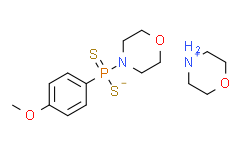
| Chemical Name: | GYY 4137 morpholine salt |
| Synonyms: | GYY 4137;GYY 4137 MORPHOLINE SALT;(4-Methoxyphenyl)morpholino-phosphinodithioic acid compound with morpholine;GYY4137;Morpholine (4-methoxyphenyl)(morpholino)phosphinodithioate;GYY4137 morpholine salt;C11H16NO2PS2.C4H9NO;BCP23715;P-(4-Methoxyphenyl)-P-4-morpholinylphosphinodithioic acid morpholine salt;(4-methoxyphenyl)-morpholin-4-yl-sulfanyl-sulfanylidene-lambda5-phosphane;morpholine |
| SMILES: | S([H])P(C1C([H])=C([H])C(=C([H])C=1[H])OC([H])([H])[H])(N1C([H])([H])C([H])([H])OC([H])([H])C1([H])[H])=S.O1C([H])([H])C([H])([H])N([H])C([H])([H])C1([H])[H] |
| Formula: | C15H25N2O3PS2 |
| M.Wt: | 376.4744 |
| Purity: | >98% |
| Sotrage: | 2 years -20°C Powder, 2 weeks 4°C in DMSO, 6 months -80°C in DMSO |
| Description: | GYY4137 is a slow releasing H2S donor with vasodilator and antihypertensive activity. GYY4137 also exhibits anti-inflammatory and anticancer activity[1][2][3]. |
| In Vivo: | GYY4137 (100-300 mg/kg; i.p.; daily for 14 days) significantly reduces the tumor volume in both animal models, in a dose-dependent manner[2]. In the complete Freund's adjuvant (CFA)-treated mouse, GYY4137 (50 mg/kg, i.p.) injected 1 hr prior to CFA increased knee joint swelling while an anti-inflammatory effect, as demonstrated by reduced synovial fluid myeloperoxidase (MPO) and N-acetyl-β-D-glucosaminidase (NAG) activity and decreased TNF-α, IL-1β, IL-6 and IL-8 concentration, was apparent when GYY4137 was injected 6 hrs after CFA[3]. GYY4137 significantly inhibited tumor growth in the subcutaneous HepG2 xenograft model by inhibiting STAT3 activation and its target gene expression[4]. GYY4137 prevents nitrative stress and α-synuclein nitration in an MPTP mouse model of parkinson’s disease[5]. Animal Model: Female, severe combined immunodeficiency (SCID) mice (bearing HL-60 or MV4-11 cells) [2] Dosage: 100, 200 and 300 mg/kg Administration: I.p.; daily for 14 days Result: Reduced tumor volume by 52.5±9.2% and 55.3±5.7% in HL-60 and MV4–11 injected animals. |
| In Vitro: | GYY4137 (400-800 µM) causes concentration-dependent killing of seven different human cancer cell lines (HeLa, HCT-116, Hep G2, HL-60, MCF-7, MV4-11 and U2OS) but did not affect survival of normal human lung fibroblasts (IMR90, WI-38)[2]. GYY4137 (0.1-0.5 mM) decreases LPS-induced production of nitrite (NO2−), PGE2, TNF-α and IL-6 from human synoviocytes (HFLS) and articular chondrocytes (HAC), reduces the levels and catalytic activity of inducible nitric oxide synthase (iNOS) and cyclooxygenase-2 (COX-2) and reduced LPS-induced NF-κB activation[3]. Cell Viability Assay[2] Cell Line: HeLa, HCT-116, Hep G2, HL-60, MCF-7, MV4-11 and U2OS Concentration: 400 or 800 µM Incubation Time: 5 days Result: Significantly affected cancer cell survivability. |
| References: | [1]. Li L, et al. Characterization of a novel, water-soluble hydrogen sulfide-releasing molecule (GYY4137): new insights into the biology of hydrogen sulfide. Circulation. 2008;117(18):2351-2360. [2]. Lee ZW, et al. The slow-releasing hydrogen sulfide donor, GYY4137, exhibits novel anti-cancer effects in vitro and in vivo. PLoS One. 2011;6(6):e21077. [3]. Li L, et al. The complex effects of the slow-releasing hydrogen sulfide donor GYY4137 in a model of acute joint inflammation and in human cartilage cells. J Cell Mol Med. 2013;17(3):365-376. [4]. Lu S, Gao Y, et al. GYY4137, a hydrogen sulfide (H₂S) donor, shows potent anti-hepatocellular carcinoma activity through blocking the STAT3 pathway. Int J Oncol. 2014;44(4):1259-1267. [5]. Hou X, et al. GYY4137, an H2S Slow-Releasing Donor, Prevents Nitrative Stress and α-Synuclein Nitration in an MPTP Mouse Model of Parkinson's Disease. Front Pharmacol. 2017;8:741. Published 2017 Oct 30. |