To enhance service speed and avoid tariff delays, we've opened a US warehouse. All US orders ship directly from our US facility.
| Cat. No. | Product Name | Field of Application | Chemical Structure |
|---|---|---|---|
| DC66100 | DSPE-Biotin Featured |
DSPE-Biotin is a lipid. DSPE-Biotin can be used for the research of various biochemical.
More description
|

|
| DC66094 | DSPE-CY5.5 Featured |
Phospholipids DSPE belong to the lipid family of biopolymers. Phospholipids consist of two fatty acids, a glycerol unit, a phosphate group, and a polar molecule. The phosphate groups and polar head regions of the molecule are hydrophilic (attracted to water), while the fatty acid tail is hydrophobic (repelled by water). When placed in water, the phospholipids Orient themselves into a double layer, where the non-polar tail region faces the inner region of the double layer. The polar head region faces outward and interacts with the water. Applications in drug release, nanotechnology and new materials research, cell culture. As well as ligand research, peptide synthesis support, grafted polymer compounds, new materials and pegylated modified functional coatings and other active compounds.
More description
|

|
| DC72426 | DSPE-SPDP Featured |
DSPE-SPDP is a phospholipid molecule. DSPE-SPDP can orient itself to form lipid bilayer in water. DSPE-SPDP can be used for the research of various biochemical.
More description
|

|
| DC66096 | DSPE-CY3 Featured |
Phospholipids DSPE belong to the lipid family of biopolymers. Phospholipids consist of two fatty acids, a glycerol unit, a phosphate group, and a polar molecule. The phosphate groups and polar head regions of the molecule are hydrophilic (attracted to water), while the fatty acid tail is hydrophobic (repelled by water). When placed in water, the phospholipids Orient themselves into a double layer, where the non-polar tail region faces the inner region of the double layer. The polar head region faces outward and interacts with the water. Applications in drug release, nanotechnology and new materials research, cell culture. As well as ligand research, peptide synthesis support, grafted polymer compounds, new materials and pegylated modified functional coatings and other active compounds.
More description
|
|
| DC65618 | DSPE-NHS Featured |
DSPE-NHS is a bioconjugation phospholipid molecule with two hydrophobic lipid tails. DSPE-NHS is a self-assembling reagent which forms lipid bilayer in aqueous solution. DSPE-NHS can be used to prepare liposomes as drug nanocarrier.
More description
|

|
| DC72430 | DSPE-Mal Featured |
DSPE-MAL is a thiol reactive a phospholipid compound. DSPE-MAL has two saturated fatty acids and can self-assemble in water to form lipid bilayer. DSPE-MAL can be used to prepare liposomes as drug nanocarrier.
More description
|

|
| DC66104 | DSPE-ICG Featured |
ICG indocyanine green is a three carbon cyanine dye with good water solubility and a molecular weight of 775. Indocyanine green can almost completely bind to plasma proteins in plasma and whole blood, ensuring that it remains almost completely in Xueguan and is not easily diffused outward. Indocyanine green (ICG) is a near-infrared imaging reagent currently approved by the US Food and Drug Administration (FDA) for clinical use. ICG is a three carbon cyanine dye with near-infrared characteristic absorption peaks, emission wavelengths between 795 and 845nm, and has amphiphilic structures that are both hydrophilic and lipophilic. Near infrared light has a greater penetration depth in tissues and is less affected by biological tissue background, Due to its near-infrared absorption and emission fluorescence characteristics, ICG can be used as an excellent tissue penetrating agent in vivo.
More description
|
|
| DC66099 | DSPE-FA Featured |
|
|
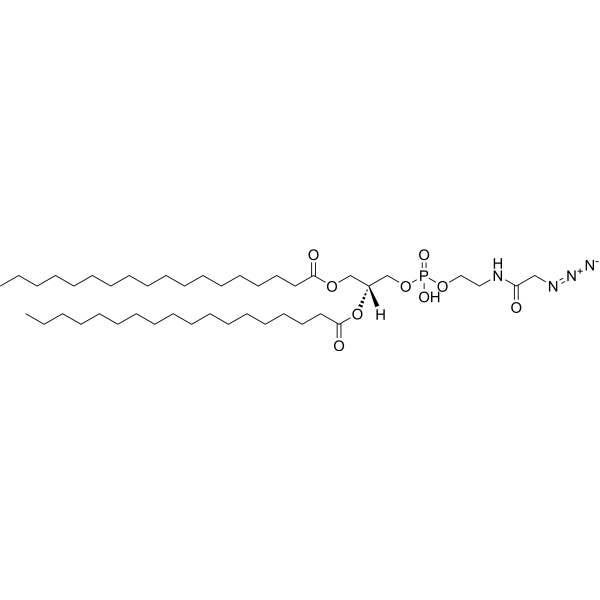
| DC72432 | DSPE-N3 Featured |
DSPE-N3 is a lipid. DSPE-N3 can be used for the research of various biochemical.
More description
|
|