 To enhance service speed and avoid tariff delays, we've opened a US warehouse. All US orders ship directly from our US facility.
| Cat. No. | Product Name | Field of Application | Chemical Structure |
|---|---|---|---|
| DC80549 | DM-1157 |
DM-1157 is an orally active asymmetric bisquinoline heme inhibitor with a IC50 of 1.6 μM and a Kd of 1.7 μM. DM-1157 binds to heme dimers in solution, inhibits β-hematin formation, suppresses hemozoin formation in the digestive vacuole of Plasmodium falciparum, accumulates in the digestive vacuole of Plasmodium falciparum, induces enlargement of the digestive vacuole of Plasmodium falciparum, and inhibits the growth of Chloroquine-sensitive and resistant Plasmodium falciparum strains. DM-1157 can be used for the research of malaria and Plasmodium falciparum-type malaria.
More description
|

|
| DC80542 | Dimefluthrin |
Dimefluthrin is an insecticide. Dimefluthrin exhibits contact toxicity against large red imported fire ant workers. Dimefluthrin undergoes horizontal transfer among red imported fire ant workers, causing secondary mortality in recipient workers. Dimefluthrin is a neurodevelopmental toxicant, which can reduces acetylcholinesterase activity, impairing neurotransmitter.
More description
|
|
| DC80537 | Diethyl benzylmalonate |
Diethyl benzylmalonate is a drug intermediate that can be used for the synthesis of central inhibitory agents.
More description
|
|
| DC80522 | Desmethylcitalopram hydrobromide |
Desmethylcitalopram hydrobromide (DCIT hydrobromide) is a drug impurity.
More description
|
|
| DC80510 | DdBIC |
DdBIC is a pyroptosis inducer. DdBIC binds to Nur77 and triggers its translocation to mitochondria, activates SDHA to deplete succinyl-CoA, disrupts heme homeostasis, induces electron leakage, and elicits mitochondrial ROS production. DdBIC induces mitochondrial ROS that oxidatively activates OMA1, promotes OPA1 cleavage and its release into the cytoplasm, activates the integrated stress response via PERK, and ultimately activates granzyme B to cleave GSDMC. DdBIC can be used for the study of melanoma.
More description
|
|
| DC80473 | COX-2/CaV2.2-IN-1 |
COX-2/CaV2.2-IN-1 is an orally active and selective dual COX-2/CaV2.2 inhibitor, exhibiting a COX-2 IC50 of 0.26 μM and a CaV2.2 IC50 of 0.29 μM. COX-2/CaV2.2-IN-1 suppresses inflammatory responses and inflammatory mediator (IL-6, TNF-α, NO) production. COX-2/CaV2.2-IN-1 produces pronounced analgesic effects in diverse models of inflammatory, neuropathic, and visceral pain. COX-2/CaV2.2-IN-1 can be used for the research of chronic pain.
More description
|
|
| DC80419 | CGP-45688 |
CGP-45688 is an orally active non-steroidal aromatase inhibitor with an ED50 of 30-100 μg/kg. CGP-45688 can reduce the level of estrogen in the body, thereby inhibiting the growth of estrogen-dependent tumors. CGP-45688 inhibits the growth of estrogen-dependent breast tumors in rat models. CGP-45688 disrupts the ovarian cycle and inhibits the weight of the uterus. CGP-45688 can be used for the study of breast cancer.
More description
|
|
| DC80407 | CDK9-IN-48 |
CDK9-IN-48 is a CDK9 inhibitor with an IC50 of 1.37 nM. CDK9-IN-48 inhibits the proliferation of various cancer cells. CDK9-IN-48 can be used in the research of cancers such as acute myeloid leukemia and prostate cancer.
More description
|
|
| DC80388 | CC-M-1 |
CC-M-1 is a potent and selective PI3K/mTOR inhibitor. CC-M-1 inhibits PI3Kα/β/γ/δ and mTOR with IC50 values of 0.68, 1.02, 1.03, 8.03, and 15 nM, respectively. CC-M-1 inhibits the proliferation of colorectal cancer cell lines, including HCT-116 (IC50 = 0.38 μM) and HT-29 (IC50 = 1.70 μM). CC-M-1 can be used for colorectal cancer (CRC) research.
More description
|
|
| DC80386 | CCL17-IN-1 |
CCL17-IN-1 (Compound Ex.132) is a CCL17 secretion inhibitor with an EC50 of 0.2 nM. CCL17-IN-1 can be used in the research of autoimmune diseases, dermatological conditions, and respiratory disorders.
More description
|
|
| DC80357 | BXY-14 |
BXY-14 is a TLR2 agonist and vaccine adjuvant. BXY-14 significantly downregulates the expression of intratumoral PD-L1 in mouse models. BXY-14 acts as a vaccine adjuvant to induce antibody responses. BXY-14 exhibits synergistic efficacy when combined with the anti-PD-L1 monoclonal antibody Atezolizumab in mouse models of melanoma, and prolongs overall survival. BXY-14 is applicable to research related to melanoma.
More description
|
|
| DC80317 | BL-1021 |
BL-1021 is an orally active ion channel blocker. BL-1021 significantly reduces symptoms of neuropathic pain without noticeable sedation or cardiac arrhythmias. BL-1021 can be used in the research of acute and chronic pain.
More description
|
|
| DC80264 | Asoxime dimesylate |
Asoxime dimesylate (HI-6 dimesylate) is an orally active thiosemicarbazone-based antidote. Asoxime dimesylate is a reversible inhibitor of AChE, and its core mechanism of action is to re-activate AChE inhibited by nerve toxins, thereby restoring the cholinergic nerve function. Asoxime dimesylate significantly restores the function of poisoned muscles without reactivating AChE. Asoxime dimesylate is an antagonist of acetylcholine receptors (AChRs), including nicotinic receptor and α7 nAChR. Asoxime dimesylate can serve as an effective immunomodulator, improving the immune effect of the nervous system.
More description
|
|
| DC80251 | AR ligand-48 |
AR ligand-48 is an AR (Androgen Receptor) inhibitor and a ligand for the target protein for PROTAC (AR). AR ligand-48 can be used to synthesize PROTAC AR Degrader-12.
More description
|
|
| DC80227 | Antiparasitic agent-30 |
Antiparasitic agent-30 is a potent adenosine kinase TbrAK modulator and antitrypanosomal agent. Antiparasitic agent-30 exhibits significant inhibitory activity against Trypanosoma brucei rhodesiense, while enhancing the activity of recombinant TbrAK(EC50=38 nM, Ka=75 nM-497 nM). Antiparasitic agent-30 exerts its pharmacological effects by eliminating intrinsic substrate inhibition and hyperactivating TbrAK in Trypanosoma brucei rhodesiense. Antiparasitic agent-30 serves as a valuable tool molecule for studying acute African human trypanosomiasis (sleeping sickness).
More description
|
|
| DC80218 | Antileishmanial agent-36 |
Antileishmanial agent-36 (compound 4f) is an indole-dihydropyrimidinone derivative with anti-leishmanial activity. Antileishmanial agent-36 induces reactive oxygen species (ROS)-mediated mitochondrial dysfunction and apoptosis. Antileishmanial agent-36 exhibits potent activity against L. donovani (IC50 =4.54 μM) with low cytotoxicity against J774.1 macrophage. Antileishmanial agent-36 clears the parasite burden in a visceral leishmaniasis (VL) model. Antileishmanial agent-36 can be used for VL research.
More description
|
|
| DC80200 | Androgen receptor degrader-6 |
Androgen receptor degrader-6 is a blood-brain barrier-permeable AR degrader. Androgen receptor degrader-6 inhibits the chaperone activity of HSP27 and disrupts the HSP27-AR complex. Androgen receptor degrader-6 promotes the degradation of wild-type and mutant AR, reduces AR protein levels, and inhibits the growth of glioblastoma cells. Androgen receptor degrader-6 can be used in glioblastoma research.
More description
|
|
| DC80136 | A-837093 sodium |
A-837093 sodium is a potent and orally active inhibitor of the hepatitis C virus (HCV) nonstructural protein 5B (NS5B) polymerase. A-837093 sodium shows potencies against polymerases derived from both HCV genotypes 1a (IC50 = 1.25 nM) and 1b (IC50 = 0.33 nM). A-837093 sodium exhibits antiviral efficacy in HCV-infected chimpanzees. A-837093 sodium can be used for HCV infection research.
More description
|
|
| DC80117 | 6-Iodonordihydrocapsaicin |
6-Iodonordihydrocapsaicin is a TRPV1 antagonist. 6-Iodonordihydrocapsaicin functionally blocks TRPV1-mediated responses, including capsaicin-induced ion currents in dorsal root ganglion neurons and distension-induced firing of jejunal spinal afferent fibers in mice. 6-Iodonordihydrocapsaicin can be used in the research of visceral pain and anxiety disorders.
More description
|
|
| DC80102 | 5-Formyl-2-hydroxy-2,4-heptadienedioic acid |
5-Formyl-2-hydroxy-2,4-heptadienedioic acid (compound II) is a product of metu-cleavage of 3,4-dihydroxyphenylacetate.
More description
|
|
| DC80055 | 3-Amino-5-hydroxybenzoic acid-13C |
3-Amino-5-hydroxybenzoic acid-13C is the 13C-labeled 3-Amino-5-hydroxybenzoic acid. 3-Amino-5-hydroxybenzoic acid is a biosynthetic precursor of the mC7N unit of ansamycin antibiotics, including ansatrienin A and geldanamycin, as well as the antitumor antibiotic mitomycin C. 3-Amino-5-hydroxybenzoic acid may be an early intermediate in the shikimic acid pathway from glucose.
More description
|
|
| DC79982 | 11β-HSD1-IN-25 |
11β-HSD1-IN-25 is a selective and orally active 11β-HSD1 inhibitor. 11β-HSD1-IN-25 effectively reduces glucocorticoid levels in vitro and serum, and diminishes lipid accumulation in both vitro and vivo. 11β-HSD1-IN-25 modulates lipid metabolism through dual mechanisms: inhibition of 11β-HSD1 and activation of the AMP-activated protein kinase (AMPK) signaling pathway. 11β-HSD1-IN-25 can be used for obesity and related metabolic disorders research.
More description
|
|
| DC79976 | 10(Z)-Pentadecenoic acid methyl ester |
10(Z)-Pentadecenoic acid methyl ester is an unsaturated fatty acid methyl ester (FAME)。
More description
|
|
| DC79940 | 1,1-Dimethoxyhexadecane |
1,1-Dimethoxyhexadecane is an ether lipid. Ether lipids are mainly found in cell membranes.
More description
|
|
| DC79932 | (S,R,S)-AHPC-Me-NHBoc |
(S,R,S)-AHPC-Me-NHBoc is an E3 ubiquitin ligase VHL ligand used to recruit the VHL protein. (S,R,S)-AHPC-Me-NHBoc can be linked to a target protein ligand via a linker to form a PROTAC.
More description
|
|
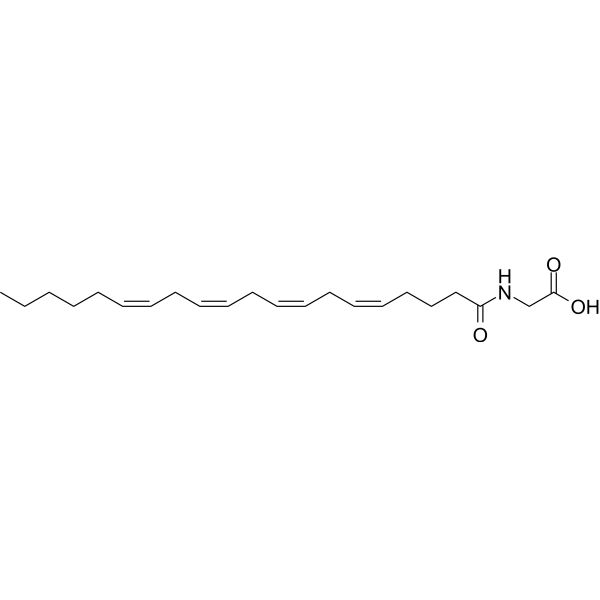
| DC46392 | N-Arachidonylglycine Featured |
N-Arachidonylglycine (NA-Gly), a carboxylic analog of the endocannabinoid anandamide (AEA), is a GPR18 agonist (EC50 = 44.5 nM). Unlike AEA, N-Arachidonylglycine has no activity at either CB1 or CB2 receptors. N-Arachidonylglycine inhibits GLYT2 (IC50 = 5.1 μM). N-Arachidonylglycine also is an effective activator of endometrial cell migration.
More description
|
|
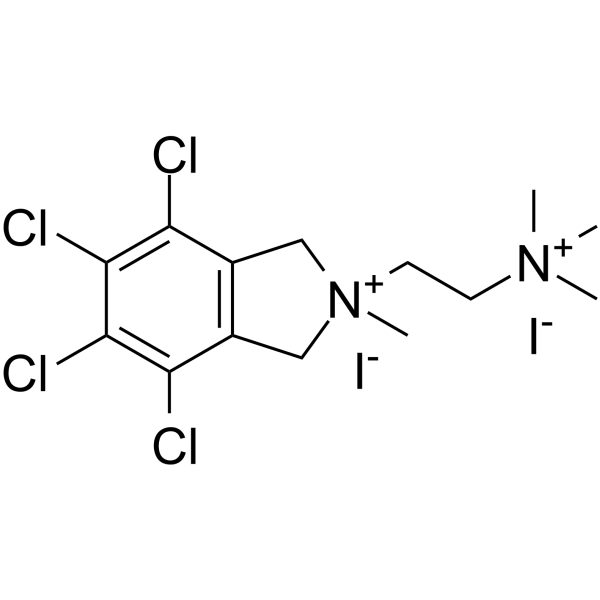
| DC71153 | Chlorisondamine diiodide Featured |
Chlorisondamine (diiodide) is a potent nicotinic acetylcholine receptor (nAChR) antagonist and a ganglion blocker. Chlorisondamine antagonizes some of nicotine's central actions in a potent, long-lasting and pharmacologically selective way.
More description
|
|
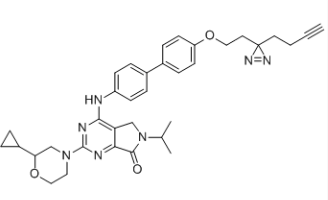
| DC73603 | OV350 Featured |
OV350 (OV-350) is a potent, selective and direct K+-Cl- cotransporter KCC2 agonist with EC50 of 261.4 nM, with no effect on KCC2 plasma membrane accumulation and phosphorylation.
More description
|
|
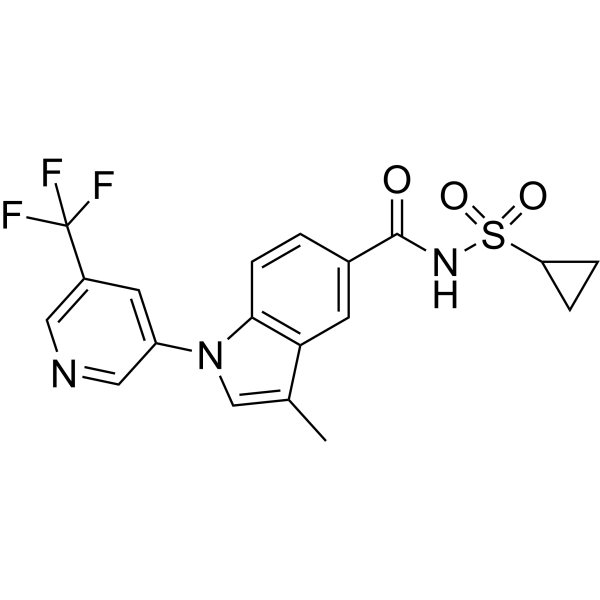
| DC73682 | DS43260857 Featured |
DS43260857 is a potent, selective NaV1.7 inhibitor with IC50 of 15 nM (hNaV1.7), shows 440-fold and 930-fold selectivity over hNaV1.1 and hNaV1.5, respectively.
More description
|
|
| DC70477 | EC18 HCN inhibitor Featured |
EC18 HCN inhibitor is a HCN channel inhibitor. EC18 acts as a potent HCN4 inhibitor in a human iPSC-derived sinus node model with proven HCN4 expression. EC18 is an attractive pharmacological tool, enabling HCN channel-modulation studies with some specificity for HCN4 (EC50 [HCN4] = 3.98 ± 1.16 µM) over HCN1 (EC50 = 21.00 ± 3.98 µM) and HCN2 (EC50 = 19.35 ± 4.48 µM). EC18 abolishes HCN4 triggered pace making in a human iPSC (hiPSC) pacemaker model.
More description
|
|
