 To enhance service speed and avoid tariff delays, we've opened a US warehouse. All US orders ship directly from our US facility.
| Cat. No. | Product Name | Field of Application | Chemical Structure |
|---|---|---|---|
| DC78068 | E3 Ligase Ligand-linker Conjugate 190 |
E3 Ligase Ligand-linker Conjugate 190 is a E3 ligase ligand-linker conjugate, used for the synthesis of BP-198.
More description
|

|
| DC78067 | E3 ligase Ligand 66 |
E3 ligase Ligand 66 is an E3 ligase ligand that can be used to recruit IAP proteins. E3 ligase Ligand 66 can be linked to SARS-CoV-2 Mpro ligand 1 through a linker to form PROTAC BP-198.
More description
|
|
| DC78037 | BY13 |
BY13 is a SRC-3 PROTAC degrader with a DC50 of 0.031 μM. BY13 selectively blocks the ER signaling pathway over that of androgen receptor (AR)) through down-regulating ERα level. BY13 potently overcomes endocrine resistance in breast cancer by inducing cell cycle arrest in G1 phase and apoptosis, with superior effect over Fulvestrant. BY13 significantly inhibits the growth of drug-resistant breast tumors without obvious toxicity in LCC2 xenograft mice model.
More description
|
|
| DC78030 | SARS-CoV-2 Mpro ligand 1 |
SARS-CoV-2 Mpro ligand 1 (Compound S15) is a PROTAC target protein ligand. SARS-CoV-2 Mpro ligand 1 can be used to synthesize BP-198.
More description
|
|
| DC78028 | Thalidomide-NH-alkynes |
Thalidomide-NH-alkynes is a synthesized E3 ligase ligand-linker conjugate that can be used for synthesis of PROTAC HDAC degrader-2.
More description
|
|
| DC78024 | MCB-36 |
MCB-36 is a VHL-recruiting pan-KRAS PROTAC degrader without affecting KRAS transcription. MCB-36 exhibits minimal effects on HRAS and NRAS protein levels. MCB-36 binds to the GDP-loaded state of G12D, G12C, G12V, and wild-type KRAS with high affinities Kd ≈ 1 pM). MCB-36 decreases p-ERK levels, leading to cell apoptosis. MCB-36 effectively suppress KRASG12C inhibitor-resistant cancer cells and remodel the tumor immune microenvironment. MCB-36 can be used for the study of colorectal cancer and lung cancer.
More description
|
|
| DC78018 | (S,R,S)-AHPC-Me-amide-C4-Br |
(S,R,S)-AHPC-Me-amide-C4-Br incorporates a VHL ligand for the E3 ubiquitin ligase and a PROTAC linker. (S,R,S)-AHPC-Me-amide-C4-Br can be used to design PROTAC, such as PROTAC ERK5 degrader-1.
More description
|
|
| DC78017 | Piperidine-azetidine-Br |
Piperidine-azetidine-Br is a PROTAC linker that can be used in the synthesis of PROTACs, such as BY13.
More description
|
|
| DC78016 | HPK1 ligand 3 |
HPK1 ligand 3 is a ligand for target protein for PROTAC that can be used to synthesize PROTAC HPK1 Degrader-4.
More description
|
|
| DC78015 | WZH-15-125 |
WZH-15-125 is a potent ALK inhibitor. WZH-15-125 can effectively overcome drug resistance, especially compound ALK mutations. WZH-15-125 has an IC50 of 101.7 nM for the highly refractory G1202R/L1196M mutation that is resistant to Lorlatinib. WZH-15-125 can be used as a PROTAC target protein ligand to synthesize PROTAC WZH-17-002. WZH-15-125 can be used in the research of non-small cell lung cancer.
More description
|
|
| DC77941 | E3 Ligase Ligand-linker Conjugate 179 |
E3 Ligase Ligand-linker Conjugate 179 is an E3 ubiquitinase ligand-linker conjugate. E3 Ligase Ligand-linker Conjugate 179 can be used to synthesize JV8.
More description
|
|
| DC77938 | (S,R,S)-AHPC-amide-PEG5-C2-azide |
(S,R,S)-AHPC-amide-PEG5-C2-azide (VH032-CO-(CH2)2-(O-CH2-CH2)5-azide) is a PROTAC linker that can be used to design PROTACs.
More description
|
|
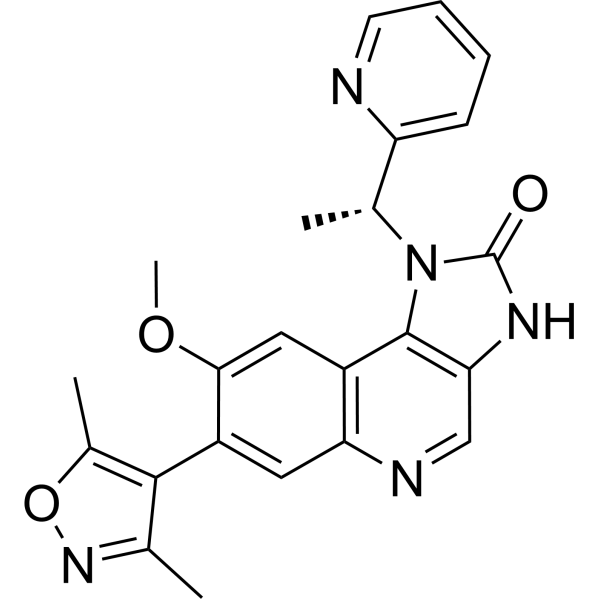
| DC5183 | I-BET151 Featured |
I-BET151 (GSK1210151A) is a novel selective BET inhibitor for BRD2, BRD3 and BRD4 with IC50 of 0.5 μM, 0.25 μM, and 0.79 μM, respectively.
More description
|
|
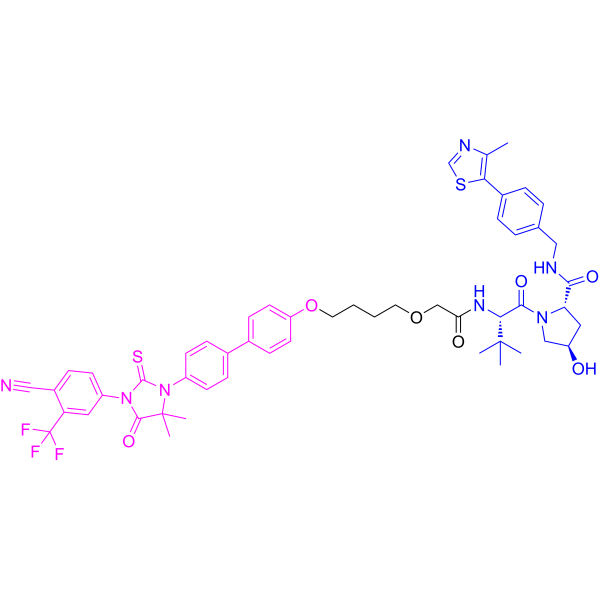
| DC40420 | ARCC-4 Featured |
ARCC-4 is a low-nanomolar androgen receptor (AR) degrader based on PROTAC, with a DC50 of 5?nM. ARCC-4 is an enzalutamide-based von Hippel-Lindau (VHL)-recruiting AR PROTAC and outperforms enzalutamide. ARCC-4 effectively degrades clinically relevant AR mutants associated with antiandrogen therapy.
More description
|
|
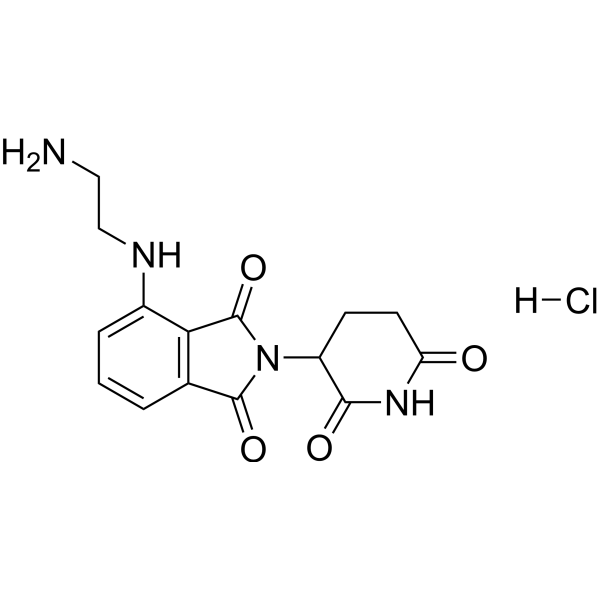
| DC26122 | Pomalidomide-C2-NH2 hydrochloride Featured |
Pomalidomide-C2-NH2 hydrochloride is a synthesized E3 ligase ligand-linker conjugate that incorporates the Pomalidomide based cereblon ligand and a linker used in PROTAC technology.
More description
|
|
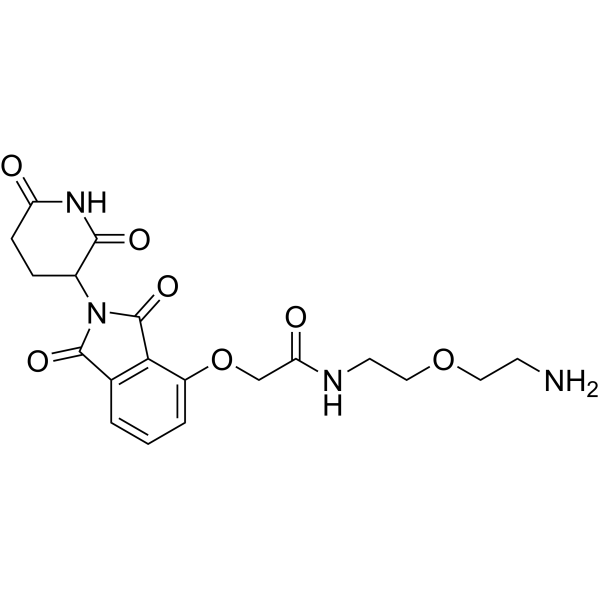
| DC11573 | E3 Ligand-Linker Conjugate 7 Featured |
An E3 ligase ligand-linker conjugate for PROTAC..
More description
|
|
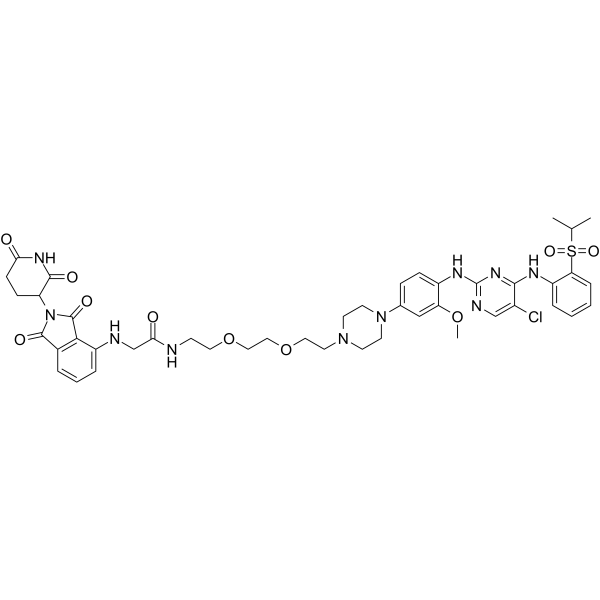
| DC21962 | TL13-12 Featured |
TL13-12 is a novel Anaplastic Lymphoma Kinase (ALK)-PROTAC developed through conjugation of TAE684 and the cereblon ligand pomalidomide.
More description
|
|
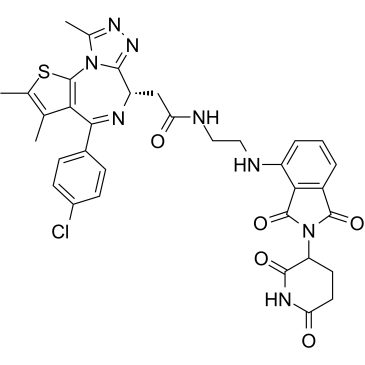
| DC21893 | dBET57 Featured |
dBET57 is a novel BRD4 heterobifunctional small-molecule ligand (PROTAC), exhibits significant and selective degradation of BRD4 BD1 (DC50/5h=500 nM), but is inactive on BRD4 BD2..
More description
|
|
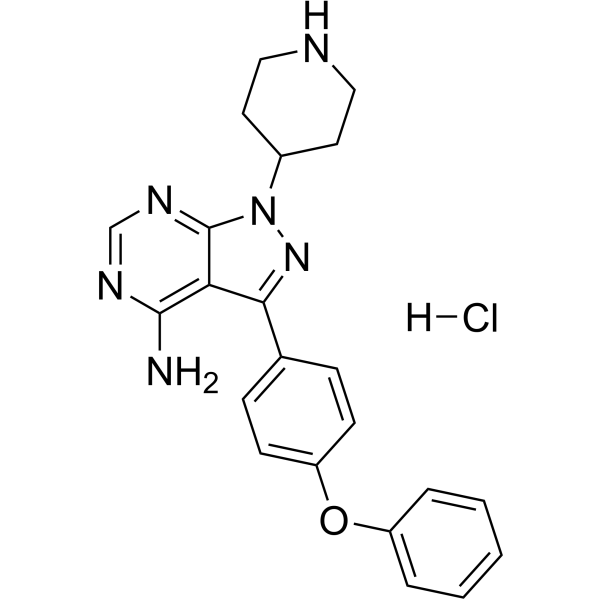
| DC40447 | N-piperidine Ibrutinib hydrochloride Featured |
N-piperidine Ibrutinib hydrochloride (Compound 1) is a reversible Ibrutinib derivative. N-piperidine Ibrutinib hydrochloride is a potent BTK inhibitor with IC50s of 51.0 and 30.7 nM for WT BTK and C481S BTK, respectively. N-piperidine Ibrutinib hydrochloride can be used as a BTK ligand in the synthesis of a series of PROTACs, such as SJF620. SJF620 is a potent PROTAC BTK degrader with a DC50 of 7.9 nM.
More description
|
|
| DC40428 | Pomalidomide 4'-alkylC5-acid Featured |
Pomalidomide 4'-alkylC5-acid is a synthesized E3 ligase ligand-linker conjugate that incorporates the Pomalidomide based cereblon ligand and a PEG linker used in PROTAC technology.
More description
|

|
| DC42553 | Pomalidomide-PEG3-azide Featured |
Pomalidomide-PEG3-azide is a synthesized E3 ligase ligand-linker conjugate that incorporates the Pomalidomide based cereblon ligand and 3-unit PEG linker used in PROTAC technology.
More description
|

|
| DC44858 | Thalidomide-O-C4-COOH Featured |
Thalidomide-O-C4-COOH is a synthesized E3 ligase ligand-linker conjugate that incorporates the Thalidomide based cereblon ligand and a linker used in PROTAC technology.
More description
|

|
| DC55003 | XY028-140 (MS140) Featured |
XY028-140 (MS-140) is a potent and selective PROTAC-based CDK4/CDK6 kinase degrader. XY028-140 specifically inhibits RB-E2F signaling and reduces CDK4 and CDK6 protein levels in a dose- and time-dependent manner in vitro. In addition, XY028-140 can degrade its targets by linking them with ubiquitin-proteasome mechanism. Further, the degradation of CDK4/6 protein by XY028-140 is specifically mediated by CRBN. Therefore, XY028-140 effectively and selectively inhibits and degrades CDK4/6 kinase by targeting CDK4/6 kinase in CDK4/6i-S (CDK4/6 inhibitor-sensitive) tumor cells to the CRL4-CRBN-E3 ubiquitin complex. Compared with CDK6 wild-type cells, XY028-140 treatment of cells expressing wild-type or mutation-activated CDK6 resulted in a more effective degradation of CDK6 (S178P).
More description
|

|
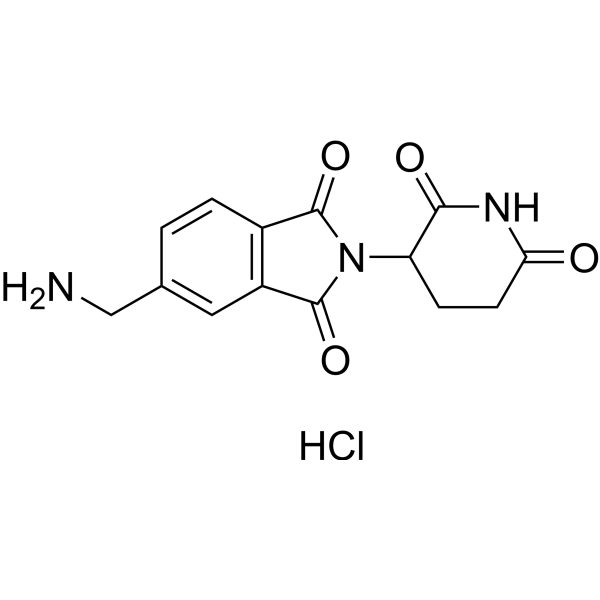
| DC47206 | Thalidomide-5-CH2-NH2 hydrochloride Featured |
Thalidomide-5-CH2-NH2 (hydrochloride) is the Thalidomide-based cereblon ligand used in the recruitment of CRBN protein. Thalidomide-5-CH2-NH2 (hydrochloride) can be connected to the ligand for protein by a linker to form PROTACs.
More description
|
|
| DC60361 | DLin-K-DM4 |

|
|
| DC77262 | YW-N-7 TFA |
YW-N-7 (TFA) is a PROTAC that targets both the inhibition and degradation of RET kinase, with a DC50 of 88 nM. YW-N-7 (TFA) exhibits antitumor activity in a KIF5B-RET-driven xenograft mouse tumor model and can be used in the area of cancer.
More description
|
|
| DC77261 | YN14-H |
YN14-H is a PROTAC degrader targeting KRASG12C. YN14-H inhibits cell growth in NCI-H358 and MIA PaCa-2 cells (IC50 values of 0.042, 0.021 μM, DC50 values of 28.9, 18.1 nM, respectively). YN14-H significantly induces apoptosis and inhibits migration. YN14-H demonstrates favorable pharmacokinetic properties and excellent antitumor activity in vivo.
More description
|
|
| DC77260 | TYD-68 |
TYD-68 is a highly efficient and selective CRBN-recruited TYK2 PROTAC degrader with a DC50 value of 0.42 nM. TYD-68 significantly inhibits IL-12 and IFN-α-induced STAT4 and STAT1 phosphorylation, thereby blocking TYK2-dependent signaling pathways.
TYD-68 can be used in the study of psoriasis.
More description
|
|
| DC77259 | TrimTAC1 |
TrimTAC1 is a PROTAC degrader that selectively targets the degradation of the multimeric protein Nucleoporin.
More description
|
|
| DC77258 | TO-1187 |
TO-1187 is a selective HDAC6 PROTAC degrader (DC50: 5.81 nM). TO-1187 promotes the ubiquitination and degradation of HDAC6 and can be used in the study of hematological malignancies and solid tumors.
More description
|
|
