
 To enhance service speed and avoid tariff delays, we've opened a US warehouse. All US orders ship directly from our US facility.
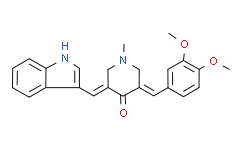



| Cas No.: | 1370032-19-1 |
| Chemical Name: | (3E,5E)-3-[(3,4-Dimethoxyphenyl)methylidene]-5-(1H-indol-3-ylmethylidene)-1-methylpiperidin-4-one |
| Synonyms: | CA-5f;BCP30170;(E)-3-((1H-Indol-3-yl)methylene)-5-((E)-3,4-dimethoxybenzylidene)-1-methylpiperidin-4-one;CA 5f;CA5f;(3E,5E)-3-(3,4-dimethoxybenzylidene)-5-[(1H-indol-3-yl)methylene]-1-methylpiperidin-4-one;(3E,5E)-3-[(3,4-Dimethoxyphenyl)methylidene]-5-(1H-indol-3-ylmethylidene)-1-methylpiperidin-4-one |
| SMILES: | O=C1/C(=C(\[H])/C2C([H])=C([H])C(=C(C=2[H])OC([H])([H])[H])OC([H])([H])[H])/C([H])([H])N(C([H])([H])[H])C([H])([H])/C/1=C(/[H])\C1=C([H])N([H])C2=C([H])C([H])=C([H])C([H])=C12 |
| Formula: | C24H24N2O3 |
| M.Wt: | 388.4590 |
| Purity: | >98% |
| Sotrage: | 2 years -20°C Powder, 2 weeks 4°C in DMSO, 6 months -80°C in DMSO |
| Description: | CA-5f is a potent late-stage macroautophagy/autophagy inhibitor via inhibiting autophagosome-lysosome fusion. CA-5f increases LC3B-II (a marker to monitor autophagy) and SQSTM1 protein both in A549 cells and HUVECs. Anti-tumor activity[1]. |
| In Vivo: | CA-5f (40 mg/kg, i.p., every 2 days for up to 30 days) is well tolerated, and potently inhibits the growth of tumor in nude mice bearing A549 lung cancer cells[1]. CA-5f (40 mg/kg, i.p.) suppresses autophagic flux and induces apoptosis in nude mice bearing A549 lung cancer cells[1]. Animal Model: Nude mice bearing A549 lung cancer cells[1] Dosage: 40 mg/kg Administration: Injected via caudal vein, every 2 days for up to 30 days Result: Significantly suppressed tumor volume and weight in mice, increased the number of apoptotic cells in mice. |
| In Vitro: | CA-5f (0-40 μM, 6 hour) concentration- and time-dependently elevates the level of LC3B-II (a marker to monitor autophagy) and SQSTM1 protein both in A549 cells and HUVECs[1]. CA-5f (20 μM, 6 hours) inhibits the degradation of autophagosomes when treated alone or in combination Bafilomycin A1 (100 nM) or Chloroquine (30 μM) in A549 cells and HUVECs[1]. CA-5f (20 μM) neither impairs the hydrolytic function nor the quantity of lysosomes[1]. CA-5f (20 μM, 96 hours) inhibits the growth of A549 cells, and less cytotoxic to normal HUVECs[1]. Cell Viability Assay[1] Cell Line: A549, HUVECs Concentration: 20 μM Incubation Time: 96 hours Result: Exhibited more cytotoxicity against A549 cells compared with normal HUVECs. Western Blot Analysis[1] Cell Line: A549 cells and HUVECs Concentration: 0-40 μM Incubation Time: 6 hours Result: Elevated LC3B-II (a marker to monitor autophagy) and SQSTM1 protein levels in a concentration- and time-dependent manner. |
| References: | [1]. Zhang L, et al. Identification of compound CA-5f as a novel late-stage autophagy inhibitor with potent anti-tumor effect against non-small cell lung cancer. Autophagy. 2019 Mar;15(3):391-406. |