To enhance service speed and avoid tariff delays, we've opened a US warehouse. All US orders ship directly from our US facility.
| Cat. No. | Product Name | Field of Application | Chemical Structure |
|---|---|---|---|
| DC68151 | KC-34 (S,S) Featured |
KC‑34 (SPC‑A9) is a novel stereopure, diketopiperazine-based ionizable cationic lipid engineered to overcome traditional liver-restricted delivery, achieving balanced multi-organ mRNA transfection. Upon systemic intravenous administration, its precisely optimized chiral configuration allows the lipid nanoparticles (LNPs) to efficiently cross endothelial barriers and target the bone marrow, offering immense therapeutic potential for in vivo hematopoietic stem cell gene editing. Concurrently, KC-34 mediates robust and long-lasting protein expression in the spleen and lungs with minimal hepatic off-target toxicity. Its stable structure provides excellent biocompatibility and high in vivo tolerance, making it ideal for systemic, multi-dose mRNA therapies.
More description
|
.png)
|
| DC68150 | Lipid A10 Featured |
A10 (Compound 16) is a diketopiperazine‑based ionizable lipid disclosed in WO 2025/217298 A1 (PCT/US2025/023899) developed by NAVA Therapeutics that enables potent, cell‑selective in vivo delivery of mRNA and nucleic acids without targeting ligands. It forms stable, well‑tolerated lipid nanoparticles (LNPs) that preferentially transfect hematopoietic stem cells (HSCs), bone marrow progenitors, lung epithelium, endothelium, and immune cells while minimizing liver off‑target delivery. In both mice and non‑human primates, A10‑containing LNPs drive functional mRNA expression and gene editing in CD34⁺ HSCs at clinically relevant low doses (0.25–1.0 mg/kg), supporting in vivo HSC gene therapy without ex vivo manipulation.
More description
|

|
| DC67283 | C14-490 |
C14-490 is an ionizable cationic lipid (pKa = 5.94).1 It has been used in the generation of lipid nanoparticles (LNPs) for the delivery of mRNA in vivo.C14-490-containing LNPs accumulate primarily in the fetal mouse liver and, to a lesser extent, in the lungs, intestine, and brain after vitelline vein injection on gestational day 16 (E16).1 CD45-functionalized LNPs containing C14-490 and encapsulating mRNA encoding GFP transfect Jurkat cells, which constitutively express the CD45 receptor (CD45R).C14-490-containing CD45-functionalized LNPs encapsulating Cre mRNA mediate genome modulation in bone marrow hematopoietic stem cells (HSCs) for at least four months after in utero injection in R26mT/mG mice at E13.5.
More description
|

|
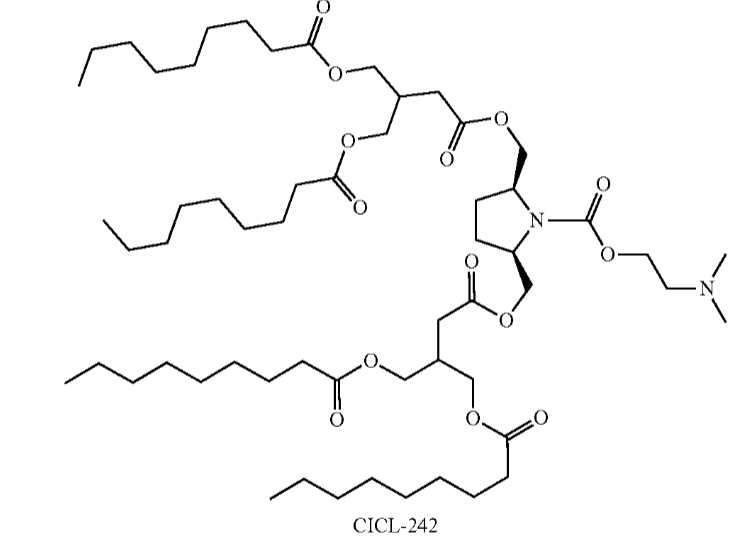
| DC67652 | CICL-242 Featured |
CICL-242 is a constrained ionizable cationic lipid highlighted in patent US 20250127728A1 developed by Capstan as a promising candidate for advanced therapeutic delivery, particularly in stem cell and gene editing applications. Its structure features a rigid amine headgroup similar to CICL-207, which likely facilitates efficient endosomal escape and reduces non-specific uptake, enhancing targeted nucleic acid delivery. Although detailed performance data is not fully disclosed in the patent, CICL-242 is explicitly synthesized and included in gene editing experimental systems (e.g., CRISPR-Cas9 workflows), suggesting its potential for high-efficiency transfection in hard-to-transfect cells like hematopoietic stem cells (CD34⁺). This makes it a strong candidate for ex vivo cell engineering and regenerative medicine, where precision and low off-target effects are critical. While further validation is needed to quantify its efficacy and safety profile, CICL-242 represents a strategic innovation in the lipid library for next-generation genetic therapies.
More description
|
|
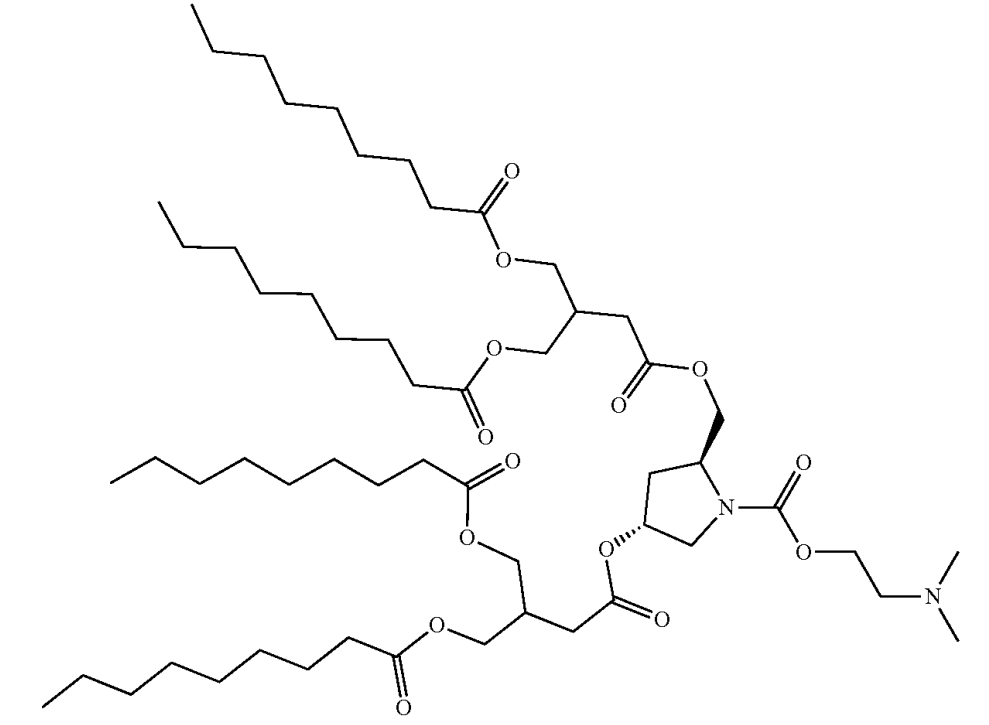
| DC67515 | CICL-207 Featured |
CICL 207 is structurally optimized based on Lipid CICL-1. CICL207 is a constrained ionizable cationic lipid designed for lipid nanoparticle (LNP) delivery systems developed by Capstan. Its structure features a rigid cyclic backbone (e.g., pyrrolidine-derived core) paired with a tertiary amine group that ionizes at acidic pH (pKa ~6.5–7.0), enhancing endosomal escape. The lipid includes asymmetric hydrophobic tails (likely C14–C18 alkyl/ester chains) to stabilize LNP membranes and improve nucleic acid encapsulation. Integrated into LNPs (e.g., 58% CICL-207, 10% DSPC, 30.5% cholesterol, PEG-lipids), it enables targeted delivery to T cells (anti-CD5/CD8 tLNPs) with high transfection efficiency (spleen T cells >70% mCherry+), reduced liver uptake, and low toxicity (no significant ALT/AST elevation in rats). Its constrained design balances stability, tissue specificity, and biocompatibility for gene therapy applications.CICL 207 (F50) significantly outperforms CICL-1 by delivering dramatically enhanced target cell transfection with reduced off-target effects. It achieves >50% transfection efficiency in splenic T-cells—nearly double that of CICL-1—while slashing off-target expression in liver cells to <5% (versus >15% for CICL-1. This precision translates to superior therapeutic outcomes: CICL-207 enables ~95% B-cell depletion in CAR-T applications, far exceeding CICL-1 ’s ~60% efficacy. Critically, it maintains an exceptional safety profile, showing no significant liver toxicity or inflammatory cytokine elevation even at high doses. Furthermore, CICL-207 demonstrates 2-fold higher transfection efficiency in hematopoietic stem cells, enabling robust gene editing. Its optimized pKa (~6.5) and constrained amine structure enhance endosomal escape while minimizing Kupffer cell uptake, making it ideal for targeted therapeutics requiring both potency and safety.
More description
|
|
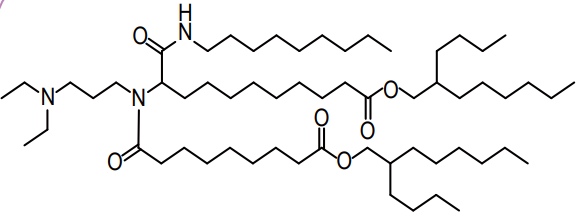
| DC60683 | Lipid-168 Featured |
LIPID168(pKa ~6.5) is an optimized ionizable lipid engineered for in vivo mRNA delivery to hematopoietic stem cells (HSCs) in bone marrow. Developed by Yoltech Therapeutics through high-throughput screening of lipid libraries, it features a diethylamino head group and a tailored hydrophobic tail structure that enables antibody-free targeting. When Lipid 168 was formulated into lipid nanoparticles (LNPs), it achieved 48.5% base editing efficiency in bone marrow cells —surpassing benchmarks like LIPID-028 (19.7%)—and reduced off-target liver editing from 71% to 19% by incorporating miR-122 target sequences. In humanized β-thalassemia models, LNP 168 delivered ABE8e mRNA/sgRNA to patient-derived HSCs, yielding 42.6% editing at the HBG promoter, reactivating fetal hemoglobin (γ-globin) and rescuing erythroid defects . Its bone marrow specificity is driven by a unique protein corona enriched in albumin, fibronectin, and fibrinogen . Safety studies confirmed transient immune responses and no cumulative toxicity . LIPID-168 represents a promising non-viral platform for curative gene therapies in blood disorders.
More description
|
|