
 To enhance service speed and avoid tariff delays, we've opened a US warehouse. All US orders ship directly from our US facility.
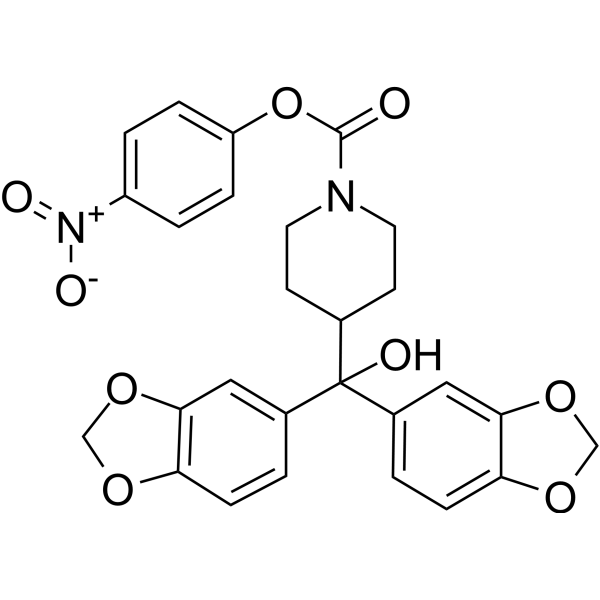



| Cas No.: | 1101854-58-3 |
| Chemical Name: | JZL184 |
| Synonyms: | (4-nitrophenyl) 4-[bis(1,3-benzodioxol-5-yl)-hydroxymethyl]piperidine-1-carboxylate;4-nitrophenyl-4-[bis(1,3-benzodioxol-5-yl)(hydroxy)methyl]piperidine-1-carboxylate;KB-78010;CTK8E9996;CHEBI:674401;4-nitrophenyl 4-(di(benzo[d][1,3]dioxol-5-yl)(hydroxy)methyl)piperidine-1-carboxylate;UNII-7MZ1I2J68A;JZL184;4-nitrophenyl 4-(dibenzo[d][1,3]dioxol-5-yl(hydroxy)methyl)piperidine-1-carboxylate;4-nitrophenyl 4-(dibenzo[d][1,3]dioxol-5-ylhydroxymethyl)piperidine-1-carboxylate;JZL-184;CHEMBL576786;JZL 184 JZL184 JZL-184;4-[Bis(1,3-benzodioxol-5-yl)hydroxymethyl]-1-piperidinecarboxylic acid 4-nitrophenyl ester;JZL 184;7MZ1I2J68A;4-nitrophenyl 4-[bis(2H-1,3-benzodioxol-5-yl)(hydroxy)methyl]piperidine-1-carboxylate;BDBM50300355;1-Piperidinecarboxylic acid, 4-(bis(1,3-benzodioxol-5-yl)hydroxymethyl)-, 4-nitrophenyl ester;1-Piperidinecarboxylic acid, 4-[bis(1,3-benzodioxol-5-yl)hydroxymethyl]-, 4-nitrophenyl ester;GTPL5207;BDBM60622 |
| SMILES: | O([H])C(C1C([H])=C([H])C2=C(C=1[H])OC([H])([H])O2)(C1C([H])=C([H])C2=C(C=1[H])OC([H])([H])O2)C1([H])C([H])([H])C([H])([H])N(C(=O)OC2C([H])=C([H])C(=C([H])C=2[H])[N+](=O)[O-])C([H])([H])C1([H])[H] |
| Formula: | C27H24N2O9 |
| M.Wt: | 520.4875 |
| Sotrage: | 2 years -20°C Powder, 2 weeks 4°C in DMSO, 6 months -80°C in DMSO |
| Description: | JZL 184 is a potent and selective inhibitor of MAGL with IC50 of 8 nM and 4 μM for inhibition of MAGL and FAAH in mouse brain membranes respectively.IC50 value: 8 nM [1]Target: MAGL inhibitorin vitro: JZL184 prolongs DSE in Purkinje neurons in cerebellar slices and DSI in CA1 pyramidal neurons in hippocampal slices. JZL184 is more potent in inhibiting mouse MAGL than rat MAGL [2]. in vivo: When administered to mice at 16 mg/kg, intraperitoneally, JZL 184 reduces MAGL activity by 85%, elevates brain 2-AG levels by 8-fold, and elicits analgesic activity in a variety of pain assays that qualitatively mimics direct central cannabinoid (CB1) agonists [1]. Acute administration of JZL184 to FAAH(-/-) mice enhanced the magnitude of a subset of cannabimimetic responses, repeated JZL184 treatment led to tolerance to its antinociceptive effects, cross-tolerance to the pharmacological effects of Δ(9)-tetrahydrocannabinol, decreases in CB1 receptor agonist-stimulated guanosine 5'-O-(3-[(35)S]thio)triphosphate binding, and dependence as indicated by rimonabant-precipitated withdrawal behaviors, regardless of genotype [3]. |