To enhance service speed and avoid tariff delays, we've opened a US warehouse. All US orders ship directly from our US facility.
| Cat. No. | Product Name | Field of Application | Chemical Structure |
|---|---|---|---|
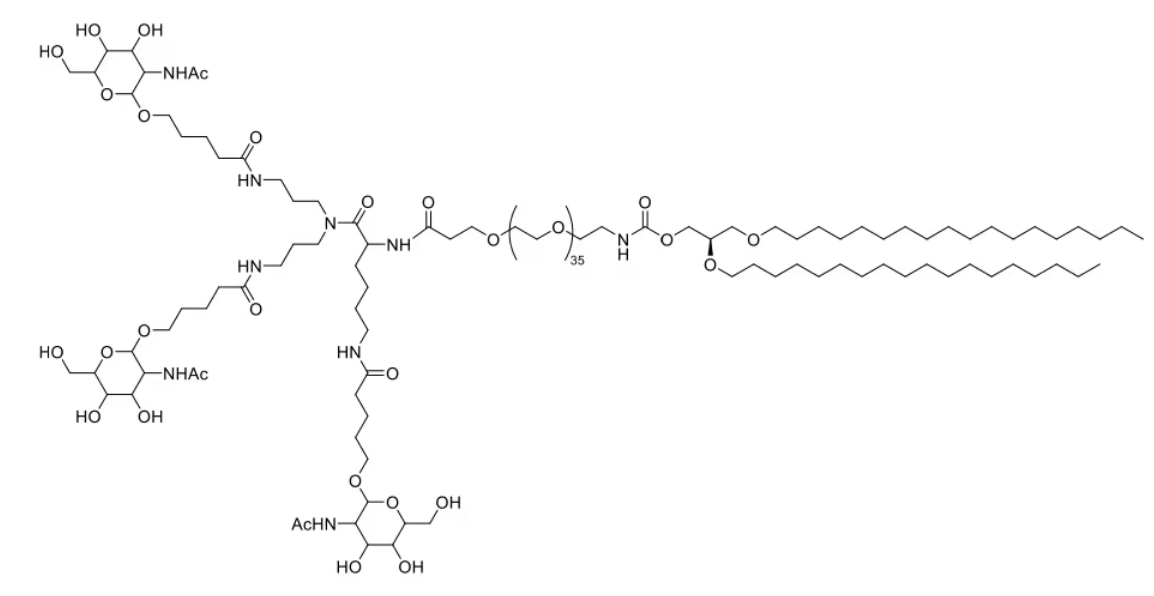
| DC60502 | GalNAc Lipid GL6(GalNAc Lipid 1004) Featured |
GL6 is a trivalent GalNAc-lipid conjugate designed for ASGPR-mediated hepatic delivery. It features a lysine-based scaffold covalently linked to three GalNAc moieties via a 36-unit PEG spacer, anchored by a 1,2-O-dioctadecyl-sn-glyceryl (DSG) lipid tail. This structure balances ligand accessibility (via optimized PEG length) and nanoparticle stability (via hydrophobic DSG anchoring). Compared to GL3 (TRIS scaffold, same PEG length), GL6’s simplified lysine scaffold improves manufacturability. In LDLR-deficient models, GL6 enabled 61% liver editing (vs. 5% with standard LNPs) at 2 mg/kg, demonstrating superior ASGPR targeting. Its design minimizes ligand crowding (0.05 mol% surface density) while maximizing endosomal escape and durable gene editing.
More description
|
|
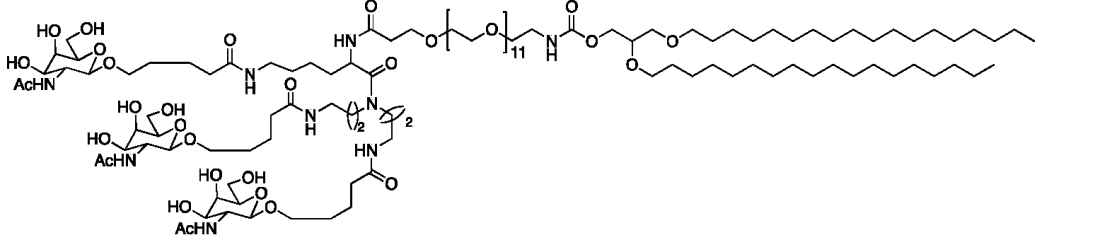
| DC67443 | GalNAc Lipid 1002 Featured |
GalNAc Lipid 1002 is a trivalent GalNAc-lipid conjugate designed for ASGPR-mediated hepatic delivery. It features a lysine-based scaffold covalently linked to three GalNAc moieties via a 12-unit PEG spacer, anchored by a 1,2-O-dioctadecyl-sn-glyceryl (DSG) lipid tail.
More description
|
|
| DC67408 | Galnac Lipid 29 Featured |

|
|
| DC67409 | Galnac Lipid 83 Featured |
Galnac Lipid 83 is developed by Prime Medicine Patent: WO2024220807.Galnac Lipid 83 83 is a GalNAc-conjugated lipid designed for targeted liver delivery. It features a triantennary GalNAc ligand linked via a PEG spacer (e.g., -(CH2CH2O)n-) to a branched hydrophobic tail (C18 alkyl chains). The structure includes amide/ester bonds for stability and a stereospecific configuration (R/S) to optimize ASGPR receptor binding. Integrated into lipid nanoparticles (LNPs), it enhances hepatic uptake of nucleic acids (e.g., mRNA, gene editors) by leveraging ASGPR-mediated endocytosis. Its design balances hydrophilicity (PEG) and lipophilicity (alkyl chains) for efficient encapsulation and in vivo delivery, supporting therapeutic applications in liver-specific gene editing or RNA therapies.
More description
|

|
| DC66648 | CP-LC-1143 |
Lipid CP-LC-1143 is an ionizable cationic amino lipid derived from homocysteine, a naturally occurring amino acid. This lipid has demonstrated an efficient delivery and high protein expression of different kinds of RNA (mRNA, cRNA and saRNA) in vivo, with no signs of toxicity.
More description
|

|
| DC65620 | cKK-E15 |
cKK-E15 is an ionizable cationic lipid and a derivative of cKK-E12 that has been used in the generation of lipid nanoparticles (LNPs).1 LNPs containing cKK-E15 and encapsulating Cre mRNA induce the expression of Cre in Kupffer cells, endothelial cells, and hepatocytes in Ai14 mice engineered to express the fluorescent protein tdTomato upon translation of Cre.
More description
|

|
| DC65622 | 306Oi9-cis2 |
306Oi9-cis2 is an ionizable cationic lipid.
WARNING This product is not for human or veterinary use.
More description
|

|
| DC65623 | Lipid AX4 |
Lipid AX4 is an ionizable cationic lipid (pKa = 6.89) that has been used in the formation of lipid nanoparticles (LNPs) for the delivery of mRNA in vivo.
More description
|

|
| DC65439 | LNP Lipid-6 |
LNP Lipid-6 (Compound Lipid 5) is an ionizable lipid (amino lipid). LNP Lipid-6 can be used to prepare lipid nanoparticles (LNP).
More description
|

|
| DC65437 | LNP Lipid-2 |
LNP Lipid-2 is a lipid product can be used to deliver agents.
More description
|

|
| DC65438 | SM-102 Analog 2(Compound 8-8) |
SM-102 Analog 2(Compound 8-8) is a lipid compound. SM-102 Analog 2(Compound 8-8) is involved in the synthesis of lipid nanoparticles compositions. SM-102 Analog 2(Compound 8-8) has potential applications in the transportation of biologically active substances.
More description
|

|
| DC60215 | Moderna Lipid 29 Featured |
Lipid 29 is an ionizable amino lipid (pKa = 6.91) from Moderna platform that has been used in combination with other lipids in the formation of lipid nanoparticles (LNPs).Administration of human erythropoietin (EPO) mRNA in lipid 29-containing LNPs increases serum EPO levels in mice.
More description
|

|
| DC60579 | Lipid B3 Featured |
Lipid B3 is a biodegradable ionizable lipid for liver targeted delivery. Lipid B3-LNP shows high delivery efficacy and low toxicity in delivering RNA to liver cells.
More description
|

|
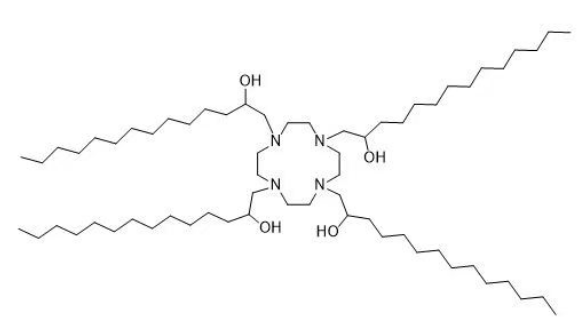
| DC60842 | Lipid H7T4-4 Featured |
H7T4-4 is an ionizable lipid designed for mRNA delivery via lipid nanoparticles (LNPs). It features a cyclic amine headgroup (derived from cyclen tetrahydrochloride) and four C14 hydrophobic alkyl tails, synthesized through a Michael addition reaction between cyclen and 1,2-epoxytetradecane. With a high transition temperature (Tm = 58.6°C) due to strong intermolecular interactions from its cyclic headgroup and multi-tail structure, H7T4-4 alone forms rigid aggregates incompatible with mRNA encapsulation. However, when blended with low-Tm helper lipids (e.g., DOPE, Tm = -16°C), the system’s overall Tm decreases, enabling stable LNP formation. Optimized formulations (20% H7T4-4, 41% DOPE, 38% cholesterol, 1% DMG-PEG) exhibit efficient mRNA encapsulation (>90%) and transfection. Structural analyses (SAXS, cryo-TEM) confirm monodisperse LNPs with lamellar/hexagonal phases. In vivo, H7T4-4 LNPs show tumor-targeted and intranasal mRNA delivery with reduced off-target accumulation compared to SM-102-based LNPs. This rational design highlights Tm-guided helper lipid selection to overcome rigidity challenges in ionizable lipids.
More description
|
|
| DC60800 | 18-2-9b2 Featured |
18-2-9b2 is a dendron-like degradable ionizable lipid which facilitates mRNA delivery to splenic macrophages. 18-2-9b2 LNP encapsulating therapeutic BTB domain and CNC homologue 1 (BACH1) mRNA exhibited proficient BACH1 expression and subsequent Spic downregulation in splenic red pulp macrophages (RPM) in a Spic-GFP transgene model.
More description
|

|
| DC41043 | NT1-O12B Featured |
NT1-O12B, an endogenous chemical and a neurotransmitter-derived lipidoid (NT-lipidoid), is an effective carrier for enhanced brain delivery of several blood-brain barrier (BBB)-impermeable cargos. Doping NT1-O12B into BBB-impermeable lipid nanoparticles (LNPs) gives the LNPs the ability to cross the BBB. NT-lipidoids formulation not only facilitate cargo crossing of the BBB, but also delivery of the cargo into neuronal cells for functional gene silencing or gene recombination.
More description
|

|
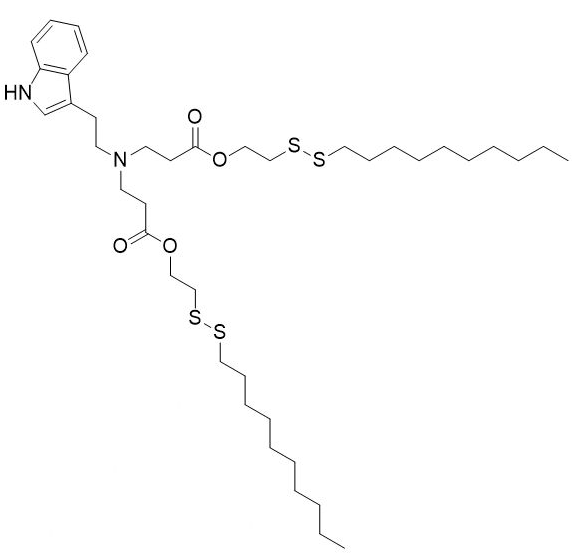
| DC60212 | NT1-O14B Featured |
NT1-O14B is a tryptamine-containing cationic lipidoid.1 It has been used in combination with other lipids in the formation of lipid nanoparticles (LNPs). Intravenous administration of LNPs containing NT1-O14B and encapsulating antisense nucleotides against tau decreases tau brain levels in mice.
More description
|
|
| DC60499 | C14-A1 Featured |
Lipid C14-A1 is an ionizable lipid. C14-A1-LPN is a potent and safe LNP platform to deliver Foxp3 mRNA to CD4+ T cells to engineer immunosuppressive FP3T cells.
More description
|

|
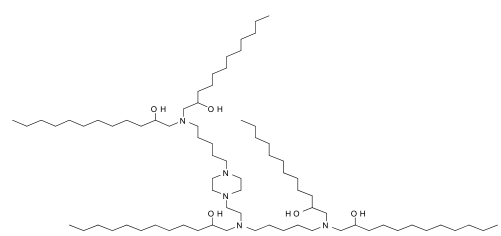
| DC60503 | C12-A1 Featured |
Lipid C12-A1 is an ionizable lipid. C12-A1-LPN is a potent and safe LNP platform to deliver Foxp3 mRNA to CD4+ T cells to engineer immunosuppressive FP3T cells. C12-A1 has a slightly lower average cell viability than C14-A1.
More description
|
|
| DC67120 | YSK12-C4 (YSK12-MEND) Featured |
YSK 12C4 is an ionizable cationic lipid primarily used to enhance siRNA cellular delivery via multifunctional envelope-type nanodevices (MEND). YSK 12C4 promotes siRNA uptake and endosomal escape, effectively silencing genes in human immune cell lines.
More description
|

|
| DC59010 | C14-4 Featured |
C14-4 (C14-494,Lipid B-4,Lipid B4) is a novel ionizable lipid with the highest T-cell transfection efficiency and low cytotoxicity.The C14-4 ionizable lipid has been explored for CAR-T therapy.To screen the excellent formulations for mRNA delivery, a
lipid library of 24 ionizable lipids was constructed to make
iLNPs, which were used to deliver luciferase mRNA into
Jurkat cells.[115] The optimal iLNPs formulation was C14-4
iLNPs (C14-4 ionizable lipid, DOPE, chol, and PEG at a molar
ratio of 35%, 16%, 46.5%, and 2.5%) (Figure 6c). The optimal
dose of luciferase mRNA for C14-4 iLNPs was 30 ng.
Compared with electroporated CAR T cells, the CAR T cells engineered
via C14-4 iLNPs showed potent cancer-killing activity
when they were cocultured with Nalm-6 acute lymphoblastic leukemia
cells. To obtain a safer and more effective CAR mRNA
delivery vehicle, the orthogonal design provided 256 potential
formulations, and 16 representative iLNPs formulations were
evaluated.Through evaluating the safety, delivery efficiency,
and transfection efficiency of 16 iLNPs, the formulation B10
(C14-4 ionizable lipid, DOPE, chol, PEG at a molar ratio of
40%, 30%, 25%, and 2.5%) was screened out as the optimal performing formulation. The luciferase expression based on B10
formulation was increased threefold than the initial formulation.
Reducing the accumulation and clearance of iLNPs in the liver
can increase the expression of CAR mRNA in T cells, further
improving the therapeutic effect of CAR-T. Studies have shown
that cholesterol analogs can alter the mechanisms of intracellular
circulation and enhance the delivery of mRNA, which may be
related to the reduced recognition of iLNPs by the Niemann
Pick C1 (NPC1) enzyme.The addition of a hydroxyl
group to various locations in the cholesterol molecule can alter
the binding kinetics between the modified cholesterol and NPC1,
and reduced NPC1 recognition of cholesterol. The results
showed that replacement of 25% and 50% 7 α-hydroxycholesterol
for cholesterol in iLNPs improved mRNA delivery to
primary human T cells in vitro by 1.8-fold and twofold,
respectively.C14-4 is one of the ionizable lipids to efficiently deliver mRNA
to Jurkat cells or primary human T cells. It will effectively promote
the development of mRNA delivery by iLNPs for CAR-T
therapy.
More description
|

|
| DC82102 | PPZ-A10 Featured |
PPZ-A10 is an ionizable cationic lipid.It has been used in the generation of lipid nanoparticles (LNPs) for the delivery of siRNA and mRNA in vitro and in vivo. Intraperitoneal administration of LNPs containing PPZ-A10 and encapsulating an mRNA reporter preferentially accumulates in hepatic Kupffer cells and splenic macrophages in mice.
More description
|

|
| DC60605 | Lipid 119-23 Featured |
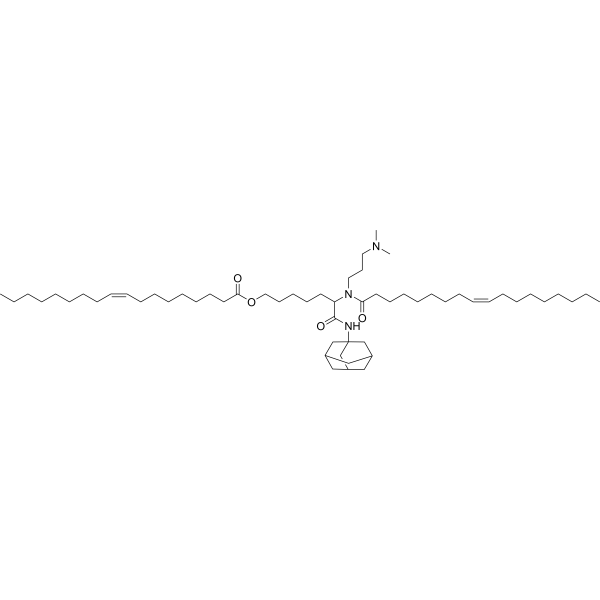
Lipid 119-23 is an ionizable lipid for mRNA delivery. 119-23 LNP exhibits an enhanced capability to express functional mCre in several categories of immune cells, spanning the liver, spleen and lung.
More description
|
|
| DC67213 | Acuitas Lipid II-10 Featured |
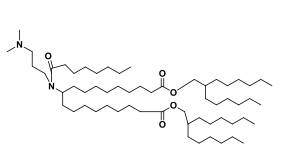
Acuitas II-10 is an novel ionizable amine lipid used for mRNA delivery from Acuitas Therapeutics patent WO2016176330A1
More description
|
|
| DC67523 | Moderna Lipid II-6 Featured |
|
|
| DC67215 | Acuitas Lipid III-7 Featured |
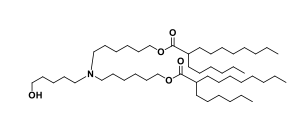
Acuitas Lipid III-7 is an novel ionizable amine lipid used for mRNA delivery from Acuitas Therapeutics patent US 10,166,298 B2.
More description
|
|
| DC153158 | ND-O1 (SM-86 Analog-2) Featured |
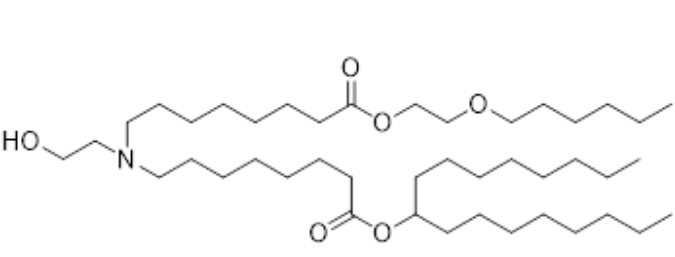
ND-O1 (SM-86 Analog-2) is a novel ionizable lipid designed to improve the delivery of siRNA via lipid nanoparticles (LNPs) for treating liver fibrosis. It is derived from SM-86 (structurally similar to SM-102, used in COVID-19 mRNA vaccines) but incorporates an ether bond within its hydrophobic tail, a first-of-its-kind modification aimed at enhancing delivery efficiency. In Vitro Efficiency: ND-O1 LNPs (LNP-O1) showed significantly higher siRNA transfection efficiency in activated fibroblasts compared to Lipid 5 LNPs (LNP-M). In Vivo Efficacy: In a CCl4-induced liver fibrosis mouse model, LNP-O1/siHSP47 (loaded with HSP47-targeting siRNA) reduced HSP47 expression by ~84%, threefold more effective than LNP-M. This led to a dramatic reduction in collagen deposition and marked improvement in liver fibrosis. Safety: The ether bond modification did not introduce additional toxicity, maintaining biocompatibility. ND-O1 represents a breakthrough in ionizable lipid design, demonstrating that strategic placement of ether bonds in hydrophobic tails can enhance LNP performance without compromising safety. Its success highlights its potential for clinical translation in RNA-based therapies for liver fibrosis and other hepatic diseases.
More description
|
|
| DC60793 | LUMI6 Featured |
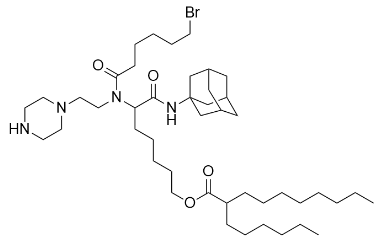
The LUMI-6 lipid, autonomously designed via the LUMI-lab platform, is a brominated ionizable lipid optimized for mRNA delivery. Formulated at a molar ratio of 35:28:34.5:2 (LUMI-6:DOTAP:cholesterol:C14-PEG2000), LNPs exhibit uniform physicochemical properties, including a hydrodynamic diameter of ~80 nm, polydispersity index (PDI) <0.2, and robust mRNA encapsulation efficiency. In vitro, LUMI-6 LNPs demonstrated 1.8-fold higher transfection potency in human bronchial epithelial cells compared to its debrominated counterpart (LUMI-6D), with minimal cytotoxicity confirmed by CCK-8 assays. In vivo, pulmonary delivery of CRISPR-Cas9 mRNA via LUMI-6 LNPs achieved 20.3% gene editing efficiency in murine lung epithelial cells, surpassing SM-102 (Moderna’s clinical benchmark) and demonstrating preferential tropism for lung epithelium over endothelial cells—critical for inhaled therapies targeting cystic fibrosis and surfactant disorders. The brominated tail enhances endosomal escape through optimized protonation dynamics, though explicit pKa values remain unmeasured. Synthesized via high-throughput combinatorial chemistry and refined through AI-driven active learning, LUMI-6 combines scalable production with organ-selective delivery, positioning it as a transformative platform for pulmonary nucleic acid therapeutics.
More description
|
|
| DC67214 | Acuitas II-12 Featured |
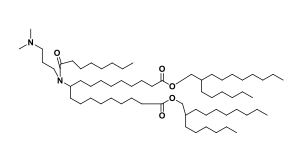
Acuitas II-12 is an novel ionizable amine lipid used for mRNA delivery from Acuitas Therapeutics patent WO2016176330A1
More description
|
|
| DC67219 | Lipid 29 analogue-3 Featured |
Lipid 29 analogue-3 is an ionizable lipid designed for the delivery of RNA-based therapeutics, such as mRNA or siRNA.
More description
|
|