To enhance service speed and avoid tariff delays, we've opened a US warehouse. All US orders ship directly from our US facility.
| Cat. No. | Product Name | Field of Application | Chemical Structure |
|---|---|---|---|
| DC67797 | 5-((14-amino-3,6,9,12-tetraoxatetradecyl)amino)-2-(2,6-dioxopiperidin-3-yl)isoindoline-1,3-dione Featured |
amino)-2-(2,6-dioxopiperidin-3-yl)isoindoline-1,3-dione.gif)
|
|
| DC67801 | 6-amino-N-(2-(2,6-dioxopiperidin-3-yl)-1-oxoisoindolin-4-yl)hexanamide Featured |
-1-oxoisoindolin-4-yl)hexanamide.gif)
|
|
| DC67800 | 5-[(4-aminobutyl)amino]-2-(2,6-dioxo-3-piperidinyl)-1H-Isoindole-1,3(2H)-dione, Featured |
amino]-2-(2,6-dioxo-3-piperidinyl)-1H-Isoindole-1,3(2H)-dione,.gif)
|
|
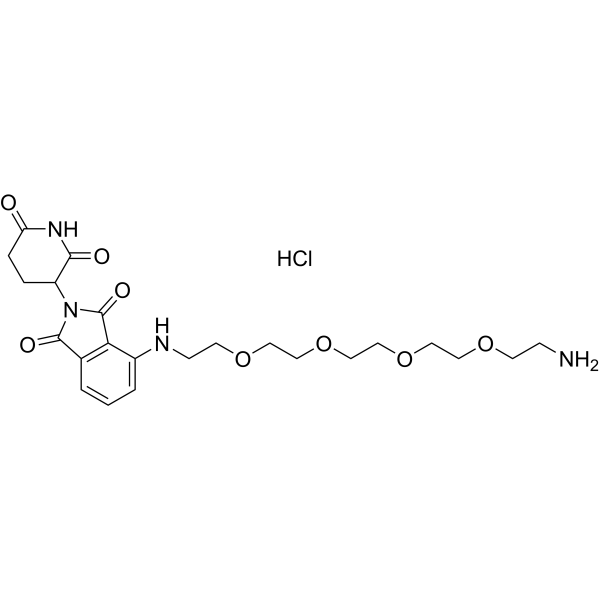
| DC67802 | Pomalidomide-PEG4-C2-NH2 hydrochloride Featured |
Pomalidomide-PEG4-C2-NH2 hydrochloride is a synthesized E3 ligase ligand-linker conjugate that incorporates the Pomalidomide based cereblon ligand and 4-unit PEG linker used in the synthesis of PROTACs.
More description
|
|
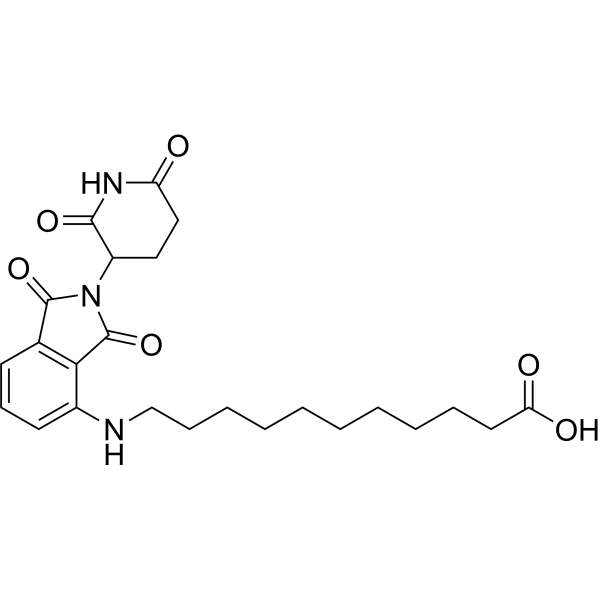
| DC67803 | Thalidomide-NH-C10-COOH Featured |
Thalidomide-NH-C10-COOH (compound 6b) is a synthesized E3 ligase ligand-linker conjugate that incorporates the Thalidomide based CRBN ligand and a linker used in PROTAC technology.
More description
|
|
| DC67806 | Thalidomide-5-NH-PEG2-C2-COO(t-Bu) Featured |
.gif)
|
|
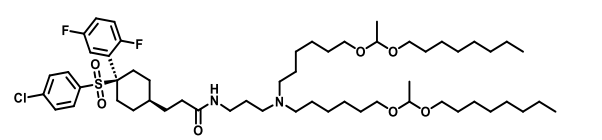
| DC68216 | Lipid CA2d Featured |
CA2d is an ionizable lipid developed for systemic mRNA delivery to the central nervous system. Its architecture combines an MK-0752-derived CNS-accessing moiety, a short three-carbon diamine spacer, a tertiary ionizable amine, and two acetal-containing hydrophobic tails. When formulated with DOPE, cholesterol and DMG-PEG2000, CA2d LNPs crossed the blood-brain barrier through caveolae- and γ-secretase-associated transcytosis and delivered mRNA to neurons, astrocytes, microglia and brain endothelial cells. Following intravenous administration of FLuc mRNA at 0.5 mg/kg in mice, CA2d produced 16.6-fold higher brain expression than MC3 and 8.6-fold higher expression than SM-102 at 6 hours. CA2d was further evaluated in repeated brain-cell transfection studies, a pilot rhesus macaque experiment and a tPA-modified TGF-β1 mRNA formulation for ischemic stroke. These results support CA2d as a promising preclinical research lipid for investigating non-viral CNS mRNA delivery; it has not been clinically validated.
More description
|
|
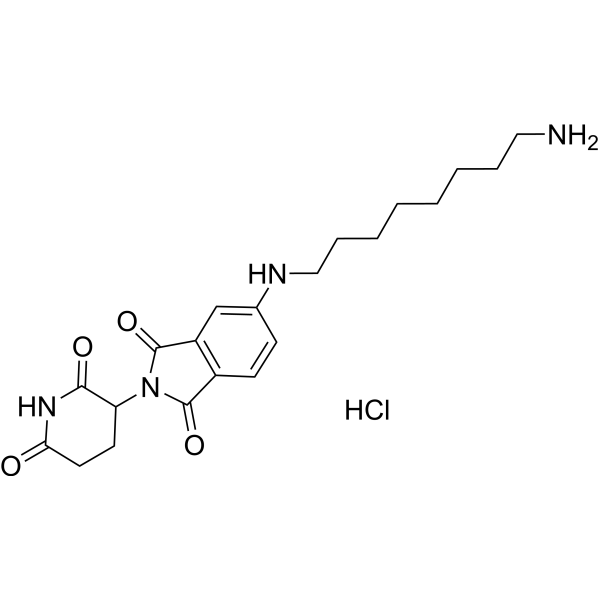
| DC67809 | Pomalidomide-5-C8-NH2 hydrochloride Featured |
Pomalidomide-5-C8-NH2 hydrochloride is the Pomalidomide (HY-10984)-based cereblon (CRBN) ligand used in the recruitment of CRBN protein.
More description
|
|
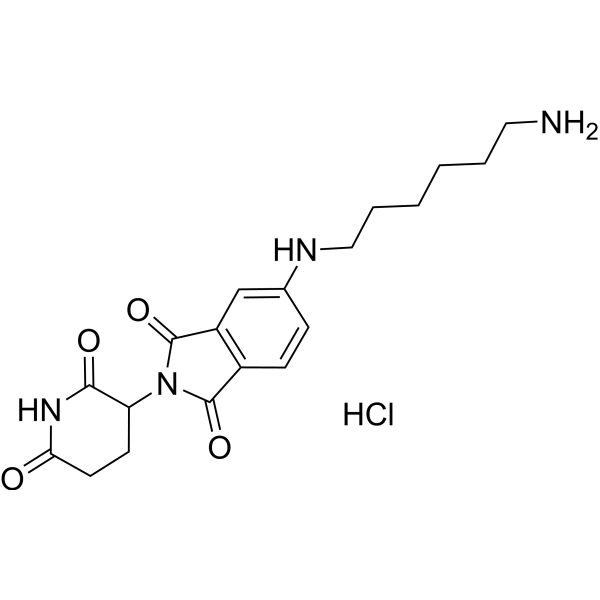
| DC67811 | Pomalidomide-5-C6-NH2 hydrochloride Featured |
Pomalidomide-5-C6-NH2 hydrochloride is the Pomalidomide (HY-10984)-based cereblon (CRBN) ligand used in the recruitment of CRBN protein.
More description
|
|
| DC48434 | TD-165 Featured |
TD165(TD 165) is a PROTAC-based cereblon (CRBN) degrader that degrads Cav1.2α with the DC50 of 20.4 nM, comprising a cereblon (CRBN) ligand binding group, a linker and an von Hippel-Landau (VHL) binding group.
More description
|

|
| DC42025 | Temporin L Featured |
Temporin L is a potent antimicrobial peptide and is active against Gram-negative bacteria and yeast strains. Temporin L also has antiendotoxin properties.
More description
|

|
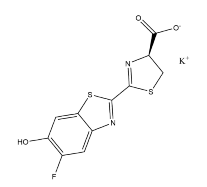
| DC67815 | 5-fluoro-D-Luciferin potassium salt Featured |
5-fluoro-D-Luciferin potassium salt is a derivative of D-Luciferin potassium salt. Its biological activity and main applications are similar to those of D-Luciferin potassium salt.
More description
|
|
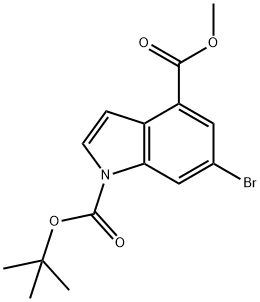
| DC67820 | 6-Bromo-indole-1,4-dicarboxylic acid 1-tert-butyl ester 4-methyl ester Featured |
|
|
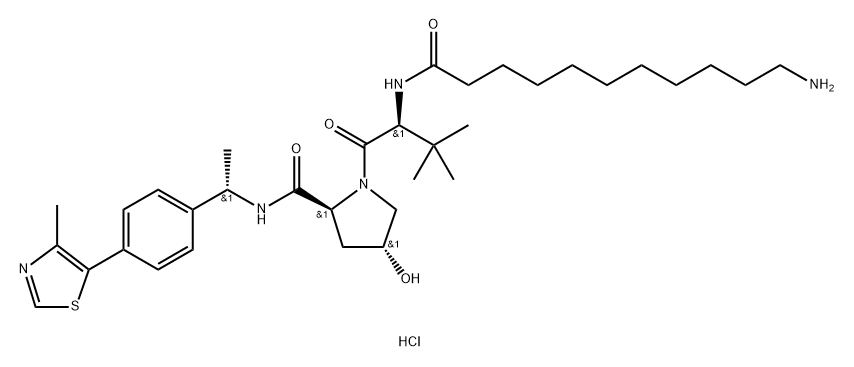
| DC67824 | (S,R,S)-AHPC-Me-C-10-NH2 hydrochloride,(S,R,S) AHPC Me C10 NH2 hydrochloride,(S,R,S)AHPCMeC10NH2 hydrochloride Featured |
|
|
| DC67825 | Undecanamide, 11-amino-N-[2-(2,6-dioxo-3-piperidinyl)-2,3-dihydro-1-oxo-1H-isoindol-4-yl]- Featured |
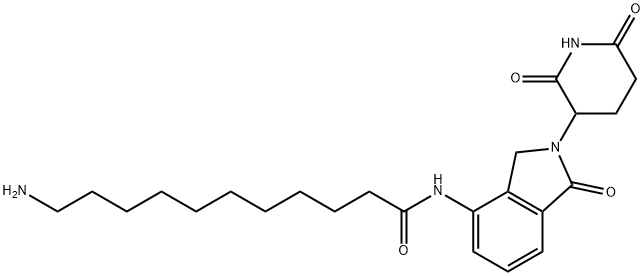
|
|
| DC67829 | 1-(Boc-L-tert-leucinyl)-(4S)-4-hydroxy-D-proline Featured |
-(4S)-4-hydroxy-D-proline.gif)
|
|
| DC67834 | 1H-Thieno[2,3-e]-1,4-diazepine-3-acetic acid, 5-(4-chlorophenyl)-2,3-dihydro-6,7-diMethyl-2-oxo-, 1,1-diMethylethyl ester, (3S)- Featured |
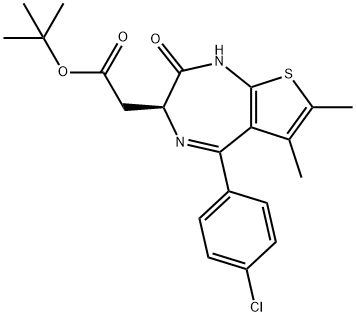
|
|
| DC67831 | 2-(aminomethyl)-5-(4-methylthiazol-5-yl)phenol hydrochloride Featured |
-5-(4-methylthiazol-5-yl)phenol hydrochloride.gif)
|
|
| DC67837 | (S)-3-Amino-piperidine-2,6-dione hydrochloride Featured |
-3-Amino-piperidine-2,6-dione hydrochloride.gif)
|
|
| DC67842 | Tert-butyl 4-(4-aMino-3-Methoxyphenyl)piperazine-1-carboxylate Featured |
piperazine-1-carboxylate.gif)
|
|
| DC67843 | 6-hydroxy-1-isopropyl-1H-pyrazolo[3,4-b]pyridine-4-carboxylic acid Featured |
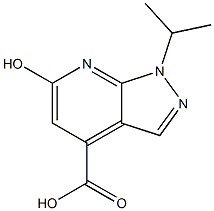
|
|
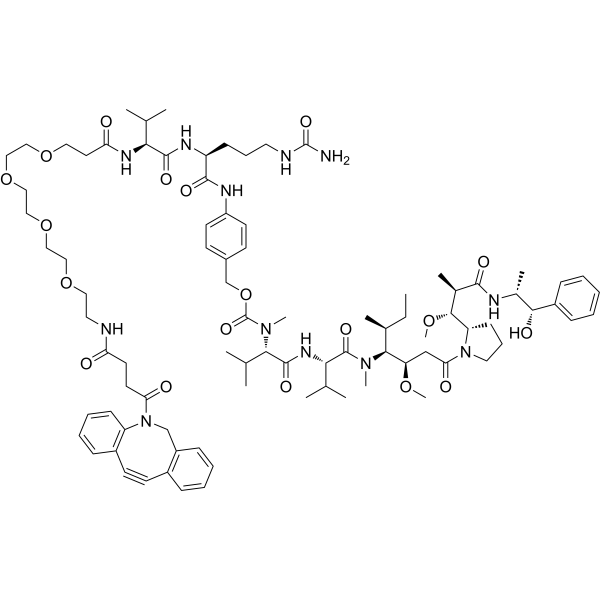
| DC67846 | DBCO-PEG4-VC-PAB-MMAE Featured |
DBCO-PEG4-VC-PAB-MMAE consists a ADC linker (DBCO-PEG4-VC-PAB) and a tubulin polymerization inhibitor MMAE (HY-15162). DBCO-PEG4-VC-PAB-MMAE can be used in the synthesis of antibody-agent conjugates (ADCs). MMAE is a synthetic derivative of dolastatin 10 and functions as a potent mitotic inhibitor by inhibiting tubulin polymerization. DBCO-PEG4-VC-PAB-MMAE is a click chemistry reagent, it contains a DBCO group that can undergo strain-promoted alkyne-azide cycloaddition (SPAAC) with molecules containing Azide groups.
More description
|
|
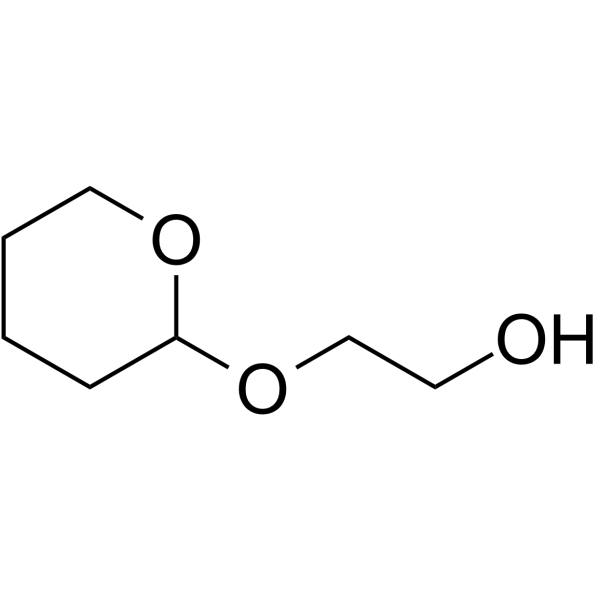
| DC44664 | THP-PEG1-alcohol Featured |
THP-PEG1-alcohol is a PEG-based PROTAC linker that can be used in the synthesis of PROTACs.
More description
|
|
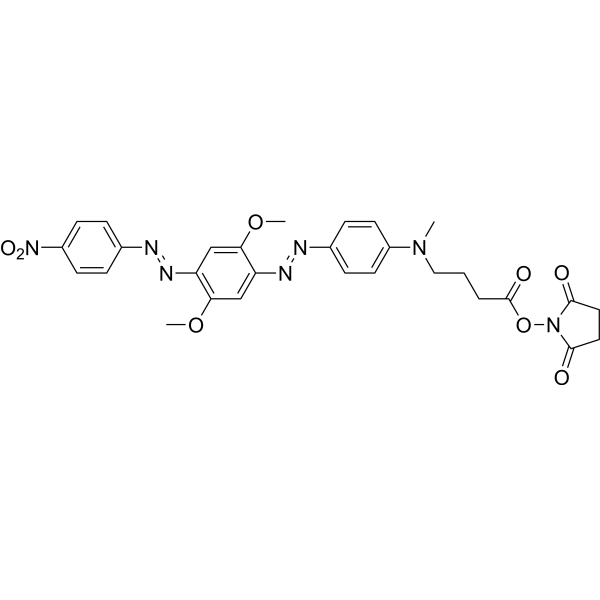
| DCC0967 | HCQ-2 NHS Featured |
HCQ-2 NHS is a dark quencher with no native emission due to the polyaromatic-azo backbone and a terminal NHS ester. UBHQ-2 NHS has a wide and intense quenching range from 560-670 nm, which makes it useful as an acceptor in fluorescence resonance energy transfer (FRET) applications in conjunction with orange to far-red emitting dyes. The NHS ester can be applied to label the primary amines (-NH2) of proteins, amine-modified oligonucleotides, and other amine-containing molecules.
More description
|
|
| DC70526 | JP-11646 Featured |
JP-11646 is a novel potent, selective, non-ATP competitive Pim2 inhibitor with IC50 of 0.5/1/24 nM for Pim2/3/1, respectively; shows less potency for other kinases in a kinase selectivity panel; exhibits 4-760-fold greater suppression of MM proliferation and viability than ATP-competitive PIM inhibitors; significant reduces tumor burden and increases median survival in xenogeneic myeloma murine models.
More description
|

|
| DC67664 | Allopole prodrug moiety Featured |
Allopole prodrug moiety is the prodrug form of Allopole.
More description
|

|
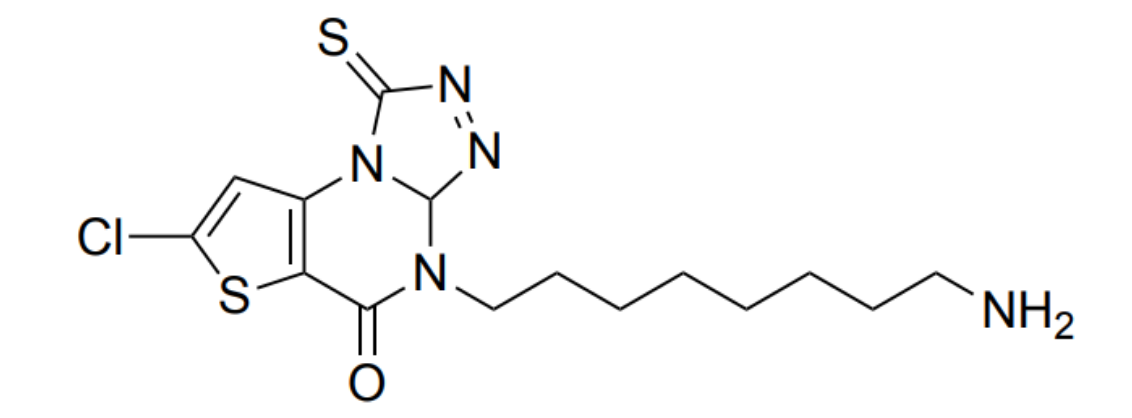
| DC67665 | Allopole-A-octyl diamine derivative Featured |
Allopole-A-octyl diamine derivative is the prodrug of Allopole-A.
More description
|
|
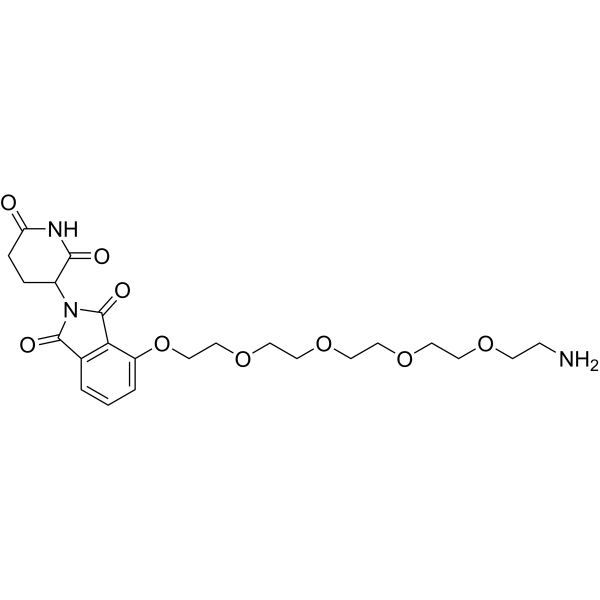
| DC67753 | Thalidomide-O-PEG4-amine Featured |
Thalidomide-O-PEG4-amine is a synthesized E3 ligase ligand-linker conjugate that incorporates the Thalidomide based cereblon ligand and a linker used in PROTAC technology.
More description
|
|
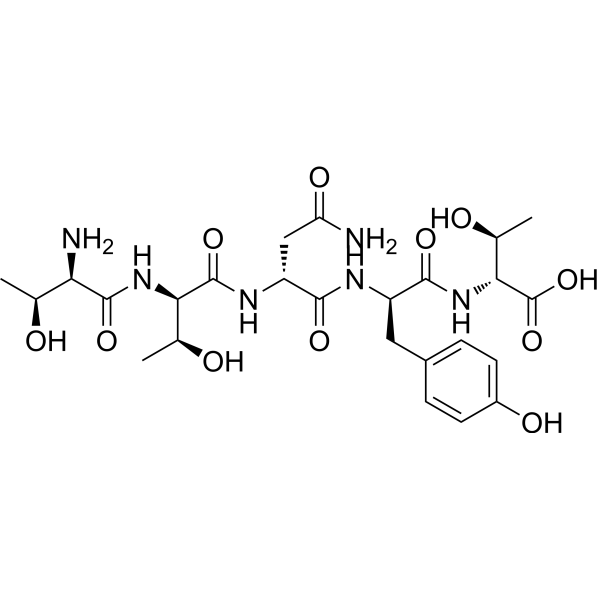
| DC73404 | RAP-103 Featured |
RAP-103 is an orally active, stabilized pentapeptide analog of DAPTA (D-ala-peptide T-amide), and multi-chemokine receptor antagonist.
More description
|
|
| DC67991 | Lenalidomide-acetamido-O-PEG3-C2-azide Featured |

|