To enhance service speed and avoid tariff delays, we've opened a US warehouse. All US orders ship directly from our US facility.
| Cat. No. | Product Name | Field of Application | Chemical Structure |
|---|---|---|---|
| DC53048 | HST5040 Featured |
HST5040 is a clinical candidate for the treatment of propionic acidemia (PA) and methylmalonic acidemia (MMA) with EC50 of 0.94 μM in P-CoA-lowering activity.
More description
|

|
| DC65341 | [18F]PSMA-1007 Featured |
[18F]PSMA-1007, a positron emission tomography (PET) tracer, specifically targets prostate-specific membrane antigen (PSMA), which is highly expressed in prostate cancer. PSMA-PET is effective especially for regional detection of biochemical recurrence, which significantly affects patient management. Herein, we established and optimized a one-step radiolabeling protocol to separate and purify [18F]PSMA-1007 with a CFN-MPS200 synthesizer for clinical application.
More description
|

|
| DC60481 | SC9 Featured |
SC9 is an uncompetitive inhibitor of WT dynamin-related protein 1 (Drp1) with IC50 of 270 nM. SC9 completely prevents the LPS-induced decline in cells with fused mitochondria.
More description
|

|
| DC70634 | N8279 Featured |
N8279 (NCATS-SM8864) is a selective, brain-penetrant small molecule Gαq-biased GHSR1a agonist with binding IC50 of 1.3 uM.N8279 is nearly an order of magnitude (8.9-fold) more potent than the endogenous ligand ghrelin and is a full agonist.iCa2+ EC50 of N8279 is 41-fold more potent than its GHSR1a binding IC50, suggesting possible allosteric activity, which could be competitively inhibited by GHSR1a antagonists YIL781 and JMV2959.N8279 is a weak activator of GHSR1a-mediated, βarr2-dependent cellular responses relative to ghrelin.N8279 requires receptor sites and/or conformational states driven by the GHSR1a ECD that are distinct from ghrelin.N8279 is brain-penetrant and attenuates aberrant DAergic behavior in mice.
More description
|

|
| DC65480 | TPH104m Featured |
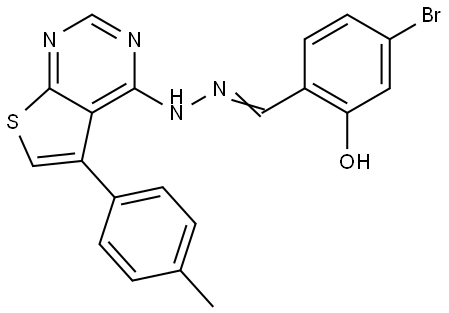
|
|
| DC65489 | CRCD2 Featured |
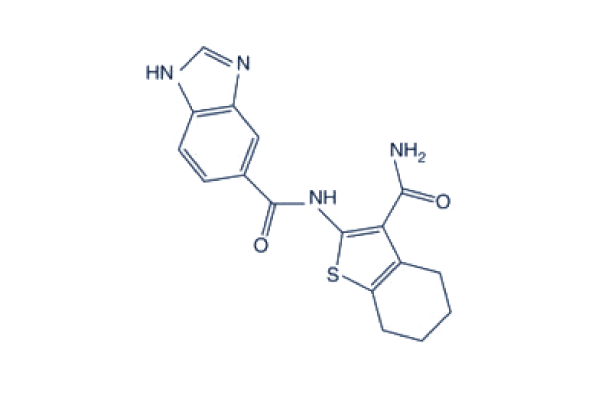
CRCD2 is an NT5C2 (cytosolic 5’ nucleotidase II) inhibitor with a kd of 70.9 μM. It enhances the cytotoxic effects of 6-MP and effectively reverses thiopurine resistance mediated by genetic and non-genetic mechanisms of NT5C2 activation in ALL.
More description
|
|
| DC65522 | Nico-52 Featured |
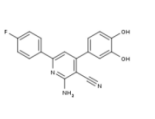
|
|
| DC70788 | SMN2 splicing modulator TEC-1 Featured |
SMN2 splicing modulator TEC-1 is a novel specific, CNS penetrant small molecule SMN2 splicing modulator, increases the expression level of FL-SMN2 mRNA and decreases the expression level of Δ7 mRNA.TEC-1 showed higher selectively (>60-fold) on galactosylceramidase and huntingtin gene expression compared to previously reported compounds (e.g., SMN-C3) due to off-target effects on cryptic exon inclusion and nonsense-mediated mRNA decay.TEC-1 modulates SMN2 splicing and displays disease-modifying effects in motor neurons derived from SMA patient iPSCs (GM24468).|TEC-1 rescues the phenotype in a murine model of spinal muscular atrophy (SMA).
More description
|

|
| DC70373 | DX314 Featured |
DX314 is a potent, specific CYP26B1 inhibitor with IC50 of 108 nM, >15-fold selectivity over CYP26A1.DX314 potentiates all-trans-RA (atRA) gene expression effects in healthy and diseased reconstructed human epidermis (RHE).DX314 potentiates the effects of atRA on the expression and localization of keratin 10 (KRT10), protects barrier function in RHE.DX314 reduces comedonal number, induces epidermal thickening, and increases comedonal profile, while having no effect on transepidermal water loss (TEWL) in treated rhino mice.
More description
|

|
| DC60491 | C11-MRTX Featured |
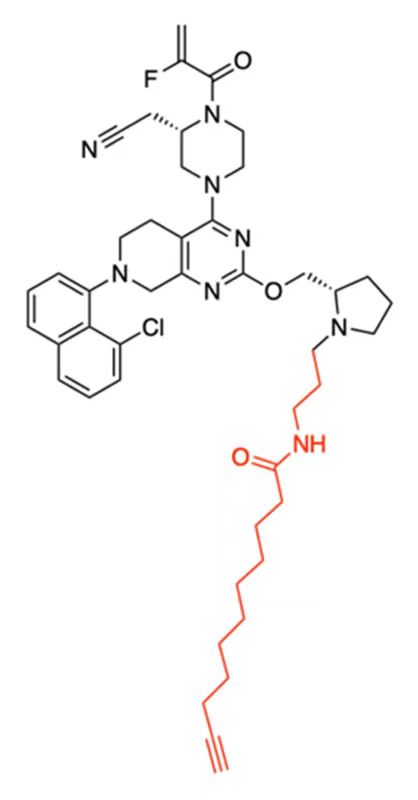
C11-MRTX is a lipid-conjugated MRTX849 analogue with a 11-carbon tail. C11-MRTX is a nonaggregating potent cellular inhibitor of K-Ras(G12C).
More description
|
|
| DC70372 | DX308 Featured |
DX-308 is a potent, selective dual CYP26A1/B1 inhibitor and retinoic acid metabolism blocking agent.DX308 does not interact with off‐target nuclear receptors or CYP450s, is not genotoxic, and is stable in skin, despite vigorous hepatic metabolism.Topical DX308 induces comedolysis and epidermal thickening without apparent adverse effects in vivo.DX308 shows potent modulation of retinoid‐responsive genes by DX308 in both healthy and keratinization disorder keratinocytes (KCs).DX 308 may present an improved therapeutic alternative for the treatment of keratinization disorders and other retinoid‐responsive skin ailments.
More description
|

|
| DC70246 | BFL-1 inhibitor 4E14 Featured |
BFL-1 inhibitor 4E14 (4E14) is a potent, selective, covalent BFL-1 inhibitor that disrupt BH3-binding activity with IC50 of 1.3 uM, targets a unique C55 residue in the BFL-1 groove.4E14 blocks BFL-1 suppression of BAX-mediated mitochondrial apoptosis.
More description
|

|
| DC65676 | Fenretinide Glucuronide Monosodium Salt Featured |
Fenretinide Glucuronide Monosodium Salt, is the metabolite of Fenretinide (F250000), which is a synthetic retinoid deriverative, substances related to vitamin A. They are also shown to be used for the treatment of cancer, as well as in the treatment of cystic fibrosis, rheumatoid arthritis, acne, and psoriasis.
More description
|

|
| DC60504 | RCS-03-104-4 Featured |
RCS-03-104-4 is a cysteine-reactive JQ1 analogue, which potently induces BRD4 degradation with DC50 and Dmax of 79 nM and 71%, respectively. RCS-03-104-4 causes BRD4 degradation by inducing its proximity with the ubiquitin ligase activity of DCAF11.
More description
|

|
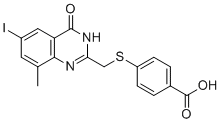
| DC70175 | AEP07 Featured |
AEP07 (AEP 07) is a selective small molecule inhibitor of PARP4 (vPARP) inhibitor with IC50 of 0.8 uM, >12-fold selective over other PARP family members.
More description
|
|
| DC70750 | Rv1625c agonist V-59 Featured |
Rv1625c agonist V-59 (V-59) is a specific small molecule agonist of the Mtb adenylyl cyclase Rv1625c, inhibits Mtb growth in macrophages (EC50=0.3 uM) in an Rv1625c-dependent mechanism.V-59 inhibits Mtb growth in cholesterol media (EC50 0.70 uM), but not in media containing the two-carbon fatty acid acetate, or in standard rich growth media.V-59 stimulates Rv1625c to produce cAMP, which is necessary for V-59 to inhibit Mtb growth.Chemically activating Rv1625c via V-59 preferentially inhibits cholesterol utilization in WT Mtb, rather than equally inhibiting all lipid utilization by the bacterium.
More description
|

|
| DC70417 | Foldamer 33 Featured |
Foldamer 33 is a small molecule HSP110 inhibitor, directly binds to the nucleotide-binding domain (NBD) of HSP110, blocks HSP110 chaperone function and colorectal cancer growth.Foldamer 33 significantly inhibit HSP110 anti-aggregating activity with IC50 of 87.8 uM.Foldamer 33 disrupts HSP110-STAT3 interaction with IC50 of 35.9 uM in competitive BLI assays.Foldamer 33 inhibits SW480 colorectal cancer cell proliferation, and (5 mg/kg) Foldamer 33 displays an anti-tumor effect (TGI of 40% and 60%) in mice bearing a colorectal cancer.
More description
|

|
| DC65699 | Mal-propyl-Ala-Ala-Asn-PAB Featured |
Mal-propyl-Ala-Ala-Asn(Trt)-PAB is a hetero bifunctional cross-linker, useful in antibody drug conjugation (ADC).
More description
|

|
| DC12314 | SLLK, Control Peptide for TSP1 Inhibitor(TFA) Featured |
SLLK, Control Peptide for TSP1 Inhibitor (TFA) is a control peptide for LSKL, which is a Thrombospondin (TSP-1) inhibitor.
More description
|

|
| DC20288 | (-)-CXL017 Featured |
(-)-CXL017 is a small molecule that has selective cytotoxicity toward MDR cancer cell lines in vitro, through inhibition of the sarco/endoplasmic reticulum Ca(2+)-ATPase (SERCA) with IC50 of 13.5 uM.
More description
|

|
| DC65704 | Mazdutide Featured |
Mazdutide (IBI-362; LY-3305677) is a long-acting synthetic oxyntomodulin analog. Mazdutide is also a glucagon-like peptide-1 (GLP-1R)/glucagon receptor GCGR co-agonist. Mazdutide has safety and tolerability, and it can be used for research in obesity and type 2 diabetes (T2D).
More description
|

|
| DC65664 | Palmitoyl tripeptide-38 Featured |
Palmitoyl tripeptide-38 is a bioactive peptide with anti-aging effect .
More description
|
.gif)
|
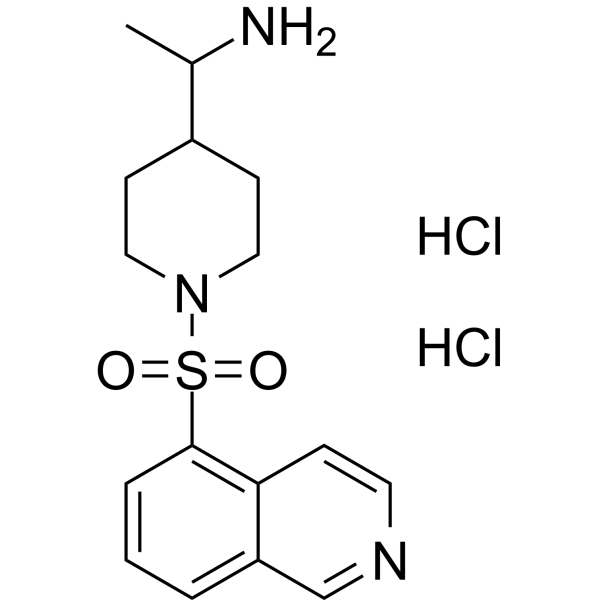
| DC65285 | Briciclib sodium Featured |
(Rac)-NRL-1049 is the racemic mixture of NRL-1049 (BA-1049 (free base)) (HY-162596). NRL-1049 is an orally available and selective ROCK2 inhibitor with IC50 values of 0.59 µM for ROCK2 and 26 µM for ROCK1, respectively. NRL-1049 modulates ROCK signaling, preserves blood-brain barrier integrity, reduces edema, seizures and hemorrhage, and alleviates cerebral cavernous malformation lesion burden. NRL-1049 can be used for the study of acute brain injury, ischemic stroke, and cerebral cavernous malformations.
More description
|
|
| DC28215 | A40926 Featured |
A40926, the precursor of Dalbavancin, is a second-generation glycopeptide antibiotic. A40926 inhibits gram-positive bacteria, and is very active against Neisseria gonorrhoeae.
More description
|
.gif)
|
| DC65139 | 7H-Pyrazolo[4,3-d]pyrimidin-7-one, 1,4-dihydro-5-methyl- (9CI) Featured |

|
|
| DC65521 | PTC-258 Featured |
PTC-258 2HCl is a specific and orally active splicing modulator of Elongator complex protein 1 gene (ELP1). PTC258 increases the expression of ELP1 in vitro and in vivo. PTC258 is well tolerated in mouse model.
More description
|

|
| DC50078 | (S,R,S)-AHPC-Me-C8-NH2 Featured |
(S,R,S)-AHPC-Me-C8-NH2 is a novel PROTAC building block.
More description
|
.png)
|
| DC50076 | (S,R,S)-AHPC-Me-C3-NH2 Featured |
(S,R,S)-AHPC-Me-C3-NH2 is a novel PROTAC building block.
More description
|
.png)
|
| DC50075 | (S,R,S)-AHPC-Me-C2-NH2 Featured |
(S,R,S)-AHPC-Me-C2-NH2 is a novel PROTAC building block.
More description
|
.png)
|
| DC50074 | (S,R,S)-AHPC-Me-C1-NH2 Featured |
(S,R,S)-AHPC-Me-C1-NH2 is a novel PROTAC Building block.
More description
|
.png)
|