To enhance service speed and avoid tariff delays, we've opened a US warehouse. All US orders ship directly from our US facility.
| Cat. No. | Product Name | Field of Application | Chemical Structure |
|---|---|---|---|
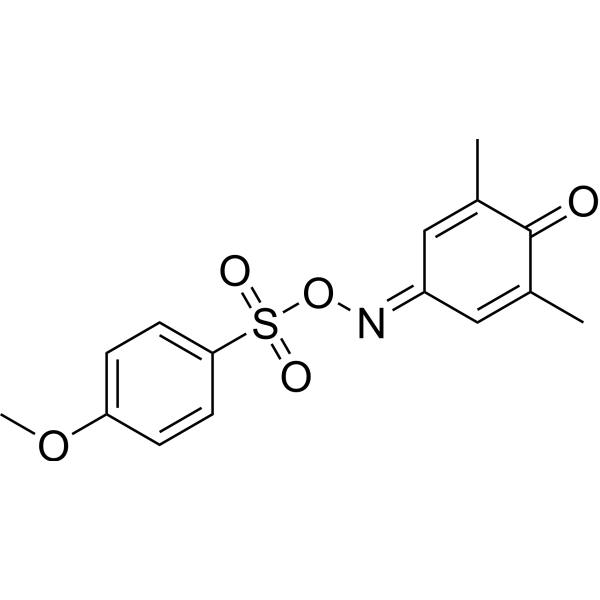
| DC8578 | L002(NSC764414) Featured |
L002 is a p300 inhibitor (IC50=1.98 μM) that inhibits p53 and histone acetylation. Suppresses STAT3 activation in vitro and suppresses tumor growth in some mouse cell lines.
More description
|
|
| DC81825 | JNJ-9350 |
JNJ-9350 is a chemical probe that inhibits spermine oxidase (SMOX) with an IC50 of 0.01 μM. This compound also shows inhibitory activity against polyamine oxidase (PAO), exhibiting an IC50 of 0.79 μM. JNJ-9350 has potential applications in cancer research.
More description
|

|
| DC81797 | ZY39 |
ZY39 is a SaClpP agonist. ZY39 promotes the enzymatic hydrolysis of SaClpP and HsClpP in vitro. ZY39 inhibits the growth of Staphylococcus aureus strains. ZY39 reduces the load of Staphylococcus aureus in organs and ascites in mouse peritonitis models and zebrafish infection models, and improves the survival rate of model animals. ZY39 can be used in studies related to Staphylococcus aureus infection, such as peritonitis.
More description
|
|
| DC81658 | TMLB-C16 |
TMLB-C16 is a potent and orally active B3GAT3 inhibitor with a KD of 3.962 μM. TMLB-C16 suppresses proliferation and migration, and induces cell cycle arrest and apoptosis in MHCC-97H (IC50 = 6.53 μM) and HCCLM3 cells (IC50 = 6.22 μM). TMLB-C16 inhibits tumor growth in both MHCC-97H and HCCLM3 xenograft tumor mouse models without causing obvious toxicity. TMLB-C16 can be used for hepatocellular carcinoma research.
More description
|
|
| DC81647 | TKP-5 |
TKP-5 is a PROTAC protein degrader targeting BRD4. TKP-5 can binds to BRD2, BRD3, BRD4 and BRDT, with Ka values of 150 nM, 100 nM and 150 nM for the first three proteins respectively. TKP-5 inhibits the production of thymic stromal lymphopoietin and suppresses the expression of IL-33 mRNA. TKP-5 is applicable to studies related to tape-stripping induced skin injury.
(Pink: Epigenetic Reader Domain ligand ; Blue: Cereblon ligand ; Black: linker).
More description
|
|
| DC81636 | Thalidomide-azetidine-COOH |
Thalidomide-azetidine-COOH is an E3 ligase ligand-linker conjugate containing a CRBN-based ligand and linker, which can be used to synthesize PROTAC.
More description
|
|
| DC81570 | STAT3-IN-53 |
STAT3-IN-53 (Compound L20) is a STAT3 inhibitor with a Kd value of 6.16 μM. STAT3-IN-53 binds directly to the SH2 domain of STAT3, inhibits phosphorylation at the Y705 site without affecting the total STAT3 protein level, and suppresses the IL-6/JAK/STAT3 pathway. STAT3-IN-53 downregulates the transcription and expression of cyclin-D1 and c-Myc. STAT3-IN-53 induces cell cycle arrest and promotes Apoptosis. STAT3-IN-53 exhibits anticancer activity against colorectal cancer.
More description
|
|
| DC81567 | ST1072 |
ST1072 is a dual inhibitor of CerS4 and CerS6. ST1072 significantly reduces the ability of murine T cells to proliferate and produce IFN-γ. ST1072 can be used for hematologic malignancies research.
More description
|
|
| DC81558 | Sodium Channel-IN-7 |
Sodium Channel-IN-7 (Example 59) is a NaV1.7 voltage-gated sodium channel inhibitor.Sodium Channel-IN-7 binds to the VSD4 binding pocket of NaV1.7, with reduced interaction with Try1537.Sodium Channel-IN-7 can be used for the research of pain.
More description
|
|
| DC81434 | RA190-PEG1-NH2 |
RA190-PEG1-NH2, RA190 derivative, is an E3 ligase ligand. RA190-PEG1-NH2 can be used to synthesis FKBP12 PROTAC degrader RAFKBP12.
More description
|
|
| DC81432 | R-130823 |
R-130823 is an orally active, highly selective p38α inhibitor with an IC50 of 22 nM against p38α, an IC50 of 820 nM against p38β, and no activity against p38γ or p38δ. R-130823 downregulates downstream cartilage degradation and inflammatory mediators, and inhibits the release of MMP-13, MMP-1 and PGE2. R-130823 reduces hind paw swelling, improves hyperalgesia, and blocks arthritis progression.\nR-130823 is applicable to research related to osteoarthritis and rheumatoid arthritis.
More description
|
|
| DC81431 | R06039-696 |
R06039-696 is a neuropeptide S receptor (NPSR) agonist with an EC50 of 91 nM. R06039-696 can participate in regulating various biological functions such as arousal, stress and anxiety responses, memory processes, and food intake by activating NPSR.
More description
|
|
| DC81377 | PROTAC HDAC3 degrader-1 |
PROTAC HDAC3 degrader-1 is a selective PROTAC degrader targeting HDAC3 with a DC50 of 30.73 nM. PROTAC HDAC3 degrader-1 induces degradation of HDAC3 via the ubiquitin-proteasome system. PROTAC HDAC3 degrader-1 promotes apoptosis, induces DNA damage, and downregulates anti-apoptotic proteins Mcl-1 and Bcl-xL. PROTAC HDAC3 degrader-1 can be used for the research of acute myeloid leukemia.
(Pink: HDAC3 ligand ; Blue: VHL ligand ; Black: linker).
More description
|
|
| DC81363 | PROTAC EZH2 Degrader-30 |
PROTAC EZH2 Degrader-30 (compound 67) is ais a PROTAC protein degrader targeting EZH2 with an IC50 of 6.22 μM against SU-DHL-6 cells. PROTAC EZH2 Degrader-30 can be used for the research of diffuse large B-cell lymphoma.
(Pink: EZH2 ligand ; Blue: MDM2 ligand ; Black: linker).
More description
|
|
| DC81317 | Premafloxacin |
Premafloxacin is a potent antimicrobial agent that exhibits activity against Staphylococcus aureus, Corynebacterium bovis, and Corynebacterium amylocolatum. Premafloxacin demonstrated potent antimicrobial activity against S. aureus by targeting topoisomerase IV, and is a poor substrate for NorA efflux pump. Premafloxacin can be used for antimicrobial research.
More description
|
|
| DC81271 | PF-07245303 |
PF-07245303 is a ITK/TRK inhibitor. PF-07245303 reduces the production of inflammatory cytokines such as IL-4 and IFNγ, and inhibits the phosphorylation of PLCγ1. PF-07245303 inhibits nerve growth factor-induced basophil activation and the phosphorylation of TRKA. PF-07245303 reduces oxazolone-induced ear swelling in mouse ear tissues. PF-07245303 is applicable to research related to atopic dermatitis.
More description
|
|
| DC81234 | PARP1/c-Met-IN-3 |
PARP1/c-Met-IN-3 (Compound L19) is a selective c-Met and PARP1 inhibitor, with an IC50 of 5.4 nM against c-Met and an IC50 of 3.7 nM against PARP1. PARP1/c-Met-IN-3 inhibits PARP2 enzymatic activity with an IC50 of 4.52 nM, and shows no specificity for PARP1 and PARP2. PARP1/c-Met-IN-3 induces cell cycle arrest and apoptosis. PARP1/c-Met-IN-3 exhibits anti-tumor activity against triple-negative breast cancer.
More description
|
|
| DC81226 | P53 mutant stabilizer-1 |
P53 mutant stabilizer-1 (compound 274) is a covalent mutant p53 stabilizer. P53 mutant stabilizer-1 can be used for the study of wild-type function of p53 mutants, such as cancers associated with p53 mutation.
More description
|
|
| DC81124 | NB-7 |
NB-7 (example 12) is a potent and orally active SARM1 inhibitor with an IC50 < 1 μM. NB-7 can be used for neurological disorders research.
More description
|
|
| DC81067 | MNK/PIM-IN-2 |
MNK/PIM-IN-2 is a Mnk/Pim kinase inhibitor with an IC50 of 32 nM for Mnk1, 3 nM for Mnk2, and 37 nM for Pim1. MNK/PIM-IN-2 reduces the levels of p-eIF4E and p-4EBP1. MNK/PIM-IN-2 induces cell cycle arrest, apoptosis (apoptosis) and exerts antiproliferative effects in leukemia cells. MNK/PIM-IN-2 can be used in studies related to leukemia.
More description
|
|
| DC81020 | ME 3407 |
ME-3407 (EF-4040) is a H+-K+-ATPase redistribution disruptor and myosin light chain kinase (MLCK) and protein kinase A inhibitor. ME-3407 blocks gastric acid secretion and aminopyrine accumulation by inhibiting microsomal-to-apical membrane redistribution of H+-K+-ATPase and suppressing MLCK-mediated myosin light chain phosphorylation. ME-3407 is promising for research of peptic ulcer.
More description
|
|
| DC80896 | KCNQ2 modulator-1 |
KCNQ2 modulator-1 is a KCNQ2 modulator.
More description
|
|
| DC80892 | JRC-I-191 |
JRC-I-191 is an anti-HIV-1 agent. JRC-I-191 inhibits HIV-1 YU-2 entry into cells. JRC-I-191 does not inhibit infection of cells by amphotropic murine leukemia virus. JRC-I-191 can be used for the research of HIV-1 infection.
More description
|
|
| DC80841 | Ikarisoside B |
Ikarisoside B is a potent and selective Organic cation transporter 1 (OCT1) inhibitor with an IC50 of 11.18 μM. Ikarisoside B shows selectivity over OCT2 (IC50 = 56.54 μM). Ikarisoside B can be used for the research of metabolic disease.
More description
|
|
| DC80769 | HD202A |
HD202A is an orally active, selective dual inhibitor of MNK1/MNK2 (with IC50 values of 6.09 nM and 8.06 nM, and Kd values of 1.913 μM and 5.244 μM, respectively) that inhibits the MNK-eIF4E signaling pathway. By downregulating perilipin 2 and SCD1, while upregulating adipose triglyceride lipase and PPARγ coactivator 1α, HD202A enhances mitochondrial fatty acid oxidation and redox homeostasis. HD202A effectively suppresses body weight gain, hepatic lipid accumulation and elevation of serum lipids, significantly improves glucose tolerance and insulin sensitivity of the organism, and ameliorates inflammatory features. With these comprehensive pharmacological activities, HD202A exhibits great application potential in studies of metabolic dysfunction-associated steatotic liver disease.
More description
|
|
| DC80726 | GPR119 agonist 4 |
GPR119 agonist 4 is a GPR119 agonist and oral glucose-lowering agent with a human GPR119 EC50 of 42 nM.GPR119 agonist 4 activates GPR119.GPR119 agonist 4 reduces blood glucose area under the curve in an oral glucose tolerance test.GPR119 agonist 4 exhibits improved clearance in liver microsomes.GPR119 agonist 4 can be used for the research of type 2 diabetes mellitus.
More description
|
|
| DC80660 | FKA-9i |
FKA-9i is an orally active anticancer agent. FKA-9i directly binds to and promotes the degradation of oncoproteins LRPPRC (kd: 7.387 μM), YBX1 (kd: 16.52 μM) and RPN1 (kd: 26.82 μM). FKA-9i inhibits the MAPK signaling pathway and mitochondrial oxidative phosphorylation. FKA-9i also induces cancer cell cycle arrest, apoptosis, mitochondrial dysfunction and ROS accumulation. FKA-9i can be used in the research of tumors such as gastric cancer.
More description
|
|
| DC80654 | FGFR3-IN-12 |
FGFR3-IN-12 is a selective fibroblast growth factor receptor 3 (FGFR3) inhibitor with an IC50 of 6.8 nM. FGFR3-IN-12 shows an IC50 of 19.2 nM against FGFR3V555M and an IC50 of 16.9 nM against TNK1 (Thirty-eight Negative Kinase 1). FGFR3-IN-12 inhibits cancer cells proliferation and induces caspase-mediated apoptosis. FGFR3-IN-12 exhibits antitumor activity in bladder cancer xenografts mice models. FGFR3-IN-12 can be used for the research of cancer, such as bladder cancer.
More description
|
|
| DC80422 | Chaperone complex ligand 1 |
Chaperone complex ligand 1 is a chaperone ligand for HSP90. Chaperone complex ligand 1 can be connected to the MET ligand by a linker to synthesis of MET degrader OZD-MET 01.
More description
|
|
| DC80369 | Carba1 |
Carba1 is a bifunctional Carbazole derivative that activates nicotinamide phosphoribosyltransferase (NAMPT) and enhances NAD biosynthesis. Carba1 binds to colchicine site of tubulin, enhancing the anti-tumor effect of various chemotherapy drugs, such as Paclitaxel. Carba1 exerts neuroprotective effect and can regulate cell energy metabolism. Carba1 can be used for the researches of cancer and chemotherapy-induced peripheral neuropathy (CIPN).
More description
|
|