To enhance service speed and avoid tariff delays, we've opened a US warehouse. All US orders ship directly from our US facility.
| Cat. No. | Product Name | Field of Application | Chemical Structure |
|---|---|---|---|
| DC81591 | T3SS-IN-6 |
T3SS-IN-6 is a thiazolidin-2-cyanamide derivative and type III secretion system (T3SS) inhibitor targeting Xanthomonas oryzae pv. oryzae (Xoo). T3SS-IN-6 exhibits no effect on Xoo growth. T3SS-IN-6 shows no measurable acute toxicity to silkworms and earthworms.
More description
|

|
| DC81394 | PROTAC SARS-CoV-2 Mpro degrader-8 |
PROTAC SARS-CoV-2 Mpro degrader-8 is an antiviral PROTAC degrader targeting the SARS-CoV-2 main protease (Mpro), with weak direct binding affinity to Mpro (Kd=80.5 μM). PROTAC SARS-CoV-2 Mpro degrader-8 exhibits broad-spectrum antiviral activity against SARS-CoV-2 and the human endemic coronavirus HCoV-OC43. It can be used for research on coronavirus infections.
(Pink: SARS-CoV Target protein ligand; Blue: VHL ligand ; Black: ).
More description
|
|
| DC81233 | Pantothenate kinase-IN-3 |
Pantothenate kinase-IN-3 is a PANK3-selective binder and CoA biosynthesis activator with a human PANK3 Ki of 9.1 nM, human PANK3 Ka of 1.8 nM, human PANK1β Ki of 113 nM, human PANK1β Ka of 23.4 nM, and oral effectiveness.Pantothenate kinase-IN-3 binds PANK3 via a water-mediated interaction between its sulfonamide NH and Gly193, elevates cellular, hepatic, and forebrain CoA levels, and shows improved metabolic stability in mouse and human microsomes.Pantothenate kinase-IN-3 has solubility properties favorable at pH 7.Pantothenate kinase-IN-3 can be used for the research of hepatic metabolic CoA deficiencies (acidemias).
More description
|
|
| DC80943 | Lazertinib mesylate hydrate |
Lazertinib (YH25448; GNS-1480) mesylate hydrate is an orally active, blood-brain barrier permeable third-generation EGFR tyrosine kinase inhibitor, as well as an ABCB1/ABCG2 inhibitor and a TRPA1 activator. Lazertinib mesylate hydrate exhibits IC50 values of 0.4 mM and 0.2 mM against human ABCB1 and ABCG2, respectively. By inhibiting mutant EGFR signaling, EGFR phosphorylation and the downstream ERK/AKT pathway, as well as upregulating surface expression of EGFR/MET, Lazertinib mesylate hydrate induces cell cycle arrest, apoptosis, spontaneous calcium responses, hyperexcitability of dorsal root ganglion (DRG) neurons, and TRPA1-dependent pain-like behaviors. Lazertinib mesylate hydrate competitively binds to the substrate-binding sites of ABCB1/ABCG2, stimulates their ATPase activity without altering their expression or plasma membrane localization, thereby enhancing ADCC activity, acting as a chemosensitizer, and reversing ABCB1-mediated multidrug resistance. It exerts antitumor activity as a single agent or in combination with other drugs. Lazertinib mesylate hydrate is applicable to research related to non-small cell lung cancer, multidrug-resistant cancers, and paresthesia.
More description
|
|
| DC80834 | IDH1 ligand 1 |
IDH1 ligand 1 (Compound 18) can serve as a negative control for the IDH1 target, with no detectable affinity for wild-type IDH1 and an IC50 >10,000 nM.
More description
|
|
| DC80542 | Dimefluthrin |
Dimefluthrin is an insecticide. Dimefluthrin exhibits contact toxicity against large red imported fire ant workers. Dimefluthrin undergoes horizontal transfer among red imported fire ant workers, causing secondary mortality in recipient workers. Dimefluthrin is a neurodevelopmental toxicant, which can reduces acetylcholinesterase activity, impairing neurotransmitter.
More description
|
|
| DC80200 | Androgen receptor degrader-6 |
Androgen receptor degrader-6 is a blood-brain barrier-permeable AR degrader. Androgen receptor degrader-6 inhibits the chaperone activity of HSP27 and disrupts the HSP27-AR complex. Androgen receptor degrader-6 promotes the degradation of wild-type and mutant AR, reduces AR protein levels, and inhibits the growth of glioblastoma cells. Androgen receptor degrader-6 can be used in glioblastoma research.
More description
|
|
| DC79976 | 10(Z)-Pentadecenoic acid methyl ester |
10(Z)-Pentadecenoic acid methyl ester is an unsaturated fatty acid methyl ester (FAME)。
More description
|
|
| DC80052 | 3-(Pyridin-2-yl)-1,2,4-triazole |
3-(Pyridin-2-yl)-1,2,4-triazole is a metal-organic framework (MOF).
More description
|

|
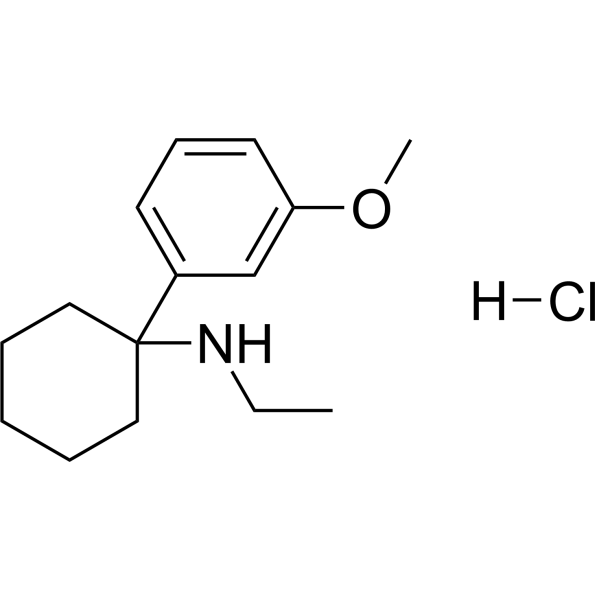
| DC76764 | 3-Methoxy PCE hydrochloride Featured |
3-Methoxy PCE (3-MEO PCE) hydrochloride is structurally classified as an arylcyclohexylamine and is an /b>NMDA receptor antagonist with a pKi value of 7.22.
More description
|
|
| DC79778 | L-703717 |
L-703717 is a NMDA receptor antagonist. L-703717 preferentially binds to cerebellar-specific NMDA receptors consisting of a GluRepsilon3 subunit and eventually accumulates in rodent cerebellum. L-703717 can be used for the research of neurological disease.
More description
|
|
| DC79713 | GPI-3000 |
GPI-3000 is a NMDA receptor antagonist. GPI-3000 can ameliorate metabolic injury and shows neuroprotective effect. GPI-3000 can be used for the researches of metabolic and neurological disease.
More description
|
|
| DC79707 | (S)-CPW 399 |
(S)-CPW 399 is a subtype-selective full agonist of AMPA receptors, with a 20-fold higher selectivity for GluA1 and GluA2 subunits over GluA3 and GluA4 subunits. (S)-CPW 399 can significantly increase the spontaneous firing rate (FR) of LC noradrenergic neurons by activating AMPA receptors containing GluA1 subunits. (S)-CPW 399 can be used for the study of neurological diseases.
More description
|
|
| DC79654 | Perfluoroheptanesulfonic acid |
Perfluoroheptanesulfonic acid (1-Perfluoroheptanesulfonic acid; Perfluoroheptanesulphonic acid) is a perfluoroalkyl substance (PFAS). PFHpS can induce malformations in zebrafish larvae (EC50=168.1 μM). It has also been found in landfill leachate, and fetal exposure to PFHpS can lead to reduced birth weight.
More description
|
|
| DC79622 | Besonprodil |
Besonprodil (CI-1041) is a potent NMDA antagonist.
More description
|
|
| DC79607 | 5-Chloro-1,4-dihydro-2,3-quinoxalinedione |
5-Chloro-1,4-dihydro-2,3-quinoxalinedione (Compound 72) is a weak NMDA inhibitor with an IC50 of 56.3 μM. 5-Chloro-1,4-dihydro-2,3-quinoxalinedione can be used for the research of neurological disease.
More description
|
|
| DC79472 | CGP 43487 |
CGP 43487 is a NMDA receptor antagonist. CGP 43487 significantly affects the gross structural characteristics of the developing dentate gyrus.
More description
|
|
| DC79415 | Perfluoroenanthic acid |
Perfluoroenanthic acid (Perfluoroheptanoic acid) is a type of perfluoroalkyl substance (PFAS) that can negatively impact the development of seminiferous tubules and m6A RNA methylation in the testes of offspring mice when exposed during pregnancy, consequently disrupting spermatogenesis and leading to reproductive toxicity. Perfluoroenanthic acid alters the morphology of dendritic spines and synaptic formation in primary cortical neuron cultures, enhancing neuronal activity and synaptic transmission, and increasing the expression of excitatory synapse-related proteins Synaptophysin and PSD95.
More description
|
|
| DC78867 | CP-283097 |
CP-283097 is a conformationally restricted and NR2B subtype-selective NMDA antagonist. CP-283097 efficiently competitively inhibits the binding of [³H]CP-101,606 to the rat meninges, with an IC50 value of 18 nM. CP-283097 exhibits nearly complete inhibition of the current mediated by the NR2B receptor (IC50 = 206 nM), while the inhibitory effect on the NR2A or NR2C receptors is very weak. CP-283097 demonstrates excellent central nervous system permeability and in vivo efficacy in animal models. CP-283097 can be used for neurological diseases related to excessive activation of NMDA receptors.
More description
|
|
| DC78841 | SGE-301 |
SGE-301 is a positive, allosteric NMDAR modulator. SGE-301 recovers NMDAR density and long-term potentiation to normal values. SGE-301 can be used in the research of neurological disorders.
More description
|
|
| DC78812 | CEB-1604 |
CEB-1604 is an NMDA receptor antagonist. CEB-1604 inhibits NMDA-induced currents in oocytes transfected with NMDA receptor isoforms (NR1/NR2A, NR1/NR2B, NR1/NR2C, NR1/NR2D) with IC50 values ranging from 5 to 12 μM. CEB-1604 abolishes NMDA-dependent epileptiform discharges in rat cortical wedge preparations and reduces the depolarizing effects of NMDA. CEB-1604 can be used in the research field of neurological damage diseases.
More description
|
|
| DC78684 | Fluorolintane |
Fluorolintane exhibits high affinity for N-methyl-D-aspartate (NMDA) receptors with a Ki of 87.92 nM. Fluorolintane inhibits prepulse inhibition in rats. Fluorolintane also inhibits NMDA receptor-induced field excitatory postsynaptic potentials in rat hippocampal slices.
More description
|
|
| DC78603 | UK-315716 |
UK-315716 is an NMDA receptor antagonist. UK-315716 has a synergistic neuroprotective effect. UK-315716 can be used for research on neurological diseases such as stroke and headache.
More description
|
|
| DC78398 | MDL 27266 |
MDL 27266 is an orally active NMDA receptor antagonist with neuroprotective effect. MDL 27266 is a broad-spectrum anticonvulsant agent.
More description
|
|
| DC78324 | EVT-101 free base |
EVT-101 free base is a GluN2B antagonist. EVT-101 free base binds at the same GluN1/GluN2B dimer interface as Ifenprodil. EVT-101 free base inhibits calcium influx in chicken-derived cells, with an EC50 of 22 nM. EVT-101 can be used in the research of brain disorders.
More description
|
|
| DC78321 | JNJ-78911118 |
JNJ-78911118 is a potent, brain-penetrant, selective GluN2A antagonist (IC50 = 44 nM). JNJ-78911118 shows >200-fold selectivity against GluN1/2B, 2C and 2D receptors. JNJ-78911118 functions as a negative allosteric modulator (NAM) by insurmountably suppressing glutamate efficacy and reducing glycine potency at GluN1/2A receptors. JNJ-78911118 produces profound pharmacodynamic effects in vivo. JNJ-78911118 can be used for depression research.
More description
|
|
| DC78297 | Satoprodil |
Satoprodil (example 2) is a potent N-methyl-D-aspartate (NMDA) receptor negative allosteric modulator with an IC50 value of 123 nM for NR2B.
More description
|
|
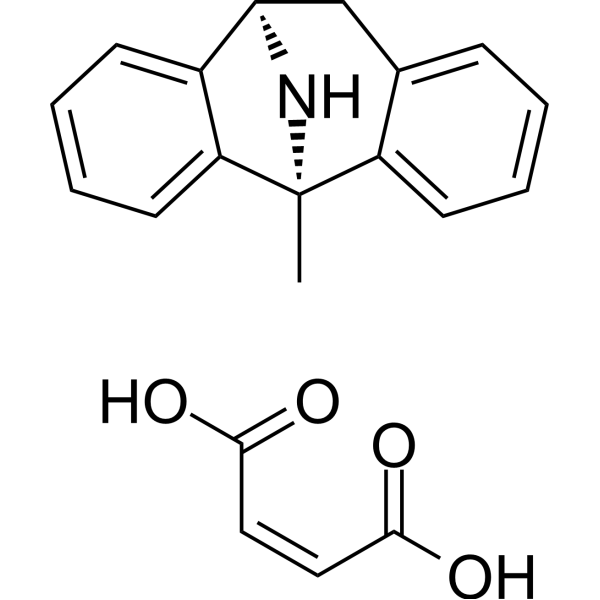
| DC7960 | (+)MK-801 maleate Featured |
Dizocilpine maleate(MK 801) is a potent N-methyl-D-aspartate (NMDA) receptor antagonist with Ki of 30.5 nM
More description
|
|
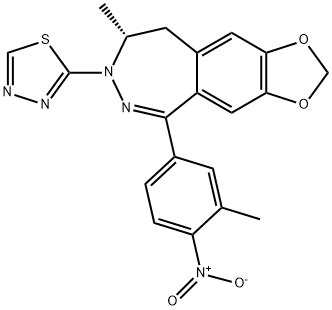
| DC10802 | AMPA/kainate antagonist-2 Featured |
A novel Non-competitive AMPA/kainate antagonist.
More description
|
|
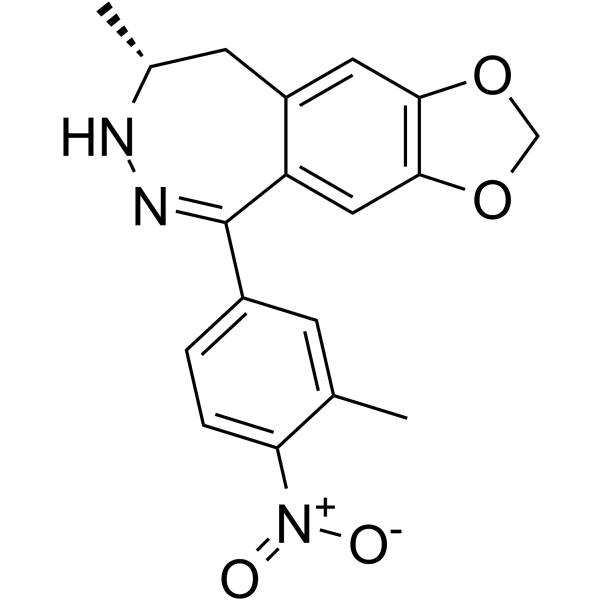
| DC10801 | AMPA/kainate antagonist-1 Featured |
A novel Non-competitive AMPA/kainate antagonist.
More description
|
|