To enhance service speed and avoid tariff delays, we've opened a US warehouse. All US orders ship directly from our US facility.
| Cat. No. | Product Name | Field of Application | Chemical Structure |
|---|---|---|---|
| DC81807 | α-Obscurine derivative-1 |
α-Obscurine derivative-1 (Compound 7) is a α-Obscurine derivative. α-Obscurine derivative-1 inhibits CaV3.1 ion channel current with an IC50 of 0.19 μM. α-Obscurine derivative-1 can be used in the research of neurological disorders.
More description
|

|
| DC81354 | PROTAC EZH2 Degrader-16 |
PROTAC EZH2 Degrader-16 (compound 51) is a PROTAC protein degrader targeting EZH2 with an IC50 of 13.74 μM in SU-DHL-6 cells. PROTAC EZH2 Degrader-16 exerts antiproliferative activity against diffuse large B-cell lymphoma cells. PROTAC EZH2 Degrader-16 can be used for the research of diffuse large B-cell lymphoma.
(Pink: Histone Methyltransferase ligand ; Blue: Cereblon ligand ; Black: linker).
More description
|
|
| DC81352 | PROTAC EZH2 Degrader-14 |
PROTAC EZH2 Degrader-14 is an EZH2 PROTAC degrader, with an IC50 of 18.21 μM against diffuse large B-cell lymphoma cells, and exhibits no antiproliferative activity against non-target cells at concentrations up to 30.00 μM. PROTAC EZH2 Degrader-14 can be used in studies related to diffuse large B-cell lymphoma.
(Pink: Histone Methyltransferase ligand ; Blue: Ligands for E3 Ligase ligand ; Black: linker).
More description
|
|
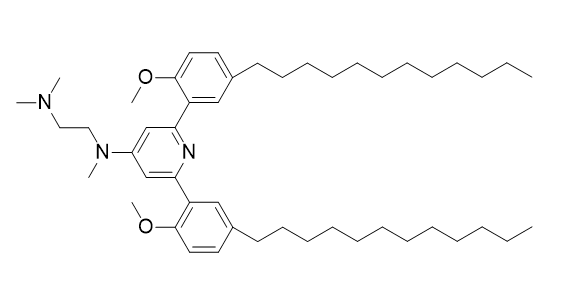
| DC81075 | Mps1/TTK-IN-1 |
Mps1/TTK-IN-1 (Compound cpd-5), a derivative of NMS-P715, is a Mps1 kinase inhibitor with an IC50 of 9.2 nM and a Kd of 1.6 nM. Mps1/TTK-IN-1 specifically targets the ATP-binding pocket of the Mps1 kinase. Mps1/TTK-IN-1 maintains inhibitory activity against Mps1 drug-resistant mutants (C604Y, C604W) with IC50 values of 170 and 19 nM and Kd values of 471 and 349 nM. Mps1/TTK-IN-1 can block the phosphorylation of kinetochore protein KNL1 mediated by Mps1, interfere with the spindle assembly checkpoint function, prevent the correct separation of chromosomes, and thereby inhibit the mitosis and proliferation of tumor cells.
More description
|
|
| DC81064 | MMP-9-IN-13 |
MMP-9-IN-13 (Example 1) is a selective inhibitor of human MMP9 with an IC50 value of 0.02 nM. MMP-9-IN-13 can be used in the research of ocular surface.
More description
|
|
| DC80977 | LUF7996 |
LUF7996 is a CCR2 PROTAC Degrader degrading CCR2 with DC50 = 2.6 μM. LUF7996 demonstrates engagement of both and the E3 ligase cereblon and displays sustain and concentration-dependent degradation of CCR2. LUF7996 reliance on the lysosomal pathway to induce CCR2 degradation. LUF7996 efficiently inhibits monocyte migration in virto.
(Pink: CCR2 ligand ; Blue: Cereblon ligand ; Black: linker).
More description
|
|
| DC80551 | DM243 |
DM243 is an EPAC1 activator and STAT3 modulator with an pIC50 of 4.769. DM243 increases GTP-bound Rap1 levels in EPAC1-expressing cells, with no activation of EPAC2 or PKA. DM243 reduces IL-6/IL-6Rα-evoked STAT3 phosphorylation in endothelial cells. DM243 suppresses TGF-β1-induced fibroblast-to-myofibroblast transition, reducing α-smooth muscle actin and Collagen I levels in lung fibroblasts. DM243 exhibits minimal cytotoxicity in normal human lung fibroblasts.
More description
|
|
| DC80510 | DdBIC |
DdBIC is a pyroptosis inducer. DdBIC binds to Nur77 and triggers its translocation to mitochondria, activates SDHA to deplete succinyl-CoA, disrupts heme homeostasis, induces electron leakage, and elicits mitochondrial ROS production. DdBIC induces mitochondrial ROS that oxidatively activates OMA1, promotes OPA1 cleavage and its release into the cytoplasm, activates the integrated stress response via PERK, and ultimately activates granzyme B to cleave GSDMC. DdBIC can be used for the study of melanoma.
More description
|
|
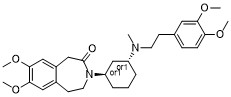
| DC70477 | EC18 HCN inhibitor Featured |
EC18 HCN inhibitor is a HCN channel inhibitor. EC18 acts as a potent HCN4 inhibitor in a human iPSC-derived sinus node model with proven HCN4 expression. EC18 is an attractive pharmacological tool, enabling HCN channel-modulation studies with some specificity for HCN4 (EC50 [HCN4] = 3.98 ± 1.16 µM) over HCN1 (EC50 = 21.00 ± 3.98 µM) and HCN2 (EC50 = 19.35 ± 4.48 µM). EC18 abolishes HCN4 triggered pace making in a human iPSC (hiPSC) pacemaker model.
More description
|
|
| DC73618 | NUCC-0200590 Featured |
NUCC-0200590 is a small-molecule inhibitor of the TRIP8b-HCN interaction with IC50 of 7.0 uM in AlphaScreen assays, effectively disrupts the TRIP8b-HCN interaction in vitro and in vivo.
More description
|

|
| DC76762 | MS7710 |
MS7710 is a brain-penetrant inhibitor targeting the hyperpolarization-activated cyclic nucleotide-gated (HCN) channels. MS7710 reduces the Ih current and decreases the activity of ventral tegmental area (VTA) dopamine neurons by inhibiting HCN channels. MS7710 can effectively improve social interaction deficits and reward-related cognitive flexibility in the chronic social defeat stress (CSDS) mouse model. MS7710 is promising for research of depression.
More description
|
|
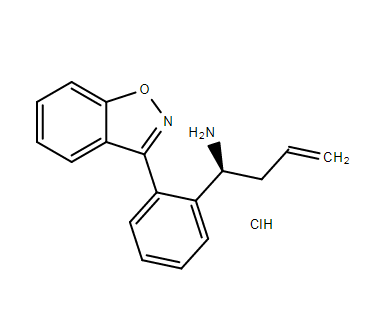
| DC73619 | Org 34167 Featured |
Org 34167 HCl salt is a broad-spectrum inhibitor of HCN channels with IC50 of 23.4, 8.2 and 9.2 uM for HCN1, HCN2 and HCN4 channels, respectively, slowing activation and causing a hyperpolarising shift in voltage-dependence of activation.
More description
|
|
| DC73620 | RO-275 |
RO-275 is a potent, selective HCN1 ion channel inhibitor with IC50 of 46 nM, displays 311/100/302-fold selectivity over HCN2/HCN3/HCN4.
More description
|
|
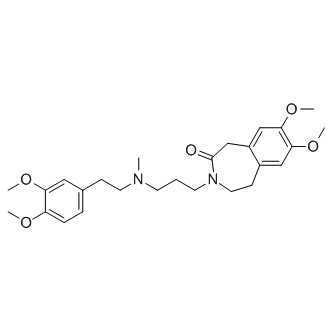
| DC9461 | Zatebradine |
Zatebradine(UL-FS49) is a potent HCN channels antagonist, which decreased the heartbeat in a reversible manner; 92% inhibition of the hHCN1-mediated current at 10 uM.
More description
|
|
| DC7753 | Zatebradine hydrochloride |
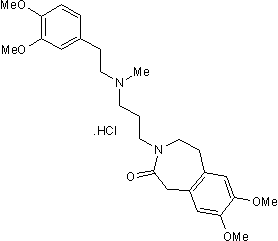
Zatebradine hydrochloride is a bradycardic agent that creates use-dependent inhibition of hyperpolarization-activated current (If) in sinoatrial node cells (EC50 = 480 nM) and Purkinje fibres.
More description
|
|