 To enhance service speed and avoid tariff delays, we've opened a US warehouse. All US orders ship directly from our US facility.
| Cat. No. | Product Name | Field of Application | Chemical Structure |
|---|---|---|---|
| DC81618 | tert-Butyl 2,7-diazaspiro[3.5]nonane-7-carboxylate hydrochloride |
tert-Butyl 2,7-diazaspiro[3.5]nonane-7-carboxylate hydrochloride is a PROTAC linker that can be used in the synthesis of PROTACs.
More description
|

|
| DC81531 | SHK1112218 |
SHK1112218 is an orally active mitochondrial proton carrier with an EC50 of 0.48 μM. SHK1112218 restores proton transport and increases oxygen consumption rate. SHK1112218 can be used for the research of diabetes, obesity, and metabolic dysfunction-associated steatotic liver disease.
More description
|
|
| DC81410 | PTERi |
PTERi is a selective inhibitor of PTER with selectivity towards HDACs. PTERi increases the level of N-acetyltaurine in both lean and obese mice, and reduces food intake in obese mice. PTERi can be used in the research of obesity.
More description
|
|
| DC81332 | PROTAC AURKA degrader 2 |
PROTAC AURKA degrader 2 (compound D) is a potent and selective PROTAC AURKA degrader with an IC50 of 3.58 nM. PROTAC AURKA degrader 2 exhibits 21.6-fold selectivity for AURKA over AURKB (IC50 = 77.2 nM). PROTAC AURKA degrader 2 specifically depletes AURKA on the mitotic spindle.
(Pink: Aurora Kinase and Aurora A ligand ; Blue: Ligands for E3 Ligase and Cereblon ligand ; Black: linker ).
More description
|
|
| DC81331 | PROTAC ALK degrader-5 |
PROTAC ALK degrader-5 (Compound 17) is an efficient ALK PROTAC degrader, with its inhibitory effects on EML4-ALK and NPM-ALK being 27.4 nM and 116.5 nM respectively. PROTAC ALK degrader-5 exhibits potent anti-proliferative activity against H3122 and Karpas 299. PROTAC ALK degrader-5 effectively inhibits the phosphorylation of ALK and STAT3. PROTAC ALK degrader-5 can be used for the study of ALK-driven malignant tumors, such as human non-small cell lung cancer and anaplastic large cell lymphoma.
(Pink: Anaplastic lymphoma kinase (ALK) Target protein ligand; Blue: Cereblon ligand ; Black: linker).
More description
|
|
| DC81275 | PHD-1-IN-2 |
PHD-1-IN-2 is an orally active inhibitor of hypoxia-inducible factor prolyl hydroxylase domain 1 (PHD-1) with an IC50 of 0.07 μM. PHD-1-IN-2 acts as a substrate of MDR1 in MDR1-MDCK cell monolayer assays. PHD-1-IN-2 can be used in the research of ischemia, inflammatory responses and neurodegenerative diseases, such as inflammatory bowel disease and ischemia-reperfusion injury.
More description
|
|
| DC81130 | NCO-650 free base |
NCO-650 free base is an antiallergic agent that acts by inhibiting tryptase, a key trypsin-like protease in mast cells. NCO-650 free base inhibits mast cell histamine release, increases intracellular cAMP levels in mast cells, suppresses bronchoconstriction, and prevents decreases in perfusion pressure and systemic blood pressure. NCO-650 free base is applicable to the research of allergic diseases and bronchial asthma.
More description
|
|
| DC80941 | LasB-IN-3 |
LasB-IN-3 is a protease elastase (LasB) inhibitor of Pseudomonas aeruginosa with an IC50 value of 8.5 nM. LasB-IN-3 shows an IC50 of 58.9 nM for the Met128Val mutant. LasB-IN-3 binds to active sites of wild-type and Met128Val mutant LasB, coordinates zinc ions, forms hydrogen bonds and CH-π interactions, and inhibits LasB proteolytic activity. LasB-IN-3 increases survival rate in LasB-induced acute lung injury mice models. LasB-IN-3 can be used for the research of Pseudomonas aeruginosa infection.
More description
|
|
| DC80915 | KRASG12C IN-18 |
KRASG12C IN-18 is an orally active covalent KRASG12C inhibitor that achieves complete covalent engagement of KRASG12C in both GDP- and GMPPNP-bound states and displays strong antiproliferative activity against KRASG12C and resistance-associated variants, including KRASG12C/R68S, with low-nanomolar IC50 values.
KRASG12C IN-18 exhibits marked in vivo efficacy in KRASG12C-driven solid tumor and KRASG12C/R68S xenograft models and can be used for colorectal cancer research.
More description
|
|
| DC80880 | JAK2-IN-20 |
JAK2-IN-20 is an orally active dual inhibitor targeting JAK2 kinase (IC50=49.17 nM) and influenza A virus PB2 protein (IC50=3.337 μM, Kd=2.82 μM). JAK2-IN-20 effectively blocks the JAK/STAT signaling pathway by reducing the phosphorylation levels of STAT1 and STAT3, thereby inhibiting viral replication and downregulating the expression of viral NP and PB2 proteins. In addition, JAK2-IN-20 significantly inhibits the mRNA expression of key inflammatory cytokines such as IL-6, TNF-α and IFN-β in inflammation and influenza infection models. JAK2-IN-20 serves as an important tool molecule for the study of influenza A virus infection and related pathologies.
More description
|
|
| DC80353 | BTS 72664 |
BTS 72664 is a broad-spectrum, non-sedating, orally effective anticonvulsant. Its anticonvulsant effect mainly arises from enhancing GABAA receptor (GABAA receptor)-mediated chloride channel currents, while it exerts weak blocking effects on Na+ channels (Ki = 350 μM) and NMDA receptors (NMDA receptor) (IC50 = 43 μM). BTS 72664 prevents the elevation of extracellular glutamate, glycine and serine concentrations in neurons, reduces cerebral infarct size, promotes functional recovery, prevents multiple types of epileptic seizures, and has low sedative potential. BTS 72664 can be used for the research of epilepsy, stroke and migraine.
More description
|
|
| DC80274 | ATR ligand 2 |
ATR ligand 2 (Compound 26) is a ATR PROTAC ligand. ATR ligand 2 can be conjugated with E3 ligase Ligand and linker to synthesize PROTAC ATR degrader-3.
More description
|
|
| DC76263 | Mal-Exatecan Featured |
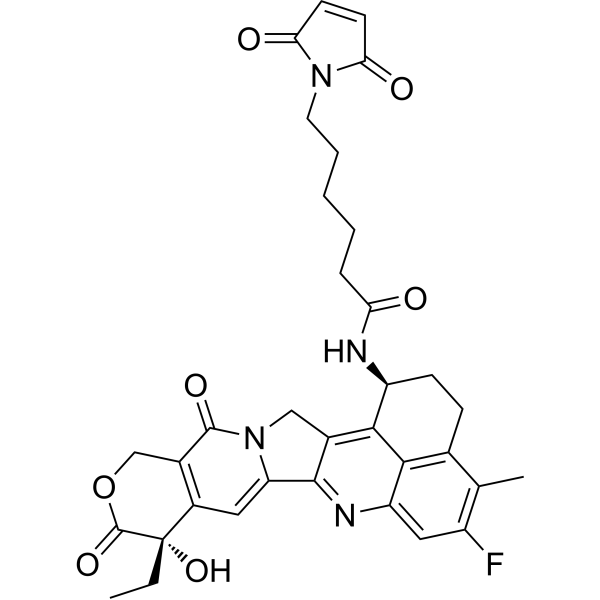
Mal-Exatecan is a Mal (Maleimide) modified Exatecan. Rilpivirine is an effective and selective diarylpyrimidine (DAPY) non-nucleoside reverse transcriptase inhibitor (NNRTI). It exhibits potent antiviral activity against both wild-type HIV (EC50 = 0.4 nM) and mutant strains (EC50 = 0.1-2.0 nM).
More description
|
|
| DC79535 | YCJ-02 |
YCJ-02 is a selective Topoisomerase I (Top I) inhibitor. YCJ-02 can inhibit cell proliferation and induce apoptosis and G2/M phase arrest. YCJ-02 can induce DNA damage and increaseγ-H2AX levels. YCJ-02 can promote Top I deqradation via a ubiquitin/26S proteasome pathway. YCJ-02 increases the expressions of pro-apoptotic proteins Bad, Bax, and cleaved
caspase-3. YCJ-02 shows broad-spectrum antitumor activity. YCJ-02 can be used for the research of cancer, such as intrahepatic cholangiocarcinoma (ICC).
More description
|
|
| DC79534 | NISC-6 |
NISC-6 is a novel dual Topo-IIα/Akt inhibitor. NISC-6 has inhibitory activity against various cells, such as UACC903 (IC50 = 2.5 µM) and CHL-1 (IC50 = 0.8 µM) cells. NISC-6 dose dependently induces early and late apoptosis. NISC-6 can be used for research on melanoma.
More description
|
|
| DC79491 | NK-611 |
NK-611 is an epipodophyllotoxin derivative. NK-611 induces DNA double-strand breaks by inhibiting topoisomerase II (IC50 = 56 μM). NK-611 does not inhibit microtubule polymerization, thus avoiding the side effects of the parent compound, Podofilox. NK-611 exhibits broad-spectrum antitumor activity and demonstrates potent efficacy in in vivo models of leukemia. NK-611 can be used in cancer research.
More description
|
|
| DC79490 | F-14512 hydrochloride |
F-14512 hydrochloride is an anticancer agent that utilizes the polyamine transport system (PTS) to selectively deliver polyamine-containing drugs to cancer cells. F-14512 hydrochloride enhances the affinity of polyamines for DNA, thereby inhibiting topoisomerase II and achieving selective cellular uptake. F-14512 hydrochloride exhibits significant cytotoxicity against cells with high PTS activity and induces DNA damage. F-14512 hydrochloride demonstrates potent antitumor activity in the MX1 breast tumor xenograft model. F-14512 hydrochloride could be used to study breast cancer.
More description
|
|
| DC79488 | GI-149893 |
GI-149893 is a selective topoisomerase I (TopoI) inhibitor. GI-149893 prevents DNA religation and induces irreversible DNA damage in tumor cells. GI-149893 is promising for research of cancers (e.g., colon carcinoma HT-29/SW-48, breast MX-1, prostate PC-3 xenografts).
More description
|
|
| DC79182 | PNU-142586 |
PNU-142586 is the major metabolite of Linezolid. PNU-142586 can inhibit the activity of DNA topoisomerase 2-α (TOP2A) and DNA topoisomerase 2-β (TOP2B). PNU-142586 interferes with DNA replication and transcription by blocking the binding of DNA to TOP2 and inhibiting ATP hydrolysis. PNU-142586 can be used to study Linezolid-induced hematotoxicity and its molecular mechanism.
More description
|
|
| DC78992 | LD2-3 |
LD2-3 is a topoisomerase I inhibitor. LD2-3 can be connected to monoclonal antibodies via linkers to form antibody-drug conjugate (ADC) molecules. LD2-3 can be coupled with CEA antibodies to form ADC drugs for the study of CEA overexpressing tumors.
More description
|
|
| DC78730 | NBTI 5463 |
NBTI 5463 is a bacterial type II topoisomerases (topoisomerase II) inhibitor with antibacterial activity. NBTI 5463 inhibits GyrA and TopoIV in Pseudomonas aeruginosa and Escherichia coli. NBTI 5463 binds to topoisomerase II to prevent DNA cleavage and religation, inhibiting bacterial DNA replication and transcription. NBTI 5463 is promising for research of Gram-negative bacterial infection.
More description
|
|
| DC78655 | ARN21929 |
ARN21929 is a Topoisomerase II inhibitor with an IC50 of 4.5 μM. ARN21929 exhibits excellent kinetic and thermodynamic solubility as well as metabolic stability. However, ARN21929 shows poor antiproliferative activity against A549, DU145, MCF7, HeLa, and A375 cells. ARN21929 can be used in the study of cancer.
More description
|
|
| DC78354 | Topobexin |
Topobexin (Topobexin 9) is a highly selective inhibitor for TOP2B. Topobexin selectively inhibits TOP2B in vitro and immobilizes TOP2B on DNA. Topobexin demonstrates significant protection of cardiomyocytes against DAU-induced damage. Topobexin prevents anthracycline-induced cardiotoxicity and DAU-induced decrease in LV systolic function in vivo with rabbit model.
More description
|
|
| DC78336 | XSJ110 |
XSJ110 is a potent irreversible topoisomerase I (Topo I) inhibitor with an IC50 value of 0.133 μM. XSJ110 blocks DNA topoisomerization, induces DNA double-strand breaks, and triggers cell cycle arrest at G0/G1 phase, inducing tumor cell apoptosis. XSJ110 is promising for research of ampullary carcinoma (AC).
More description
|
|
| DC78305 | Topoisomerase II inhibitor 23 |
Topoisomerase II inhibitor 23 is a potent topoisomerase II inhibitor (IC50 = 0.94 μM). Topoisomerase II inhibitor 23 shows high selectivity and exceptional cytotoxic activity in MCF-7, HepG2, and HCT116 cells. Topoisomerase II inhibitor 23 induces cell cycle arrest at the G1 phase, leading to inhibition of cell proliferation. Topoisomerase II inhibitor 2 induces apoptosis by up-regulating the pro-apoptotic Bax level and down-regulating the anti-apoptotic Bcl-2 level.
More description
|
|
| DC78250 | XSJ81 |
XSJ81 is an orally active anti-cancer agent. XSJ81 significantly inhibits the proliferation of ampullary carcinoma (AC) DPC-X3 cells with an IC50 of 0.655 μM. XSJ81 inhibits the colony formation, arrests cell cycle at the G2/M phase and inhibits the migration in DPC-X3 cells. XSJ81 induces DNA damage and apoptosis in DPC-X3 cells. XSJ81 demonstrates significant anti-tumor efficacy in mice bearing DPC-X3 xenografts. XSJ81 can be used for the study of ampullary carcinoma.
More description
|
|
| DC78246 | Topi MF-6 |
Topi MF-6 is a DNA topoisomerase I (Top1) inhibitor. Topi MF-6 has superior cytotoxicity against gastrointestinal cancer cells. Topi MF-6 can be used as an ADC payload.
More description
|
|
| DC78094 | Topoisomerase inhibitor 6 |
Topoisomerase inhibitor 6 (Compound REDX05931) is a dual irreversible inhibitor of DNA gyrase and topoisomerase IV (MIC=0.06 μg/mL against fluoroquinolone-resistant S. aureus). Topoisomerase inhibitor 6 blocks DNA strand break-reunion, inducing lethal DNA damage. Topoisomerase inhibitor 6 is promising for research of Gram-positive bacterial infections (e.g., S. aureus, S. pneumoniae).
More description
|
|
| DC7131 | GENZ-644282 Featured |
Genz-644282 is a non-camptothecin inhibitor of topoisomerase I with potential antineoplastic activity(IC50=1.2 nM).
More description
|

|
| DC76268 | Eleutherin |
Eleutherin ((+)-Eleutherin) is a pyranonaphthoquinones that is isolated from the bulb of Eleutherine americana and a potent catalytic inhibitor of Topoisomerase II. It exhibits potent anti-cancer activity and protects human umbilical vein endothelial cells (HUVECs) from injury in vitro.
More description
|
|
