 To enhance service speed and avoid tariff delays, we've opened a US warehouse. All US orders ship directly from our US facility.
| Cat. No. | Product Name | Field of Application | Chemical Structure |
|---|---|---|---|
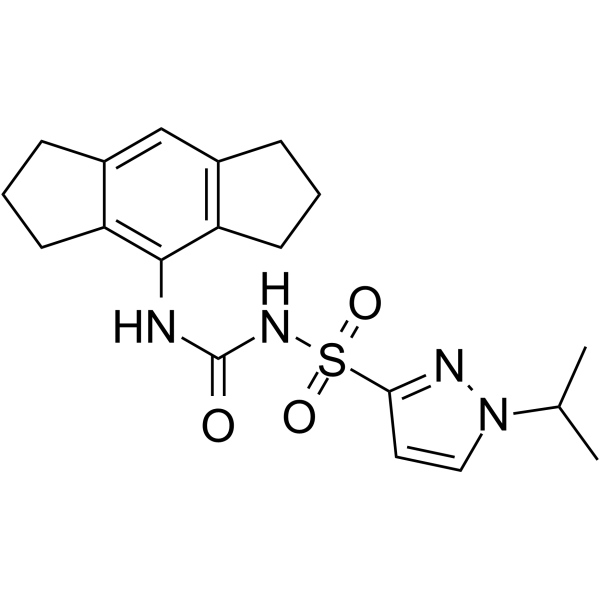
| DC44153 | Emlenoflast(MCC7840) Featured |
MCC7840, a sulfonylurea, is a potent and selective inhibitor of NLRP3 inflammasome, with an IC50 of <100 nM. MCC7840 can be used for the research of inflammatory diseases.
More description
|
|
| DC81784 | Zifcasiran sodium |
Zifcasiran (ADS-007) sodium is an siRNA synthetic double-stranded RNAi trigger. Zifcasiran sodium selectively target hypoxia-inducible factor-2α (HIF2α) interrupting downstream pro-oncogenic signaling in clear cell renal cell carcinoma (ccRCC). Zifcasiran sodium engages the cell's RNAi machinery to target HIF2α (EPAS1) mRNA for degradation, thereby reducing the amount of free HIF2α mRNA available for translation.
More description
|

|
| DC81777 | Z8779877149 |
Z8779877149 (Z7149) is a blood-brain barrier-permeable multi-target ligand that targets SERT (Ki=198 nM), α2A adrenergic receptor (Ki=180 nM; EC50=440 nM) and 5-HT2A receptor (EC50=172 nM, Emax=76%). Z8779877149 inhibits 5-HT reuptake and activates Gi and Gq protein signaling pathways, respectively. Z8779877149 effectively alleviates pain responses as well as depression- and anxiety-like behaviors, while exhibiting favorable safety without inducing sedation or motor impairment. Z8779877149 is available for the research of pain, depression and anxiety disorders.
More description
|
|
| DC81744 | WRN-IN-24 |
WRN-IN-24 is an orally active allosteric covalent Werner syndrome helicase (WRN) inhibitor with an IC50 of 201 nM. WRN-IN-24 binds to a novel allosteric cavity, forms an additional hydrogen bond with K894, and functionally inhibits WRN activity. WRN-IN-24 inhibits colorectal cancer cells proliferation and exerts dose-dependent antitumor activity in xenograft mouse models. WRN-IN-24 can be used for the research of microsatellite instability-high cancers, including colorectal cancer.
More description
|
|
| DC81740 | WMK-1 |
WMK-1 is a 1,2,4,5-tetraoxane derivative and ferroptosis inducer, with significantly higher cytotoxicity against cancer cells than non-cancerous cells. WMK-1 triggers ferroptosis in cancer cells and cancer stem cells. WMK-1 can be used for the research of cancer.
More description
|
|
| DC81665 | Topoisomerase I-IN-19 |
Topoisomerase I-IN-19 (Example 36) is a Topoisomerase I inhibitor. Topoisomerase I-IN-19 can be used to investigate Topoisomerase I-mediated diseases such as cancer.
More description
|
|
| DC81552 | SMTIN-P01 |
SMTIN-P01 is a TRAP1 inhibitor that is selective for cytosolic Hsp90 and accumulates in mitochondria. SMTIN-P01 binds to the ATP-binding site of TRAP1 as an ATP mimic, thereby inhibiting ATPase and foldase activities. SMTIN-P01 induces mitochondrial membrane depolarization and proteolytic degradation in cancer cells. SMTIN-P01 exhibits significant cytotoxicity, but shows extremely low toxicity to primary mouse hepatocytes, and does not interfere with SIRT3-related functions or the levels of cytosolic Hsp90 substrates. SMTIN-P01 has important application value in cancer-related research.
More description
|
|
| DC81478 | RSK4-IN-2 |
RSK4-IN-2 (compound 16o) is a potent, orally active RSK4 inhibitor with an IC50 of 17 nM. RSK4-IN-2 suppresses esophageal squamous cell carcinoma (ESCC) cell growth and invasion, by inhibiting phosphorylation of RSK4 downstream targets. RSK4-IN-2 inhibits tumor growth and metastasis in ESCC mouse models. RSK4-IN-2 can be used for ESCC research.
More description
|
|
| DC81449 | Retro-1 |
Retro-1 is a toxin inhibitor. Retro-1 blocks the retrograde transport of STxB to the trans-Golgi network/Golgi. Retro-1 inhibits the cytotoxic effects of Ricin, bacterial toxins Stx1 and Stx2. Retro-1 can also substantially enhance the effectiveness of antisense and splice switching oligonucleotides.
More description
|
|
| DC81411 | PTH1R agonist 1 |
PTH1R agonist 1 (Example 2) is a parathyroid hormone 1 receptor (PTH1R) agonist. PTH1R agonist 1 can be used for research of hypoparathyroidism and osteoporosis.
More description
|
|
| DC81385 | PROTAC LRRK2 Degrader-2 |
PROTAC LRRK2 Degrader-2 is a PROTAC-based degrader targeting LRRK2 with a DC50 of 0.14 nM. PROTAC LRRK2 Degrader-2 recruits LRRK2 or its mutants to the cereblon E3 ubiquitin ligase, thereby mediating the targeted ubiquitination and subsequent proteasomal degradation of LRRK2. PROTAC LRRK2 Degrader-2 can be used in research related to Parkinson's disease.
More description
|
|
| DC81367 | PROTAC EZH2 Degrader-40 |
PROTAC EZH2 Degrader-40 (compound 56) is a PROTAC protein degrader targeting EZH2 with an IC50 of 15.35 μM against SU-DHL-6 cells. PROTAC EZH2 Degrader-40 can be used for the research of diffuse large B-cell lymphoma.
(Pink: Histone Methyltransferase ligand ; Blue: Aminopeptidase ligand ; Black: linker).
More description
|
|
| DC81347 | PROTAC DAPK1 Degrader-1 |
PROTAC DAPK1 Degrader-1 (Compound CP1) is a DAPK1 PROTAC degrader with a DC50 of 119.6 nM. PROTAC DAPK1 Degrader-1 significantly increased the MDM2 protein level. PROTAC DAPK1 Degrader-1 significantly reduced the levels of cleaved caspase-3 and cleaved PARP in a cell apoptosis model induced by the neurotoxin ceramide, indicating that it effectively inhibits neuronal apoptosis by degrading DAPK1. PROTAC DAPK1 Degrader-1 can be used to study neurological diseases such as cerebral ischemia and traumatic brain injury (pink: DAPK1 ligand; blue: CRBN ligand; black: linker).
More description
|
|
| DC81341 | PROTAC CDK2/4/6 Degrader-1 |
PROTAC CDK2/4/6 Degrader-1 is an orally active CDK2/CDK4/CDK6 PROTAC degrader. PROTAC CDK2/4/6 Degrader-1 is a prodrug derived from PROTAC CDK2/4/6 Degrader-2 via one-step reaction with chloromethyl pivalate. PROTAC CDK2/4/6 Degrader-1 can be used for malignant melanoma research.
(Pink: Aurora A ligand ; Blue: Cereblon ligand ; Black: linker).
More description
|
|
| DC81316 | PPO-IN-25 |
PPO-IN-25 (Compound B2) is a PPO inhibitor and Herbicide, with a Ki value of 9.50 nM against NtPPO. PPO-IN-25 exhibits control efficacy against broadleaf weeds and shows broad-spectrum herbicidal activity. PPO-IN-25 can be used in studies related to weed damage.
More description
|
|
| DC81259 | PDE4B/D-IN-5 |
PDE4B/D-IN-5 (Compound P32) is a peripherally restricted, oral active inhibitor of PDE4B and PDE4D with extremely low blood-brain barrier penetration, with IC50 values of 3.4 nM and 2.2 nM, respectively. PDE4B-IN-8 inhibits the production of TNF-α. PDE4B/D-IN-5 significantly reduces the Bax/Bcl2 ratio, and alleviates oxidative stress by decreasing MPO activity and NO levels. PDE4B/D-IN-5 exhibits anti-inflammatory, antioxidant, and anti-apoptotic activities. PDE4B/D-IN-5 can be used for the research of acute lung injury.
More description
|
|
| DC81164 | NN-01-195 |
NN-01-195 is a HSP90 inhibitor-drug conjugate. NN-01-195 binds tightly to and inhibits AURKA and HSP90, with an IC50 of 3.1 nM against AURKA and an IC50 of 8.7 nM against HSP90α. NN-01-195 induces mitotic arrest and spindle abnormality in tumor cells, and triggers cell apoptosis. NN-01-195 can be used in the research of solid tumors.
More description
|
|
| DC81135 | N-Desmethyl xanomeline |
N-Desmethyl xanomeline is a pharmacologically active metabolite of Xanomeline. N-Desmethyl xanomeline binds to muscarinic, serotonergic, histaminergic and dopaminergic receptors. N-Desmethyl xanomeline can be used for the research of schizophrenia.
More description
|
|
| DC81078 | MrgprX2 antagonist-10 |
MrgprX2 antagonist-10 (Example 218) is a MrgprX2 antagonist with an IC50 of less than 100 nM. MrgprX2 antagonist-10 can be used for the study of various inflammatory diseases.
More description
|
|
| DC80996 | Mal-PEG2-Val-Arg-PABC-OMe-Eribulin |
Mal-PEG2-Val-Arg-PABC-OMe-Eribulin (Compound L-1) is a drug-linker conjugate composed of O-Me Eribulin and the linker Mal-PEG2-Val-Cit-PAB-OH. Mal-PEG2-Val-Arg-PABC-OMe-Eribulin can be used to synthesize anti-HER3/MET antibody-drug conjugates (ADCs).
More description
|
|
| DC80879 | JAK2-IN-18 |
JAK2-IN-18 (Compound example1) is a selective JAK2 inhibitor. JAK2-IN-18 can inhibit JAK-STAT signaling and shows an IC50 of <100 nM for pSTAT5 in HEL9217 cells. JAK2-IN-18 can inhibit the proliferation of abnormally proliferating myeloid cells and can be used for the research of myeloproliferative disorders, such as essential thrombocythemia.
More description
|
|
| DC80863 | Iptacopan hydrochloride hydrate |
Iptacopan (LNP023) hydrochloride hydrate is an effective and orally-active highly selective factor B inhibitor with an IC50 value of 10 nM and KD of 7.9 nM. Iptacopan hydrochloride hydrate exerts a proximal effect in the complement cascade reaction, preventing the destruction (hemolysis) of red blood cells in PNH and the damage of renal cells in IgAN and C3G. Iptacopan hydrochloride hydrate can be used for the study of complement-mediated diseases, particularly paroxysmal nocturnal hemoglobinuria (PNH), primary immunoglobulin A nephropathy (IgAN), and complement 3 glomerulopathy (C3G).
More description
|
|
| DC80703 | GIPR antagonist 2 |
GIPR antagonist 2 (Example 14) is a GIPR antagonist that can be used for the study of diseases such as obesity and type 2 diabetes.
More description
|
|
| DC80574 | DX-8951 Hydroxy-acid |
DX-8951 Hydroxy-acid is a prodrug of phosphoramide. ProAX can effectively increase intracellular ATP levels. DX-8951 Hydroxy-acid activates the AMPK signaling pathway by increasing the AMP/ATP ratio. DX-8951 Hydroxy-acid can enhance mitochondrial function and antioxidant capacity while reducing reactive oxygen species (ROS) levels. DX-8951 Hydroxy-acid has shown significant anti-aging and longevity effects in both human fibroblast and nematode models.
More description
|
|
| DC80478 | CP-470711 |
CP-470711 is an orally active and potent and selective sorbitol dehydrogenase (SDH) inhibitor with an IC50=10 nM for human SDH and IC50=17 nM for rat SDH. CP-470711 is promising for research of chronic complications related to type 2 diabetes mellitus, such as neuropathy and nephropathy.
More description
|
|
| DC80348 | Brosuximide |
Brosuximide is a succinimide-type antiepileptic agent.
More description
|
|
| DC80316 | BKT300 |
BKT300 is a potent and selective protein regulator of cytokinesis 1 (PRC1) inhibitor. BKT300 inhibits PRC1 dephosphorylation at T481, disrupts actin and microtubule formation, induces G2/M cell cycle arrest, triggers mitotic catastrophe, and promotes apoptosis, thereby inhibiting proliferation and migration of acute myeloid leukemia (AML) cells while sparing normal cells. BKT300 inhibits tumor growth in mouse xenograft AML models. BKT300 can be used for the research of AML[1].
More description
|
|
| DC80269 | AT-9 |
AT-9 is an anthraquinone-triazene derivative. AT-9 exhibits strong DNA intercalation ability. AT-9 can also interact with Topo IIA. AT-9 exhibits anticancer activity against non-small cell lung cancer and cervical cancer.
More description
|
|
| DC80103 | 5-HT2A agonist 8 |
5-HT2A agonist 8 (Compound 67) is a 5-HT2A agonist, with an EC50 of 4 nM. 5-HT2A agonist 8 can be used in the research of neuropsychiatric and neurodegenerative diseases.
More description
|
|
| DC79933 | (S,R,S)-BBO-11818 |
(S,R,S)-BBO-11818 (compound 59) is an inhibitor of KRAS that can be used in the research of cancer.
More description
|
|
