To enhance service speed and avoid tariff delays, we've opened a US warehouse. All US orders ship directly from our US facility.
| Cat. No. | Product Name | Field of Application | Chemical Structure |
|---|---|---|---|
| DC80788 | PROTAC BCL6 Degrader-3 |
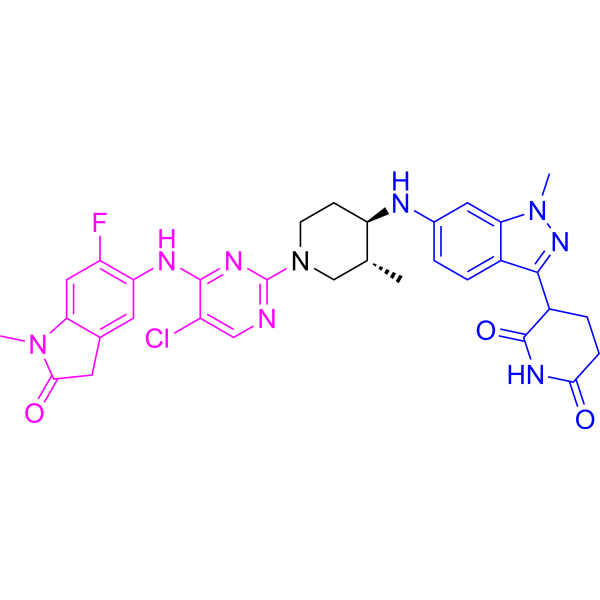
PROTAC BCL6 Degrader-3 (compound 92) is a BCL6 PROTAC degrader. PROTAC BCL6 Degrader-3 can be used for the study of cancer or an autoimmune disease.
More description
|
|
| DC68007 | Tri-GalNAc-β-Ala-PEG3-MAL Featured |
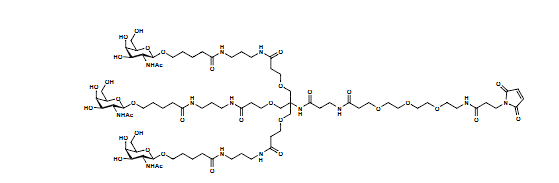
Tri-b-GalNAc-b-Ala-PEG3-MAL contains three terminal beta-N-acetylgalactosamine (GalNAc) sugars arranged in a trivalent configuration, facilitating high-affinity binding to the asialoglycoprotein receptor (ASGPR) expressed on hepatocyte surfaces. The crucial functional group is a terminal maleimide (MAL) moiety, enabling chemoselective bioconjugation with biomolecules harboring thiol (-SH) groups. This strategy allows for site-specific conjugation under mild conditions, valuable for developing targeted conjugates in disciplines like targeted drug delivery and antibody-drug conjugate (ADC) development for hepatocellular carcinoma.
More description
|
|
| DC81811 | β-Catenin modulator-9 |
β-Catenin modulator-9 (Compound IIa-2075) is a β-Catenin modulator. β-Catenin modulator-9 specifically targets the activity of the stable β-catenin pool and inhibits the Wnt signaling pathway. β-Catenin modulator-9 can be used in cancer-related research.
More description
|

|
| DC81801 | α5β1 integrin-IN-1 |
α5β1 integrin-IN-1 (compound 65) is a potent and selective α5β1 integrin inhibitor with a pIC50 of 9.4. α5β1 integrin-IN-1 displays >10000-fold selectivity for α5β1 over αVβ3 (pIC50 = 5.5). α5β1 integrin-IN-1 reduces airway smooth muscle (ASM) tension through the disruption of cellular tethering. α5β1 integrin-IN-1 exhibits excellent inhalation pharmacokinetics in rodent. α5β1 integrin-IN-1 can be used for asthma research.
More description
|
|
| DC81800 | α4β7 Integrin-IN-1 |
α4β7 Integrin-IN-1 (Example 356) is a potent inhibitor of α4β7 integrin (integrin). Its ability to block the interaction between α4β7 integrin and MadCAM-1 (EC50) is 0.05 nM. α4β7 Integrin-IN-1 can be used for the study of inflammatory bowel disease.
More description
|
|
| DC81799 | α1A/1D-Adrenoceptor antagonist-1 |
α1A/1D-Adrenoceptor antagonist-1 (Compound 15) is a selective α1A/1D-adrenoceptor dual antagonist with IC50 values of 20.26 and 164.9 nM. α1A/1D-Adrenoceptor antagonist-1 shows an IC50 of 1912 nM for α1B-adrenoceptor.α1A/1D-Adrenoceptor antagonist-1 can be used for research of benign prostatic hyperplasia.
More description
|
|
| DC81798 | α,δ-NAG |
α,δ-NAG is an orally active glutaminase-resistant less-hydrolyzable L-Glutamine derivative. α,δ-NAG is a G protein-coupled receptor (GPCR) allosteric modulator. α,δ-NAG suppresses neutrophilic airway inflammation by activating the GPCR/ERK/MKP-1 pathway. α,δ-NAG can be used for the researches of inflammation and immunology, such as asthma.
More description
|
|
| DC81790 | ZMC2 |
ZMC2 is a thiosemicarbazone-class metal ion chelator and zinc ionophore with a human mutant p53R175H binding Ka of 27.4 nM.ZMC2 binds Fe, Cu, Mn, Zn, and other transition metals.ZMC2 facilitates zinc transport across membranes.ZMC2 restores zinc binding to zinc-deficient p53 mutants, restoring wild-type structure and function, including site-specific DNA binding.ZMC2 generates reactive oxygen species (ROS).ZMC2 can be used for the research of cancer.
More description
|
|
| DC81789 | ZLY025 |
ZLY025 is a potent and orally active CCNK molecular glue degrader with an DC50 of 42.7 nM. ZLY025 exhibits broad-spectrum antiproliferative activity against various tumor cells with IC50 values ranging from 0.08 to 2.45 μM. ZLY025 can induce cells apoptosis and G1 phase arrest. ZLY025 can be used for the research of cancer, such as lung cancer.
More description
|
|
| DC81788 | ZLWH-67 |
ZLWH-67 is a β-Carboline derivative and Antibacterial agent. ZLWH-67 inhibits DNA synthesis, suppresses biofilm formation, and increases reactive oxygen species (ROS) levels. ZLWH-67 exhibits potent in vitro antibacterial activity against MRSA (MIC = 0.5-4 μg/mL), S. epidermidis (MIC = 4 μg/mL), E. faecalis (MIC = 4-8 μg/mL), and S. pneumoniae (MIC = 16 μg/mL). ZLWH-67 displays anti-MRSA effects in murine skin and pneumonia infection models.
More description
|
|
| DC81787 | ZK-Thiazolidinone |
ZK-Thiazolidinone is an ATP-competitive Polo-like kinase 1 (Plk1) inhibitor with an IC50 of 19 nM. ZK-Thiazolidinone inhibits tumor cell proliferation, induces cell cycle arrest and typical mitotic defects. ZK-Thiazolidinone impairs the recruitment of γ-tubulin and Aurora A kinase to centrosomes, resulting in failure of bipolar spindle maintenance and sister chromatid arm cohesion.\nZK-Thiazolidinone is applicable for cancer research.
More description
|
|
| DC81778 | ZAK-IN-2 |
ZAK-IN-2 (Compound 8) is a selective, covalent ZAK inhibitor with an IC50 of 11.5 nM. ZAK-IN-2 forms a covalent bond with Cys22 in the P-loop of ZAK to inhibit its kinase activity. ZAK-IN-2 inhibits the phosphorylation of the downstream target p38. ZAK-IN-2 blocks Doxorubicin-induced cleavage of Caspase 3. ZAK-IN-2 is applicable to research related to myocardial hypertrophy.
More description
|
|
| DC81776 | Z226407860 |
Z226407860 is a RING-box protein 1 (RBX1) inhibitor. Z226407860 reduces house dust mite-induced airway epithelial injury and ROS accumulation by inhibiting RBX1. Z226407860 can be used for the research of asthma.
More description
|
|
| DC81774 | YZ-836P |
YZ-836P is a Protein arginine methyltransferase 5 (PRMT5) targeting agent. YZ-836P promotes ubiquitination and proteasomal degradation of PRMT5 in a cereblon (CRBN)-dependent manner, which in turn reduces levels of its downstream target KLF5. YZ-836P induces G1 phase cell cycle arrest in triple-negative breast cancer cells. YZ-836P induces apoptosis in triple-negative breast cancer cells. YZ-836P exerts cytotoxic effects on triple-negative breast cancer cells. YZ-836P inhibits the growth of triple-negative breast cancer patient-derived organoids. YZ-836P inhibits the growth of triple-negative breast cancer xenografts in nude mice. YZ-836P can be used for the research of triple-negative breast cancer.
More description
|
|
| DC81769 | YM-1758735 |
YM-1758735 is an orally active androgen receptor (AR) antagonist with an IC50 of 0.2 μM. YM-1758735 inhibits AR-mediated transcriptional activation. YM-1758735 can be used for the research of prostate.
More description
|
|
| DC81764 | YCH3292 |
YCH3292, a derivative of YCH189 is a potent, selective and orally active PARP1/2 inhibitor with IC50 both <0.001 nM. YCH3292 can increase the stability of PARP-DNA complexes. YCH3292 exhibits robust antiproliferative activity. YCH3292 can induce double-strand breaks in DNA, increase the protein levels of γH2AX, P-RPA32, and P-Chk1 and induce tumor cells S or G2/M phase arrest and apoptosis. YCH3292 can inhibit tumor growth in MC38 xenograft model.
More description
|
|
| DC81763 | YAP/TEAD-IN-2 |
YAP/TEAD-IN-2 (Compound T-1) is a YAP/TEAD inhibitor. YAP/TEAD-IN-2 inhibits the luciferase activity driven by YAP/TEAD in 293T cells. YAP/TEAD-IN-2 exhibits strong anti-proliferative activity against human pleural mesothelioma NCI-H226 cells. YAP/TEAD-IN-2 can be used for the study of diseases associated with Hippo pathway dysregulation, particularly cancers.
More description
|
|
| DC81762 | YAP/TAZ-TEAD-IN-3 |
YAP/TAZ-TEAD-IN-3 is a YAP/TAZ-TEAD interaction inhibitor with an IC50 of 1.8 nM. YAP/TAZ-TEAD-IN-3 can be used as a TEAD1 ligand to construct PROTACs, such as PROTAC TEAD degrader-2.
More description
|
|
| DC81761 | Y502-3888 |
Y502-3888 is a c-Myc inhibitor. Y502-3888 binds to the c-Myc G4 structure, inhibits c-Myc transcription, and downregulates c-Myc expression at both mRNA and protein levels. Y502-3888 inhibits the viability of myeloma cells and induces cell apoptosis. Y502-3888 can be used for the research of multiple myeloma.
More description
|
|
| DC81756 | XL541 |
XL541 is a potent, selective S1P1 antagonist. XL541 inhibits GDP-GTP exchange. XL541 causes frank surface hemorrhaging of tumors. XL541 collaborates with Paclitaxel to exhibit antitumor activity against breast cancer and lung cancer.
More description
|
|
| DC81747 | WX-02-23 |
WX-02-23 is a small-molecule probe that stereoselectively and site-specifically binds to C258 of FOXA1 and C1111 of SF3B1. WX-02-23 remodels FOXA1's chromatin binding and pioneer activity in a DNA-dependent manner, disrupts spliceosome assembly, and enhances the thermal stability of SF3B1. WX-02-23 inhibits tumor cell proliferation and induces apoptosis. WX-02-23 can be used for research on cancers such as prostate cancer.
More description
|
|
| DC81743 | WRN-IN-23 |
WRN-IN-23 is a Werner Syndrome helicase enzyme (WRN) inhibitor. WRN-IN-23 inhibits the ATP-dependent helicase domain activity of WRN. WRN-IN-23 can be used for the research of cancers characterized by microsatellite instability (MSI) and/or defective DNA mismatch repair system (dMMR).
More description
|
|
| DC81741 | WMK-2 |
WMK-2 is a 1,2,4,5-tetraoxane derivative and ferroptosis inducer with broad-spectrum anticancer activity. WMK-2 generates hydroxyl radicals and lipid ROS to induce ferroptosis in cancer cells and cancer stem cells. WMK-2 can be used for the research of cancer.
More description
|
|
| DC81737 | WEE1/PKMYT1-IN-2 |
WEE1/PKMYT1-IN-2 is the axial chiral P configuration of WEE1/PKMYT1-IN-1. WEE1/PKMYT1-IN-1 is a potent and orally active WEE1 and PKMYT1 inhibitor. WEE1/PKMYT1-IN-1 shows antiproliferation activity.
More description
|
|
| DC81734 | WB2838 |
WB2838 is a non-steroidal androgen-receptor antagonist (IC50: 0.8 μM for partially purified rat prostate cytosol receptor). WB2838 exhibits anti-cancer activity against androgen-responsive breast cancer. WB2838 also shows the inhibitory activity against the growth of the ventral prostate induced by Testosterone propionate.
More description
|
|
| DC81730 | Vrucaparib-TP4 |
Vrucaparib-TP4 (Compound 9) is a PARP1 PROTAC-type degrader. Vrucaparib-TP4 promotes the ubiquitination and degradation of PARP1. Vrucaparib-TP4 can be used in the research of tumors.
(Pink: PARP and PARP-1 and PARP-2 and PARP-3 ligand ; Blue: VHL ligand ; Black: linker ).
More description
|
|
| DC81720 | VHL Ligand 35 |
VHL Ligand 35 (Compound 14) is a von Hippel-Lindau protein (pVHL) E3 ubiquitin ligase ligand with a Kd of 0.291 μM. VHL Ligand 35 disrupts protein-protein interaction between pVHL and hypoxia inducible factor 1α (HIF-1α).
More description
|
|
| DC81710 | UNPD139734 |
UNPD139734 is a CDK-1 inhibitor and PARP-1 inhibitor that forms stable complexes with each target protein. UNPD139734 serves as a lead compound for structural optimization to develop dual-target anticancer agents targeting CDK-1 and PARP-1.UNPD139734 can be used for the research of breast cancer.
More description
|
|
| DC81709 | UK 343664 |
UK 343664 is a potent, orally active and selective PDE5 inhibitor. UK 343664 partially reverses Thromboxane-induced pulmonary hypertension.
More description
|
|
| DC81700 | U-19052 |
U-19052 is a selective competitive peptidoleukotriene D/E receptor antagonist. U-19052 acts as a reversible antagonist that not affecting responses to non-leukotriene agonists. U-19052 does not exhibit agonist activity or induce contraction in guinea pig tracheal or ileal strips. U-19052 is a leukotriene antagonist developed by modifying leukotriene chemical structure. U-19052 can be used for the research of allergic asthma and hypersensitivity diseases.
More description
|
|