 To enhance service speed and avoid tariff delays, we've opened a US warehouse. All US orders ship directly from our US facility.
| Cat. No. | Product Name | Field of Application | Chemical Structure |
|---|---|---|---|
| DC77949 | OZO-Cl |
OZO-Cl is an OZO derivative. OZO-Cl has anti-cancer activity. OZO-Cl significantly decreases the intracellular glutathion S-transferase Pi (GST) activity. OZO-Cl exhibits cytotoxicity to cancer cell lines, with IC50s of 150 and 120 μmol/L in Panc-1 and K562 cells respectively.
More description
|

|
| DC77948 | BO 1341 |
BO 1341 is a PBPs inhibitor and an antipseudomonal semisynthetic cephalosporin. BO 1341 exhibits antibacterial activity against most Gram-negative bacteria, such as Pseudomonas aeruginosa (MIC90: 1.56 μg/mL), Pseudomonas maltophilia (MIC50: 1.56 μg/mL), and Acinetobacter calcoaceticus (MIC90: 3.13 μg/mL) . BO 1341 can be used in the research of infectious diseases.
More description
|
|
| DC77947 | DQ 2556 |
DQ 2556 is a semi-synthetic cephalosporin antibiotic. DQ-2556 exhibits significant activity against both Gram-positive and Gram-negative bacteria, particularly Gram-positive bacteria and Enterobacteriaceae infections. DQ 2556 exerts its bactericidal effect by interfering with cell division. DQ-2556 has a strong affinity for the penicillin-binding proteins (PBPs) of Escherichia coli: PBP1A/1B (IC₅₀ = 0.57-0.73 μg/mL) and PBP3 (IC₅₀ = 0.088 μg/mL). DQ-2556 demonstrates significant in vivo protective effects. DQ-2556 can be used in the development of injectable cephalosporins.
More description
|
|
| DC77946 | ME-1036 |
ME-1036 (CP-5609) is a carbapenem antibiotic. ME-1036 against resistant Gram-positive organisms, including Methicillin-resistant Staphylococcus aureus (MRSA), and vancomycin-resistant Enterococci (VRE), and ESBL-producing E. coli and K. pneumoniae but is not effective against P. aeruginosa.
More description
|
|
| DC77945 | Nucresiran |
Nucresiran is a siRNA that inhibits hepatic synthesis of both wild-type and variant TTR mRNA.
More description
|
|
| DC77944 | Nucresiran sodium |
Nucresiran sodium is a siRNA that inhibits hepatic synthesis of both wild-type and variant TTR mRNA.
More description
|
|
| DC77943 | Nivudirsen |
Nivudirsen is an antisense oligonucleotide that can promote the synthesis of functional dystrophin protein.
More description
|
|
| DC77942 | Nivudirsen sodium |
Nivudirsen sodium is an antisense oligonucleotide that can promote the synthesis of functional dystrophin protein.
More description
|
|
| DC77941 | E3 Ligase Ligand-linker Conjugate 179 |
E3 Ligase Ligand-linker Conjugate 179 is an E3 ubiquitinase ligand-linker conjugate. E3 Ligase Ligand-linker Conjugate 179 can be used to synthesize JV8.
More description
|
|
| DC77940 | Nelitolimod |
Nelitolimod, a CpG oligonucleotide, is a TLR9 agonist.
More description
|
|
| DC77939 | Nelitolimod sodium |
Nelitolimod sodium, a CpG oligonucleotide, is a TLR9 agonist.
More description
|
|
| DC77938 | (S,R,S)-AHPC-amide-PEG5-C2-azide |
(S,R,S)-AHPC-amide-PEG5-C2-azide (VH032-CO-(CH2)2-(O-CH2-CH2)5-azide) is a PROTAC linker that can be used to design PROTACs.
More description
|
|
| DC77937 | FBnG-amino-PEG3-C2-azido |
FBnG-amino-PEG3-C2-azido is a tag-linker conjugate that incorporates a degradation tag FBnG and a glycol linker (Amino-PEG3-C2-Azido). FBnG-amino-PEG3-C2-azido can be used for synthesis of GPX4-AUTAC
More description
|
|
| DC77936 | Duazomycin sodium |
Duazomycin (Duazomycin A) sodium is a glutamine antagonist. Duazomycin sodium can significantly enhance the effectiveness of 6-Mercaptopurine (6-MP) in experimental allergic encephalomyelitis (EAE) without increasing toxicity.
More description
|
|
| DC77935 | Movronersen |
Movronersen is an antisense oligonucleotide targeted to α-synuclein.
More description
|
|
| DC77934 | Movronersen sodium |
Movronersen sodium is an antisense oligonucleotide targeted to α-synuclein.
More description
|
|
| DC77933 | Mivelsiran |
Mivelsiran is a siRNA targeted to amyloid-beta precursor protein (APP). It is used for the study of Alzheimer's disease.
More description
|
|
| DC77932 | Mivelsiran sodium |
Mivelsiran sodium is a siRNA targeted to amyloid-beta precursor protein (APP). It is used for the study of Alzheimer's disease.
More description
|
|
| DC77931 | Lufepirsen |
Lufepirsen is an unmodified antisense oligonucleotide targeted to Connexin43 (Cx43). Connexin43 is a specific protein in the eye, which plays a role in wound healing.
More description
|
|
| DC77930 | Lufepirsen sodium |
Lufepirsen sodium is an unmodified antisense oligonucleotide targeted to Connexin43 (Cx43). Connexin43 is a specific protein in the eye, which plays a role in wound healing.
More description
|
|
| DC77929 | Lixadesiran |
Lixadesiran is a siRNA in STP705. It targets to COX-2. STP705 is composed of 2 siRNA oligonucleotides (Pixofisiran and Lixadesiran) that individually target TGF-β1 and COX-2 mRNA.
More description
|
|
| DC77928 | Lixadesiran sodium |
Lixadesiran sodium is a siRNA in STP705. It targets to COX-2. STP705 is composed of 2 siRNA oligonucleotides (Pixofisiran and Lixadesiran) that individually target TGF-β1 and COX-2 mRNA.
More description
|
|
| DC77927 | Litenimod |
Litenimod is potent type B agonist of toll Like receptor 9 (TLR9), triggering both innate and adaptive immune response.
More description
|
|
| DC75934 | (-)-Luteoskyrin |
(-)-Luteoskyrin has a wide range of antibacterial activity, such as against malaria (with an IC50 of 0.51 μg/mL), tuberculosis (MIC of 6.25 μg/mL), and it also shows antibacterial effects (with MIC for Gram-positive bacteria ranging from 0.39 to 1.56 μg/mL, and for Gram-negative bacteria from 3.13 to 12.50 μg/mL), as well as antifungal activity (with MIC against plant pathogens ranging from 3.13 to 50μg/mL). (-)-Luteoskyrin exhibits cytotoxicity against NCI-H187 cells, with an IC50 range of 0.16–17.99 μg/mL.
More description
|
|
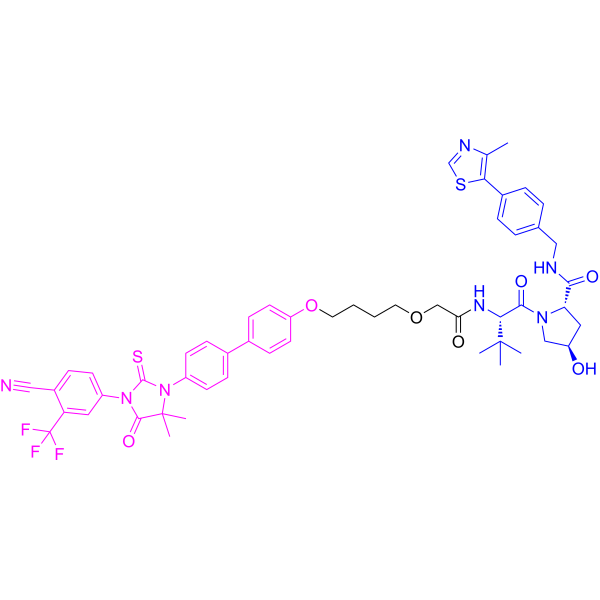
| DC40420 | ARCC-4 Featured |
ARCC-4 is a low-nanomolar androgen receptor (AR) degrader based on PROTAC, with a DC50 of 5?nM. ARCC-4 is an enzalutamide-based von Hippel-Lindau (VHL)-recruiting AR PROTAC and outperforms enzalutamide. ARCC-4 effectively degrades clinically relevant AR mutants associated with antiandrogen therapy.
More description
|
|
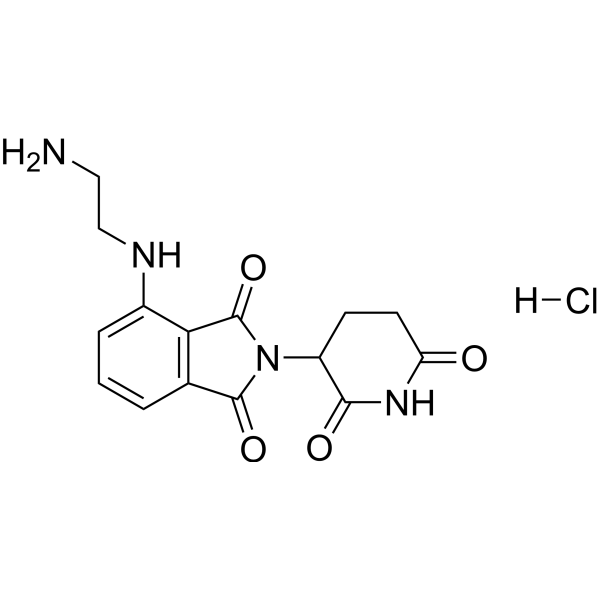
| DC26122 | Pomalidomide-C2-NH2 hydrochloride Featured |
Pomalidomide-C2-NH2 hydrochloride is a synthesized E3 ligase ligand-linker conjugate that incorporates the Pomalidomide based cereblon ligand and a linker used in PROTAC technology.
More description
|
|
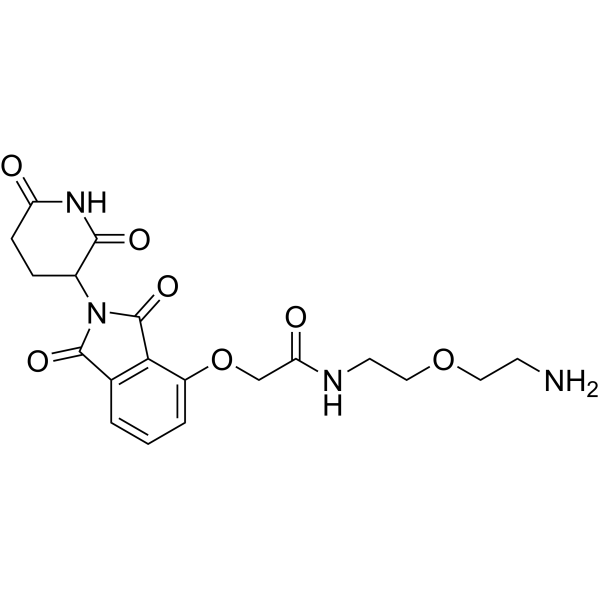
| DC11573 | E3 Ligand-Linker Conjugate 7 Featured |
An E3 ligase ligand-linker conjugate for PROTAC..
More description
|
|
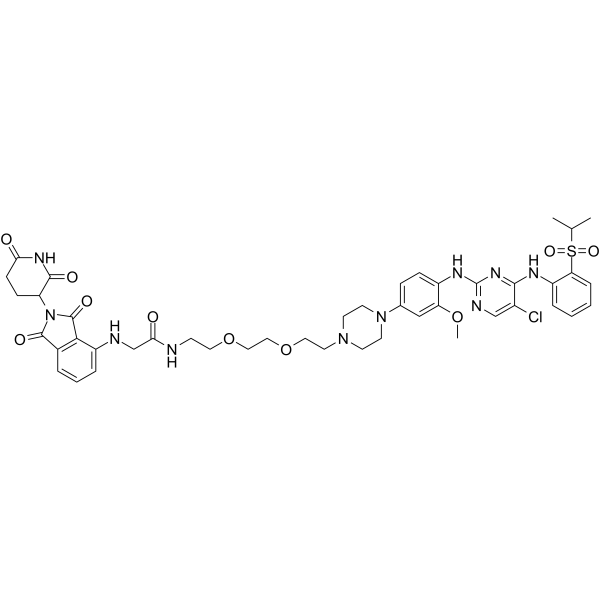
| DC21962 | TL13-12 Featured |
TL13-12 is a novel Anaplastic Lymphoma Kinase (ALK)-PROTAC developed through conjugation of TAE684 and the cereblon ligand pomalidomide.
More description
|
|
| DC21893 | dBET57 Featured |
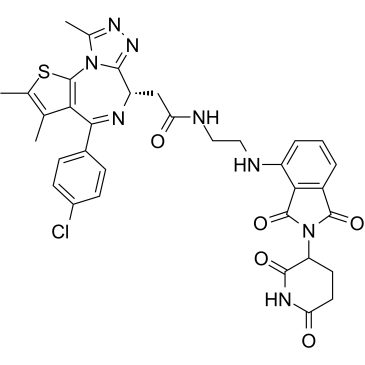
dBET57 is a novel BRD4 heterobifunctional small-molecule ligand (PROTAC), exhibits significant and selective degradation of BRD4 BD1 (DC50/5h=500 nM), but is inactive on BRD4 BD2..
More description
|
|
| DC40447 | N-piperidine Ibrutinib hydrochloride Featured |
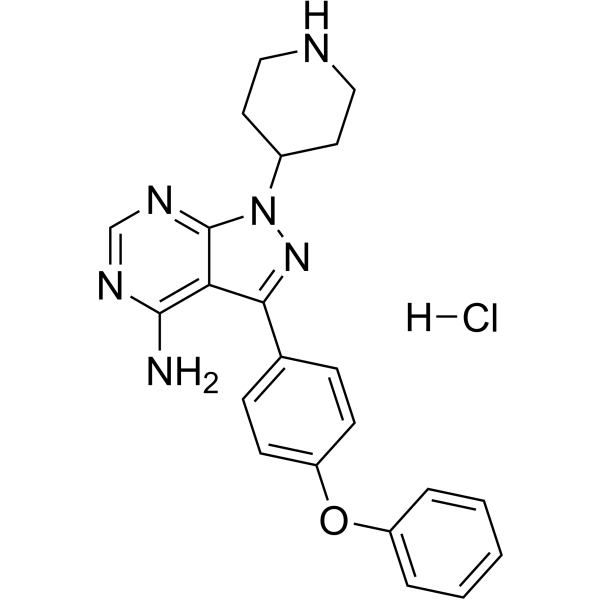
N-piperidine Ibrutinib hydrochloride (Compound 1) is a reversible Ibrutinib derivative. N-piperidine Ibrutinib hydrochloride is a potent BTK inhibitor with IC50s of 51.0 and 30.7 nM for WT BTK and C481S BTK, respectively. N-piperidine Ibrutinib hydrochloride can be used as a BTK ligand in the synthesis of a series of PROTACs, such as SJF620. SJF620 is a potent PROTAC BTK degrader with a DC50 of 7.9 nM.
More description
|
|
