
Alternate TextTo enhance service speed and avoid tariff delays, we've opened a US warehouse. All US orders ship directly from our US facility.
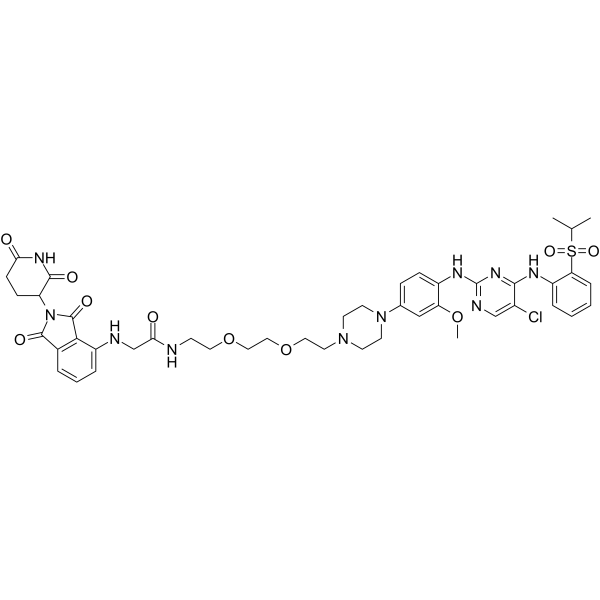

TL13-12

  Cat. No.:  DC21962   Featured
Chemical Structure
2229037-04-9
For research use only. We do not sell to patients.
We match the best price and quality on market.
Email:order@dcchemicals.com  sales@dcchemicals.com
Tel:+86 21 58447131
We are official vendor of:
  • 20
  • 19
  • 18
  • 17
  • 16
  • 15
  • 14
  • 12
  • 11
  • 10
  • 9
  • 8
  • 13
  • 6
  • 5
  • 4
  • 3
  • 2
  • 1
More than 5000 active chemicals with high quality for research!
Field of application
TL13-12 is a novel Anaplastic Lymphoma Kinase (ALK)-PROTAC developed through conjugation of TAE684 and the cereblon ligand pomalidomide.
Cas No.: 2229037-04-9
Chemical Name: TL13-12
Synonyms: N-(2-(2-(2-(4-(4-((5-Chloro-4-((2-(isopropylsulfonyl)phenyl)amino)pyrimidin-2-yl)amino)-3-methoxyphenyl)piperazin-1-yl)ethoxy)ethoxy)ethyl)-2-((2-(2,6-dioxopiperidin-3-yl)-1,3-dioxoisoindolin-4-yl)amino)acetamide;N-[2-[2-[2-[4-[4-[[5-Chloro-4-(2-propan-2-ylsulfonylanilino)pyrimidin-2-yl]amino]-3-methoxyphenyl]piperazin-1-yl]ethoxy]ethoxy]ethyl]-2-[[2-(2,6-dioxopiperidin-3-yl)-1,3-dioxoisoindol-4-yl]amino]acetamide;BDBM50453141;Chembl4217325;TL13-12;Acetamide, N-[2-[2-[2-[4-[4-[[5-chloro-4-[[2-[(1-methylethyl)sulfonyl]phenyl]amino]-2-pyrimidinyl]amino]-3-methoxyphenyl]-1-piperazinyl]ethoxy]ethoxy]ethyl]-2-[[2-(2,6-dioxo-3-piperidinyl)-2,3-dihydro-1,3-dioxo-1H-isoindol-4-yl]amino]-
SMILES: ClC1C=NC(=NC=1NC1C=CC=CC=1S(C(C)C)(=O)=O)NC1C=CC(=CC=1OC)N1CCN(CCOCCOCCNC(CNC2=CC=CC3C(N(C(C=32)=O)C2C(NC(CC2)=O)=O)=O)=O)CC1
Formula: C45H53ClN10O10S
M.Wt: 961.481327772141
Purity: >98%
Sotrage: 2 years -20°C Powder, 2 weeks 4°C in DMSO, 6 months -80°C in DMSO
Description: TL13-12 is a novel Anaplastic Lymphoma Kinase (ALK)-PROTAC developed through conjugation of TAE684 and the cereblon ligand pomalidomide; also promotes the degradation of additional kinases including PTK2 (FAK), Aurora A, FER, and RPS6KA1 (RSK1).
Cat. No. Product name Field of application
DC32733 VH032-linker 5 VH032-linker 5 is a derivative of the proteolysis-targeting chimera technology (PROTAC) for PROTAC research and development; by incorporating an E3 ligase ligand and an alkyl C4 linker with terminal carboxylic acid, it is ready for conjugation to a target protein ligand.
DC26169 MS1943 MS1943 is a first-in-class, orally bioavailable EZH2 selective degrader, with an IC50 of 120 nM. MS1943 significantly reduces EZH2 protein levels in numerous triple-negative breast cancer (TNBC) and other cancer and noncancerous cell lines.
DC26119 VHL ligand 2 hydrochloride VHL ligand 2 hydrochloride) is the (S,R,S)-AHPC-based VHL ligand used in the recruitment of the von Hippel-Lindau (VHL) protein. (S,R,S)-AHPC-Me hydrochloride can be used to synthesize ARV-771, a von Hippel-Landau (VHL) E3 ligase-based BET PROTAC degrader.
DC21962 TL13-12 TL13-12 is a novel Anaplastic Lymphoma Kinase (ALK)-PROTAC developed through conjugation of TAE684 and the cereblon ligand pomalidomide.
DC26122 Pomalidomide-C2-NH2 hydrochloride Pomalidomide-C2-NH2 hydrochloride is a synthesized E3 ligase ligand-linker conjugate that incorporates the Pomalidomide based cereblon ligand and a linker used in PROTAC technology.
DC21360 MZ1 MZ1 is a PROTAC that tethers JQ1 to a ligand for the E3 ubiquitin ligase VHL, triggers, induces degradation of the BET bromodomain BRD4.
DC21351 MS4078 MS4078 is a novel PROTAC (degrader) of ALK, potently decreases cellular levels of oncogenic active ALK fusion proteins in a concentration- and time-dependent manner in SU-DHL-1 lymphoma and NCI-H2228 lung cancer cells (DC50=11 nM).
DC12191 JQ-35-(S) JQ-35, (S)- is an inhibitor of the Bromodomain and Extra-Terminal (BET) family bromodomain-containing proteins with potential antineoplastic activity.
DC20367 dTRIM24 dTRIM24 is a potent TRIM24 bromodomain inhibitor with IC50 of 217.8 nM (TRIM24 ligand displacement).
DC21893 dBET57 dBET57 is a novel BRD4 heterobifunctional small-molecule ligand (PROTAC), exhibits significant and selective degradation of BRD4 BD1 (DC50/5h=500 nM), but is inactive on BRD4 BD2..
X