
Alternate TextTo enhance service speed and avoid tariff delays, we've opened a US warehouse. All US orders ship directly from our US facility.
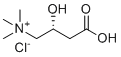

L-Carnitine hydrochloride

  Cat. No.:  DC29077   Featured
Chemical Structure
6645-46-1
For research use only. We do not sell to patients.
We match the best price and quality on market.
Email:order@dcchemicals.com  sales@dcchemicals.com
Tel:+86 21 58447131
We are official vendor of:
  • 20
  • 19
  • 18
  • 17
  • 16
  • 15
  • 14
  • 12
  • 11
  • 10
  • 9
  • 8
  • 13
  • 6
  • 5
  • 4
  • 3
  • 2
  • 1
More than 5000 active chemicals with high quality for research!
Field of application
L-Carnitine hydrochloride ((R)-Carnitine hydrochloride), a highly polar, small zwitterion, is an essential co-factor for the mitochondrial β-oxidation pathway. L-Carnitine hydrochloride functions to transport long chain fatty acyl-CoAs into the mitochondria for degradation by β-oxidation. L-Carnitine hydrochloride is an antioxidant. L-Carnitine hydrochloride can ameliorate metabolic imbalances in many inborn errors of metabolism.
Cas No.: 6645-46-1
Chemical Name: (R)-3-Carboxy-2-hydroxy-N,N,N-trimethylpropan-1-aminium chloride
Synonyms: (R)-3-Carboxy-2-hydroxy-N,N,N-trimethylpropan-1-aminium chloride;(r)-3-carboxy-2-hydroxy-n,n,n-trimethyl-1-;propanaminiumchloride;(r)-carnitinehydrochloride;3-carboxy-2-hydroxy-n,n,n-trimethyl-,chloride,(r)-1-propanaminiu;l-(3-carboxy-2-hydroxypropyl)trimethylammoniumchloride;lc-80;l-carnitinechloride;levocarnitinechloride;L-CARNITINE HYDROCHLORIDE, SYNTHETIC;(2R)- (9CI);1-Propanaminium, 3-carboxy-2-hydroxy-N,N,N-trimethyl-;chloride;(R)- 1-Propanaminium;3-carboxy-2-hydroxy-N,N,N-trimethyl-, chloride, (2R)-;(R)-(3-carboxy-2-hydroxypropyl)trimethylammonium chloride;[(2R)-3-carboxy-2-hydroxypropyl]-trimethylazanium,chloride;(?)-β-Hydroxy-γ-(trimethylammonio)butyrate;(R)-3-Hydroxy-4-(trimethylammonio)butyrate Hydrochloride;3-Hydroxy-4-(trimethylammonio)butanoate hydrochloride;Vitamine BT-hydrochloride;L(-)-Carnitine hydrochloride;L-Carnitine Hydrochloride
SMILES: [Cl-].C(CC(O)C[N+](C)(C)C)(O)=O
Formula: C7H16ClNO3
M.Wt: 197.659841537476
Purity: >98%
Sotrage: 2 years -20°C Powder, 2 weeks 4°C in DMSO, 6 months -80°C in DMSO
Description: L-Carnitine hydrochloride ((R)-Carnitine hydrochloride), a highly polar, small zwitterion, is an essential co-factor for the mitochondrial β-oxidation pathway. L-Carnitine hydrochloride functions to transport long chain fatty acyl-CoAs into the mitochondria for degradation by β-oxidation. L-Carnitine hydrochloride is an antioxidant. L-Carnitine hydrochloride can ameliorate metabolic imbalances in many inborn errors of metabolism[1][2][3].
Target: Human Endogenous Metabolite
In Vivo: L-Carnitine hydrochloride ((R)-Carnitine hydrochloride) (125, 250 mg/kg; i.p.) has a more pronounced bronchodilator effect in this chronic murine asthma model, and decreases urinary LTE4 excretion[4]. Animal Model: 8- to 10-weeks-old and weighed 28-30g BALB/c mice[4] Dosage: 125, 250 mg/kg Administration: i.p. Result: SaO2 increased significantly at 250 mg/kg and decreased urinaryLTE4 excretion.
References: [1]. Agarwal A, et al. Role of L-carnitine in female infertility. eprod Biol Endocrinol. 2018 Jan 26;16(1):5. [2]. Ferreira GC, et al. L-Carnitine and Acetyl-L-carnitine Roles and Neuroprotection in Developing Brain. Neurochem Res. 2017 Jun;42(6):1661-1675. [3]. Ferreira GC, et al. L-Carnitine and Acetyl-L-carnitine Roles and Neuroprotection in Developing Brain. Neurochem Res. 2017 Jun;42(6):1661-1675. [4]. Uzuner N, et al. The role of L-carnitine in treatment of a murine model of asthma. Acta Med Okayama. 2002 Dec;56(6):295-301.
Cat. No. Product name Field of application
DC76915 3-Epideoxycholic acid 3-Epideoxycholic acid is the microbial metabolite of Deoxycholic acid. 3-Epideoxycholic acid targets FXR of dendritic cells, reduces their immunostimulatory properties, promotes the generation of Treg cells, and exhibits anti-inflammatory activity. 3-Epideoxycholic acid promotes the growth of bacteria Bacteroides.
DC49789 Biliverdin hydrochloride Biliverdin hydrochloride is a tetrapyrrolic, water-soluble compound formed by the breakdown of heme. Biliverdin hydrochloride can upregulate the activity of biliverdin reductase which is an enzyme that is a regulator of the innate immune system.
DC49409 Glucose oxidase Glucose oxidase is used in the food and beverage industry as a preservative and stabilizer and is commonly derived from the fungus Aspergillus niger. Glucose oxidase can react with intracellular glucose and oxygen (O2) to produce hydrogen peroxide (H2O2) and gluconic acid, which can cut off the nutrition source of cancer cells and consequently inhibit their proliferation.
DC45591 2′-Deoxyadenosine 5′-monophosphate disodium 2′-Deoxyadenosine 5′-monophosphate disodium, a nucleic acid AMP derivative, is a deoxyribonucleotide found in DNA. 2′-Deoxyadenosine 5′-monophosphate disodium can be used to study adenosine-based interactions during DNA synthesis and DNA damage.
DC45590 Disodium 5'-dGMP 2'-Deoxyguanosine 5'-monophosphate disodium (5′-dGMP disodium) is a mononucleotide having guanine as the nucleobase. 2'-Deoxyguanosine 5'-monophosphate disodium is a nucleic acid guanosine triphosphate (GTP) derivative.
DC45589 2'-Deoxyuridine 5'-monophosphate disodium 2'-Deoxyuridine 5'-monophosphate disodium is reductively methylated to dTMP (2'-deoxythymidine 5'-monophosphate) by bisubstrate enzyme thymidylate synthase (TS). dTMP is a nucleotide required for DNA synthesis.
DC44897 Lysophosphatidylcholine 18:2 Lysophosphatidylcholine 18:2 (1-Linoleoyl-2-Hydroxy-sn-glycero-3-PC), a lysophospholipid, is a potential biomarker identified from insulin resistance (IR) polycystic ovary syndrome (PCOS). Low plasma Lysophosphatidylcholine 18:2 also has been shown to predict impaired glucose tolerance, insulin resistance, type 2 diabetes, coronary artery disease, and memory impairment.
DC42106 Dibenzyl disulfide Dibenzyl disulfide is an endogenous metabolite.
DC41297 D-Valine D-Valine is the enantiomer of L-Valine. L-Valine is one of 20 proteinogenic amino acids. L-Valine is an essential amino acid.
DC41148 1,3-Butanediol 1,3-Butanediol, an ethanol dimer providing a source of calories for human nutrition. 1,3-Butanediol is converted in the body to β-hydroxybutyrate and has cerebral protective and hypoglycaemic effect.
X