To enhance service speed and avoid tariff delays, we've opened a US warehouse. All US orders ship directly from our US facility.
| Cat. No. | Product Name | Field of Application | Chemical Structure |
|---|---|---|---|
| DC46438 | Picrasidine Q |
Picrasidine Q, an alkaloid component extracted from Angelica keiskei species, has the capacity of anti-cell transformation and anti-cancer. Picrasidine Q induces cell apoptosis and G1 phase arrest in human esophageal cancer cell lines, and directly inhibits FGFR2 kinase activity.
More description
|

|
| DC46420 | MDM2-IN-21 |
MDM2-IN-21 is a potent MDM2 inhibitor. MDM2-IN-21 can be used for the research of cancer.
More description
|
|
| DC46388 | F1324 |
F1324 is a potent, high affinity peptidic inhibitor of B cell lymphoma 6 (BCL6) with an IC50 of 1 nM. F1324 exhibits binding t1/2 value of 441 s and has strong inhibition activity against BCL6 PPI.
More description
|
|
| DC46248 | PUMA BH3 TFA |
PUMA BH3 (TFA) is a p53 upregulated modulator of apoptosis (PUMA) BH3 domain peptide, acts as a direct activator of Bak, with a Kd of 26 nM.
More description
|
|
| DC46206 | Difopein TFA |
Difopein (TFA), a specific and competitive inhibitor of 14-3-3 protein (a highly conserved eukaryotic regulatory molecule), blocking the ability of 14-3-3 to bind to target proteins and inhibits 14-3-3/Ligand interactions. Difopein (TFA) leads to induction of apoptosis and enhances the ability of cisplatin to kill cells.
More description
|
|
| DC45984 | Malvidin-3-galactoside chloride |
Malvidin-3-galactoside chloride, an anthocyanin monomer, induces hepatocellular carcinoma (HCC) cells cycle arrest and apoptosis. Malvidin-3-galactoside chloride inhibits the production and accumulation of ROS. Malvidin-3-galactoside chloride has anti-tumor function.
More description
|
|
| DC45981 | Glychionide A |
Glychionide A is a flavonoside that can be found in the roots of Glychirriza glabra. Glychionide A promotes apoptosis and autophagy of PANC-1 pancreatic cancer cells. Glychionide A can be used for the research of cancer.
More description
|
|
| DC45974 | Toddaculin |
Toddaculin is a natural coumarin that can induce differentiation and apoptosis in leukemic cells. Toddaculin suppresses excess osteoclast activity and enhances osteoblast differentiation and mineralization. Toddaculin also exhibits anti-inflammatory activity.
More description
|
|
| DC45947 | Gypenoside LI |
Gypenoside LI, a gypenoside monomer, possesses anti-tumor activity. Gypenoside LI induces cell apoptosis, cell cycle and migration.
More description
|
|
| DC45941 | Eupalinolide O |
Eupalinolide O is a sesquiterpene lactone with anticancer activities. Eupalinolide O induces cell apoptosis in human MDA-MB-468 breast cancer cells.
More description
|
|
| DC45917 | Hematoporphyrin monomethyl ether |
Hematoporphyrin monomethyl ether, second generation of porphyrin-related photosensitizer, is characterized by its single form, high yield of singlet oxygen, high selectivity, and low toxicity, which has been widely used in the diagnosis and treatment of various tumors, including lung cancer, bladder cancer, and nevus flammeus and brain glioma.
More description
|
|
| DC45913 | Cantrixil |
Cantrixil (TRX-E-002-1), an active enantiomer of TRX-E-002, is a second-generation super-benzopyran (SBP) compound. Cantrixil increases phosphorylated c-Jun levels resulting in caspase-mediated apoptosis in ovarian cancer cells. Cantrixil has potent pan anti-cancer activity against a broad range of cancer phenotypes.
More description
|
|
| DC45902 | S65487 sulfate |
S65487 (VOB560) sulfate is a potent and selective Bcl-2 inhibitor. S65487 sulfate is also active on BCL-2 mutations, such as G101V and D103Y. S65487 sulfate has poor affinity with MCL-1, BFL-1 and BCL-XL. S65487 sulfate induces apoptosis and has anticaner activities.
More description
|
|
| DC45901 | MitoTam bromide, hydrobromide |
MitoTam bromide, hydrobromide, a Tamoxifen derivative, is an electron transport chain (ETC) inhibitor. MitoTam bromide, hydrobromide reduces mitochondrial membrane potential in senescent cells and affects mitochondrial morphology. MitoTam bromide, hydrobromide is an effective anticancer agent, suppresses respiratory complexes (CI-respiration) and disrupts respiratory supercomplexes (SCs) formation in breast cancer cells.
More description
|
|
| DC45816 | Rapanone |
Rapanone is a natural benzoquinone. Rapanone exhibits a broad spectrum of biological actions, including anti-tumor, antioxidant, anti-inflammatory, antibacterial and antiparasitic. Rapanone also is a potent and selective human synovial PLA2 inhibitor, with an IC50 of 2.6 μM.
More description
|
|
| DC45550 | L-Buthionine-(S,R)-sulfoximine hydrochloride |
L-Buthionine-(S,R)-sulfoximine hydrochloride is a cell-permeable, potent, fast acting, orally active and irreversible inhibitor of g-glutamylcysteine synthetase and depletes cellular glutathione levels. The IC50 value of L-Buthionine-(S,R)-sulfoximine on melanoma, breast and ovarian tumor specimens are 1.9 μM, 8.6 μM, and 29 μM, respectively.
More description
|
|
| DC45549 | TC11 |
TC11 is a MCL1 degradator and Caspase-9 and CDK1 activator. TC11 is structurally related to immunomodulatory drugs as phenylphthalimide derivative. TC11 induces apoptotic death caused by degradation of MCL1 during prolonged mitotic arrest.
More description
|
|
| DC45547 | MSN-50 |
MSN-50 is a Bax and Bak oligomerization inhibitor, efficiently inhibiting liposome permeabilization, preventing genotoxic cell death and promoting neuroprotection.
More description
|
|
| DC45546 | HXR9 |
HXR9 is a cell-permeable peptide and a competitive antagonist of HOX/PBX interaction. HXR9 antagonizes the interaction between HOX and a second transcrip-tion factor (PBX), which binds to HOX proteins in paralogue groups1 to 8. HXR9 selectively decreases cell proliferation and promotes apoptosis in cells with a high level of expression of the HOXA/PBX3 genes, such as MLL-rearranged leukemic cells.
More description
|
|
| DC45545 | 7,3′,5′-Trihydroxyflavanone |
7,3′,5′-Trihydroxyflavanone, a flavanoid derivative, induces the apoptotic cell death of MCF-7 cells by increasing Bax expression level. 7,3′,5′-Trihydroxyflavanone also exhibits antioxidant activity.
More description
|
|
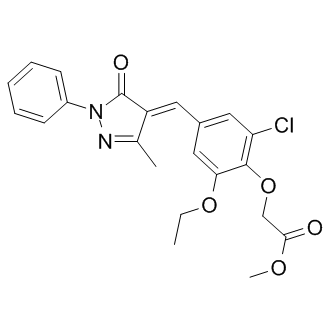
| DC9506 | SJ-172550 Featured |
SJ-172550 is the first MDMX inhibitor with EC50 of 0.84 uM; binds reversibly to MDMX and effectively kills retinoblastoma cells in which the expression of MDMX is amplified.
More description
|
|
| DC45499 | Ardisiacrispin B |
Ardisiacrispin B displays cytotoxic effects in multi-factorial drug resistant cancer cells via ferroptotic and apoptotic cell death.
More description
|
|
| DC45400 | Damulin B |
Damulin B is a dammarane-type saponin found in Gynostemma pentaphyllum.Damulin B can induce cell apoptosis and has anti-cancer activities in vitro.
More description
|
|
| DC45352 | 6-Hydroxykaempferol 3-O-β-D-glucoside |
6-Hydroxykaempferol 3-O-β-D-glucoside possesses anticancer activity and induces apoptosis.
More description
|
|
| DC44826 | S65487 |
S65487 (VOB560) is a potent and selective Bcl-2 inhibitor. S65487 has poor affinity with MCL-1, BFL-1 and BCL-XL. S65487 has anticaner activities.
More description
|
|
| DC44825 | PUMA BH3 |
PUMA BH3 is a p53 upregulated modulator of apoptosis (PUMA) BH3 domain peptide, acts as a direct activator of Bak, with a Kd of 26 nM.
More description
|
|
| DC44806 | Sodium Fluoride |
Sodium fluoride (NaF) induces apoptosis and autophagy via the endoplasmic reticulum (ER) stress pathway in MC3T3-E1 osteoblastic cells.
More description
|
|
| DC44805 | (+)-Nortrachelogenin |
(+)-Nortrachelogenin (Wikstromol), a pharmacologically ligand from from wikstroemia indica, possesses antileukemic activity.
More description
|
|
| DC44542 | Episappanol |
Episappanol is a natural compound isolated from Caesalpinia sappan heartwood with anti-inflammatory activity. Episappanol significantly inhibits the IL-6 and TNF-α secretion.
More description
|
|
| DC44541 | LEESGGGLVQPGGSMK acetate |
LEESGGGLVQPGGSMK acetate, a proteolysis peptide, is a component of Infliximab. LEESGGGLVQPGGSMK acetate can be used for quantitative analysis of Infliximab. Infliximab is a chimeric monoclonal IgG1 antibody that specifically binds to TNF-α.
More description
|
|